Launch of Advanced Learning Academy expands lifelong educational opportunities in public health
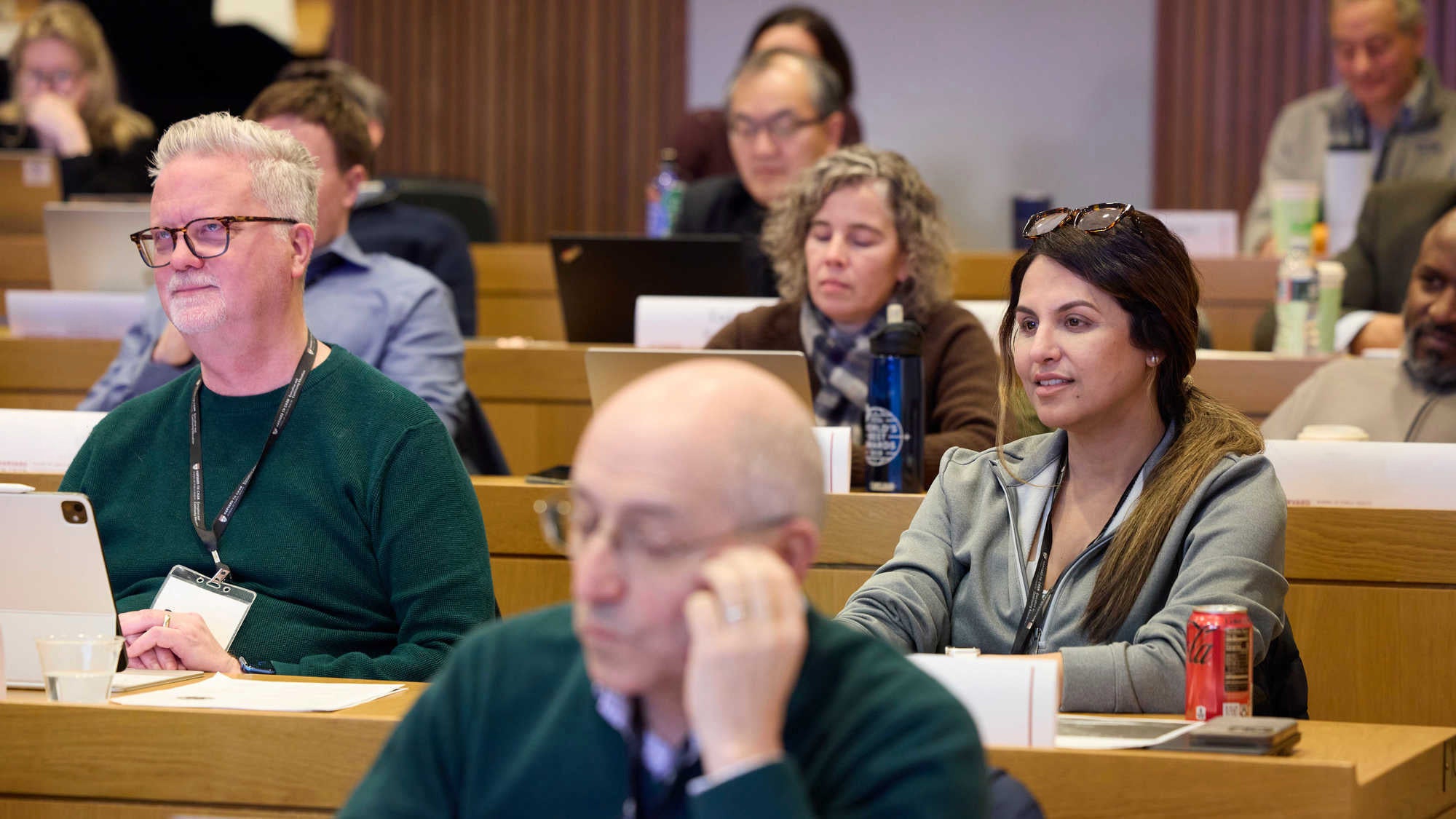
People interested in exploring public health at all stages of their careers—from high schoolers trying out the field before college to senior leaders updating their skillsets—can now do so through Harvard T.H. Chan School of Public Health’s Advanced Learning Academy (ALA). The new program, which launched April 29, brings together and expands the School’s non-degree learning opportunities—existing Executive and Continuing Education (ECE) offerings and hundreds of additional non-degree programs—under one umbrella.
At the ALA’s core is a five-stage lifelong learning framework: Aspire (pre-professional), Professional Development (early career), Executive Education (mid- to senior-level), Advanced Leadership (global and senior executives), and Frontiers, which focuses on cutting-edge research and innovation.
“The ALA offers a clear portfolio of courses for learners at each stage, with offerings designed to build over one’s career,” said Rifat Atun, vice dean for non-degree education and Innovation and Julio Frenk Professor of Public Health Leadership. “We want to train the next generation of leaders across the learning continuum to not just understand problems but actually develop solutions.”
Flexible learning pathways
Learners can earn certificates in subject areas such as leadership or artificial intelligence in health care on their own timelines. Atun calls the ALA’s credentials “stackable,” meaning that people can start with individual courses and build toward the Certificates of Specialization and Advanced Certificates of Specialization. These credentials can help learners advance in their organizations or pivot from different sectors such as technology into health care, Atun said.
But it’s not necessary to follow a certificate pathway. Learners can choose from individual courses in formats tailored to different time commitments and learning goals. For example, Frontiers courses highlight emerging research in sessions lasting just a few hours.
In addition, longstanding non-ECE programs such as the National Preparedness Leadership Initiative (NPLI) will benefit from the ALA umbrella. That will allow for administrative efficiencies, and marketing synergies, Atun said. And it opens up more opportunities for participants in these programs. For example, Atun said, a mid-career professional competing an NPLI course might go on to earn a certificate of specialization that helps advance their career.
New courses in global health, longevity science, health care innovation
Atun said that the ALA’s courses have been designed with an eye towards emerging needs in public health and market potential, with an emphasis on innovative content. Many are offered online in synchronous (live, instructor-led) or asynchronous (self-paced) formats for broader accessibility.
One of the first new courses to launch is Global Environmental Health I: Air Pollution & Radiation. Led by Petros Koutrakis, Akira Yamaguchi Professor of Environmental Health and Human Habitation, this asynchronous online course provides an introduction to major air pollutants, exposures, and health impacts, and is the first step towards the Environmental Health Certificate of Specialization.
“Our goal with Global Environmental Health is to reach professionals and students beyond Harvard—across the U.S. and around the world—to share essential environmental health concepts that can inform research, policy, and practice,” Koutrakis said.
Two additional courses are launching on April 29: Fundamentals of Longevity Science, led by Gloria Dalla Costa, research scientist in the Department of Nutrition, and Fundamentals of Designing for Scale in Health Care, led by Katherine Semrau, associate professor in the Department of Health Policy and Management and deputy director of Ariadne Labs.
“Fundamentals of Longevity Science is for anyone making decisions—whether clinical, strategic, or personal—who wants to cut through the noise and ground their thinking in rigorous science,” Dalla Costa said. “The asynchronous, self-paced format pushed us to think carefully about how to make complex, interdisciplinary content both rigorous and engaging without a live classroom. We’ve been able to bring in real-world case studies from Japan, Costa Rica, Italy, and beyond—the kind of applied, global lens that I think sets the ALA apart.”
Semrau and her Ariadne Labs colleagues Meghan Long, Francine Maloney, and Robbie Singal bring Ariadne’s approach to health care innovation to their course. A key concept is the “know-do gap”—the distance between what evidence says should happen in health care (such as preventive health screenings for every eligible patient) and what actually happens in practice. In this course, participants learn to identify these gaps in their own settings and develop practical solutions such as redesigned workflows or checklists.
“This course builds core skills for roles that focus on designing, improving, and scaling health services and programs—such as quality improvement leads, implementation specialists, program directors, and clinical or operational leaders,” Semrau said. “It’s also highly relevant for people working in health policy, population health, global health, and innovation who need to ensure promising ideas can move beyond a pilot and achieve impact at scale.”
More than 30 other new courses are in the pipeline and will be taught by faculty and contributors from across Harvard Chan School, in addition to alumni and practitioners. Topics include health care quality improvement, nutrition, artificial intelligence, health innovation, and crisis leadership.
Looking ahead, Atun said he expects the ALA to become a fully embedded and integral part of the School’s offerings. He said that it’s already exciting to see so many faculty engaged in developing courses. “The ALA showcases how the School’s excellence in research, teaching, and translation can be harnessed to provide public health education to a wider group of individuals throughout their careers,” he said.