Fundamentals of Designing for Scale in Health Care
This new course is currently in development. Click subscribe to be notified when the course is open for enrollment.

Program Overview
Address the urgent need for innovative thinking and evidence-based solutions in healthcare
In this applied online course, healthcare professionals will learn how to identify and address “know-do” gaps—the gap between what evidence suggests should happen and what occurs in practice—while designing solutions with scale in mind.
Through self-paced learning and live faculty-led sessions, the course integrates human-centered design with the science of scaling innovations, providing a holistic approach to sustainable healthcare improvement. With a focus on both early-stage design, implementations science, and strategies for broader healthcare impact, the program supports participants in developing practical, real-world approaches that are grounded in user needs and informed by sustainability and scale considerations.
Over a 6-8 week period, you will go from identifying healthcare challenges to designing and planning solutions for wider adoption and sustained impact across the following modules:
- Module 1: Defining Your Know-Do Gap
- Module 2: Introduction to Human-Centered Design and Defining the Problem
- Module 3: Ideation and Prototyping
- Module 4: Midpoint Prototype Presentations
- Module 5: Introduction to Implementation Science and Small Scale Implementation Test
- Module 6: Large Scale Implementation Test
- Module 7: Spread Strategies to Expand Impact
- Module 8: Presentations and Reflections
Ariadne Labs
This Harvard Chan Advanced Learning Academy program was designed in collaboration with Ariadne Labs, a joint center for health systems innovation at Brigham and Women’s Hospital and Harvard T.H. Chan School of Public Health.
A joint center between Brigham and Women’s Hospital and the Harvard Chan School, Ariadne is a team of global experts and innovators with a mission to save lives and reduce suffering. Ariadne Labs’ vision is that health systems equitably deliver the best possible care for every patient, everywhere, every time.
From checklists and conversation guides to fostering international collaborations and establishing global standards of measurement, Ariadne Labs’ work has been accessed in more than 170 countries, touching hundreds of millions of lives.
Fundamentals of Designing for Scale in Healthcare was designed by Katherine Semrau, PhD, MPH. Dr. Semrau is Program Director of the BetterBirth Program at Ariadne Labs, which improves maternal and newborn care through scalable, evidence-based solutions. She also serves as Deputy Director of Ariadne Labs, where she provides scientific leadership across platforms and supports the Lab’s overall strategy and operations. Dr. Semrau is an Associate Professor of Medicine at Harvard Medical School and an Associate Epidemiologist at Brigham and Women’s Hospital in the Division of Global Health Equity.
Key program faculty from Ariadne Labs include:
- Meghan (Meg) Long, MHA: Meg Long is Director of Innovation and Community Engagement at Ariadne Labs, where she leads human-centered design initiatives and a global research community to develop and scale impactful healthcare solutions. Her work focuses on applying design thinking and improvement science to enhance care across multiple clinical areas.
- Francine Maloney, MPH: Francine Maloney is Director of Implementation at Ariadne Labs, where she leads efforts to translate innovative ideas into scalable, sustainable solutions using implementation and improvement science. She also leads the Atlas Initiative, supporting organizations in strengthening quality improvement efforts.
- Robbie Singal, DrPH: Dr. Robbie Singal is Director of Science and Technology at Ariadne Labs, leading multidisciplinary teams to design, test, and implement healthcare interventions. She ensures scientific rigor and the integration of innovative technology across the organization’s work.
Learning Objectives
By the end of the program, participants will be able to:
- Assess where and how their solution can spread and describe common ways health solutions are scaled across settings.
- Use human-centered design to analyze a defined problem, clearly state users’ needs, generate at least three solution ideas, and create a low-fidelity prototype that addresses those needs.
- Explain when and how to test a solution on a small scale versus a large scale, and identify at least three key outcomes to measure at each stage.
Program Details
This online blended program combines the flexibility of self-paced videos, readings, and project work with live, interactive learning, including sessions led by Harvard faculty, faculty check-ins, and structured peer engagement. Over an immersive 6–8 week period, you will take part in:
- Live online faculty-led sessions (course introduction and conclusion)
- Faculty check-ins
- Self-paced learning activities and exercises
- Reflection
- Project work
The modules follow a structured progression with a focus on real-world application, guiding participants from identifying problems in healthcare to designing and planning solutions for broader implementation.
This program is designed for healthcare professionals and organizational leaders who are interested in improving care delivery and designing innovations that can achieve broad impact, including:
- Clinicians
- Administrators
- Researchers
- Program planners
- Healthcare leaders
Fundamentals of Designing for Scale in Health Care in its integrated focus on both designing and scaling healthcare solutions. While many programs emphasize quality improvement or innovation in isolation, this course brings together human-centered design, implementation science, and strategies for spreading and sustaining change—equipping participants to move from identifying challenges to delivering solutions that can achieve real-world impact at scale.
It is also highly applied. Rather than working only through case studies, participants develop a project based on a real challenge from their own setting, building practical skills they can immediately use in their organizations.
Finally, the program is designed for busy professionals. Its flexible, primarily self-paced format allows you to engage with content on your own schedule, while live faculty sessions, check-ins, and peer interaction provide structure, accountability, and opportunities for feedback and networking.
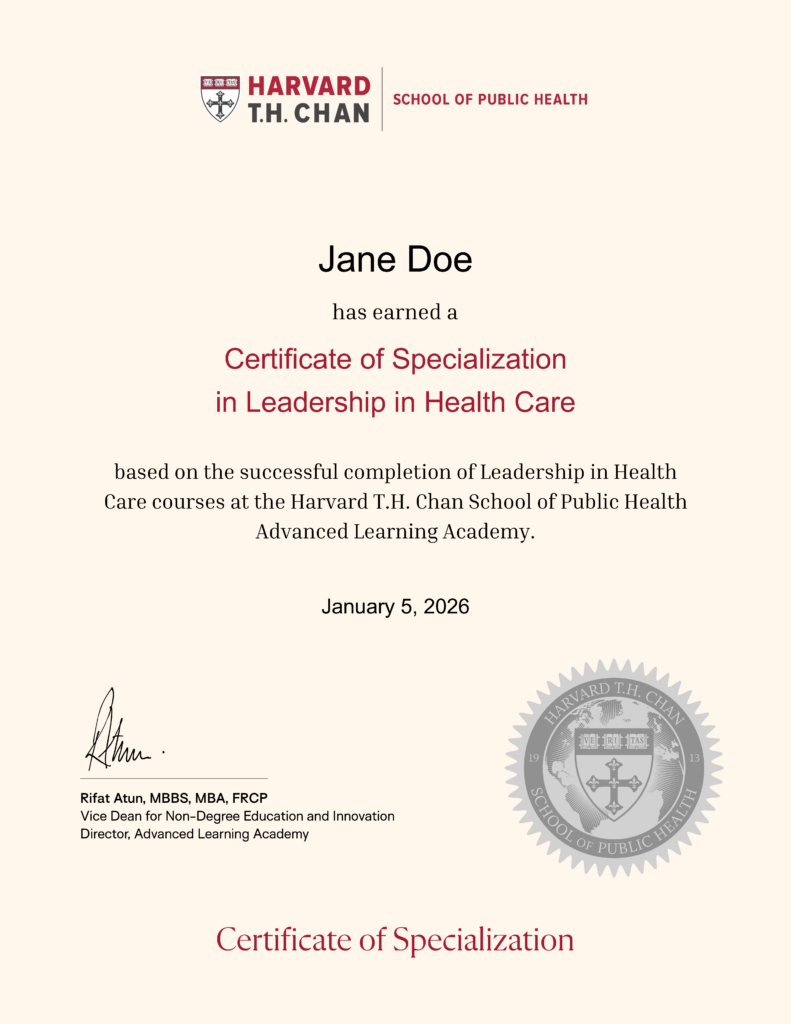
Certificate of Specialization
Earn a Leadership in Health Care Certificate of Specialization
Take this program to earn a Certificate of Fundamentals, or take 3-4 courses to earn a Certificate of Specialization. Learn more here.