Meet Mia Sanchez: Climate researcher, first-gen student, marathoner
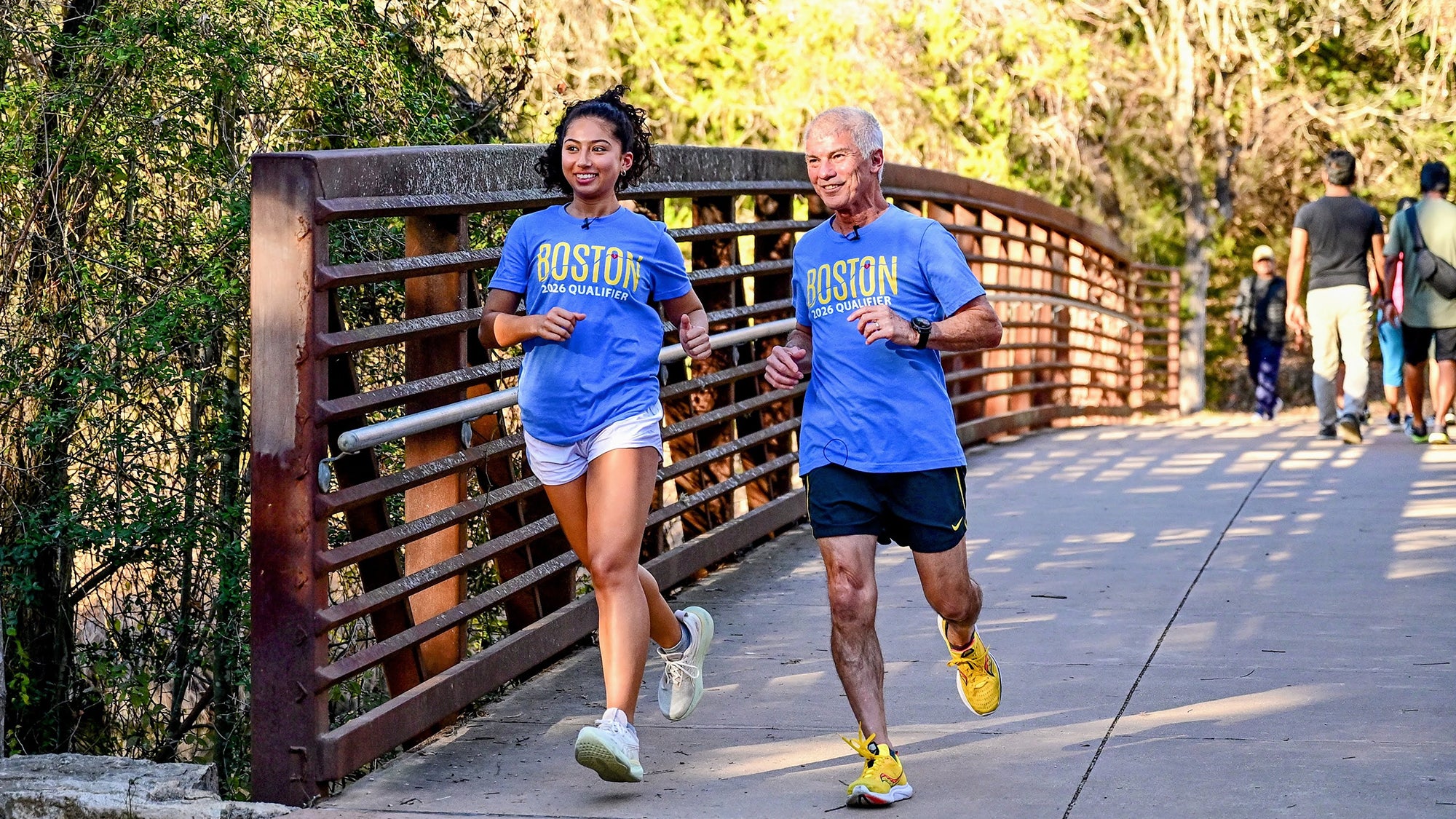
Sanchez, SM ’26, wants to create sustainable solutions for climate change and inspire new generations of scientists. But first, she’s running the Boston Marathon—with her grandfather.
On a run along Boston’s Emerald Necklace in February 2025, Mia Sanchez took a hard fall on the ice. She thought, “That’s it, I’m done running in Boston this winter.”
The next day, she got a text from her 67-year-old grandfather Carlos, asking if she would run the Boston Marathon with him in April 2026. It was an offer she couldn’t refuse.
“Having the opportunity to run this race with my grandpa was so special, I wasn’t going to waste it,” she said. Till the ice melted, she moved her runs indoors to the Vanderbilt Gym treadmills. Later, in April 2025, Sanchez and her grandfather ran a marathon together in Ventura, California, and both qualified for the Boston race.
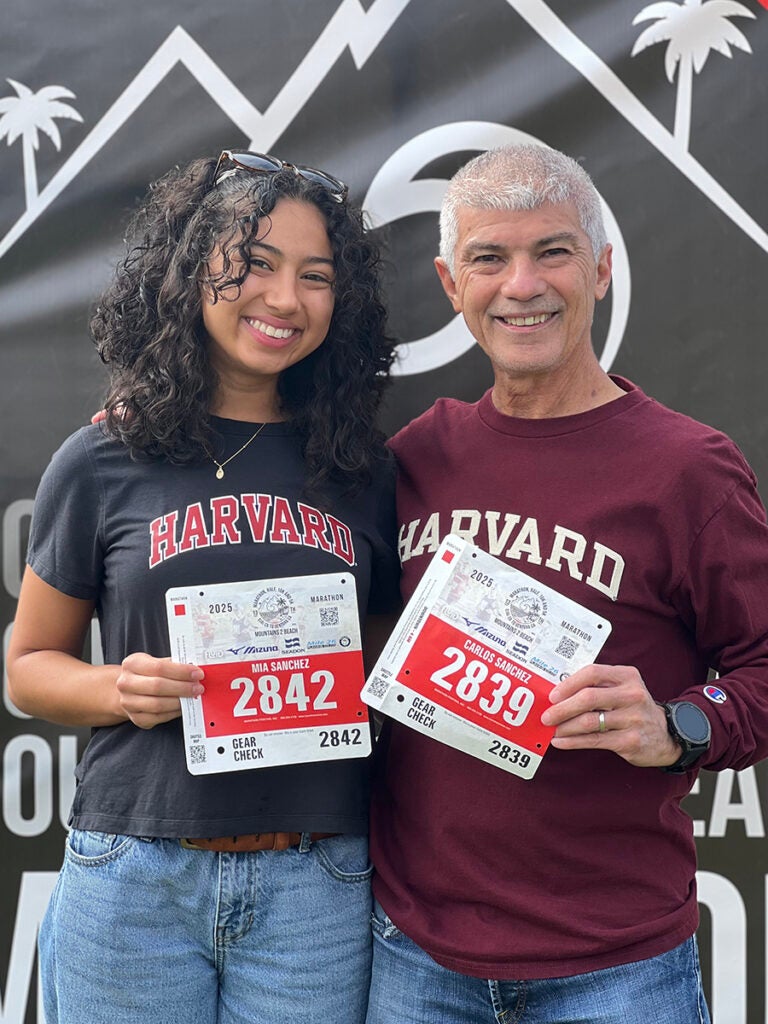
The grandfather-granddaughter duo’s plan to run Boston has caught media attention. They’re the only such pair ever documented to be running the race together, and have been profiled in segments on Austin-based ABC affiliate KVUE and Boston-based WBUR, and in articles in the Boston University Daily Free Press and the Boston Herald.
While Sanchez has been training hard for the big race on April 20, she’s also been working hard at Harvard T.H. Chan School of Public Health. She’s finishing up her master of science in environmental health, focusing on climate and sustainability—and thinking about eventually earning a PhD.
Committing to environmental health
Sanchez, a native of Round Rock, Texas, was the first in her family to attend college. Her parents and grandparents had been migratory farm workers. “Hearing their stories of how they grew up, traveling across the country, picking fruits and vegetables, got me interested in environmental and occupational health,” she said. “Then, in middle school, there was the Flint water crisis. I vividly remember sitting on the couch and watching the news with my dad. I was stunned at the possibility of a community in the U.S. not having access to safe drinking water for what was going to be a year. That was the thing that really pushed me to commit to environmental health.”
In college at Austin’s St. Edwards University, Sanchez studied environmental biology and climate change and minored in bioinformatics. At that point she wasn’t thinking about a research career—but then she joined the lab of Dan Gold, a biological sciences professor, where she conducted DNA and RNA sequencing on cockroach parasites. Gold was a great mentor, said Sanchez. “He taught me what a PhD meant and what working in research looked like, and that I was very capable of moving toward that path,” she said.
She decided to apply to Harvard Chan School for a master of science. “Harvard was the big one that was the dream to apply to,” she said. “I applied but didn’t tell anyone—because if I didn’t get in, no one would have to know.”
When she got the email saying that she’d been admitted and finally told her parents, they were shocked that she’d applied—and thrilled. “My dad ordered a Harvard T-shirt and wore it every day to work for a week.”
Hands-on experiences
Sanchez’s overarching aim is to create long-term, sustainable solutions for climate change. “Climate change is inevitable,” she said. “Its impacts are vast. So we need to develop clear, adaptable plans that are going to withstand these impacts.”
Courses at Harvard Chan School have helped Sanchez see ways to achieve this goal. For instance, in a course called Analytical Methods and Exposure Assessment, taught by Gary Adamkiewicz and Jaime Hart, she and her fellow students got a chance to build their own exposure assessment study. She was part of a group that examined levels of fine particulate air pollution (PM2.5) in graduate school cafeterias at Harvard. They put PM2.5 monitors in various dining halls, analyzed the data, then explained their findings to staff. They didn’t find any dining halls with dangerous levels of PM2.5, but some had more than others. For those with higher levels, the students recommended fixes such as trying to minimize the amount of time gas burners were on or increasing ventilation.
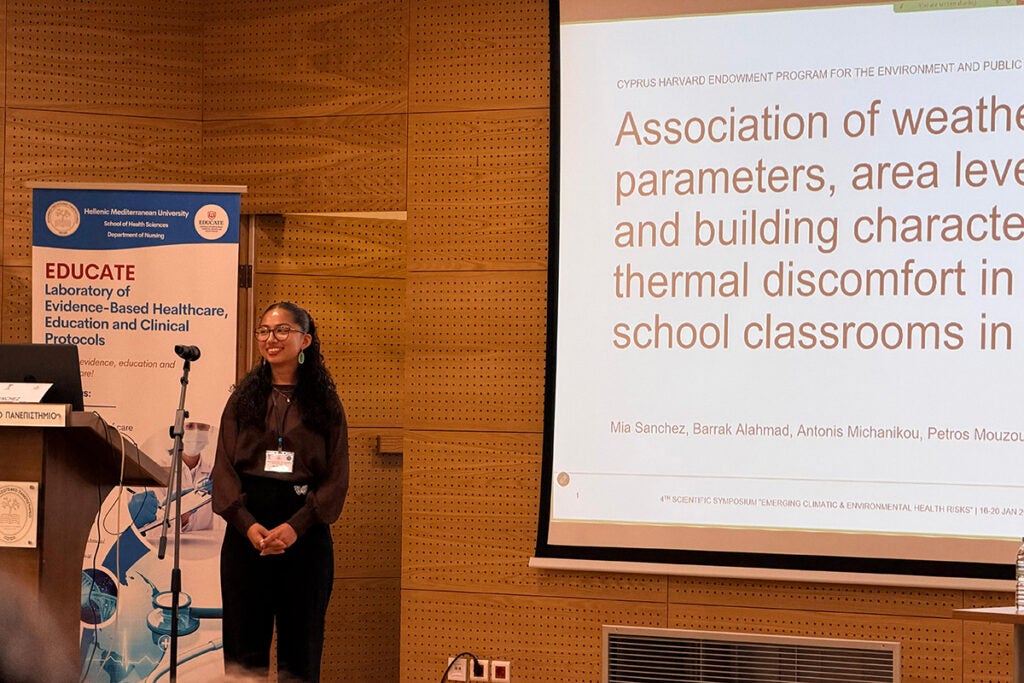
As a fellow in the School’s Cyprus Harvard Endowment Program for the Environment and Public Health, Sanchez worked on a project analyzing how building characteristics, daily weather, and student occupancy impact indoor classroom temperatures and student comfort in primary schools. She used data from 16 classrooms across eight primary schools in Nicosia, Cyprus. She found, unsurprisingly, that a lack of air conditioning—common in Cyprus—made a difference. But so, unexpectedly, did the type of windows in the classrooms.
She’s continuing to work on this project, building a dashboard that translates her research findings into an interactive tool that community members can use to see “how changing one aspect of a classroom can really impact the indoor temperature,” she said.
For Sanchez, a highlight of the program was when the 13-member cohort traveled to Greece in January to present their various research projects at an environmental health conference. It was her first-ever trip across the Atlantic.
A supportive environment
Sanchez’s first year at Harvard Chan was also the first year of the Harvard Chan FirstGen Mentoring Network. The program pairs first-year master of science students from across the School with second-year students who identify as first-generation—first in their families to earn either an undergraduate or graduate degree. Offerings include sessions on financial literacy, speed networking with first-gen staff and faculty, social gatherings, and workshops on the PhD application process and research opportunities.
Sanchez signed up. “I was very scared of what a big-name institution would be like, and worried that I would feel out of place,” she admitted.
The first-gen network was a big help. She said, “Having that group of other first-gen students to share our experiences together and talk about them, as well as build a larger community with people across departments at Chan, has been like a really nice family.”
After graduation, Sanchez plans to take some time to work in industry, aiming to learn how environmental health research is translated into operational impacts and strengthen her project management and science communication skills.
Her long-term plan, however, is to return to the classroom—first as a doctoral student, then as a professor, researcher, and mentor. “When I do return to academia,” she said, “I will have a more focused understanding of the specific environmental challenge I want to solve. My goal is to earn a PhD and transition into a teaching role, through which I can inspire the next generation of scientists just as my mentor, Dr. Gold, inspired me.”