Leaving Things Better: Reflections on Power, Ethics, and Community Partnerships
What would our projects look like if we planned for the ending from the very beginning?
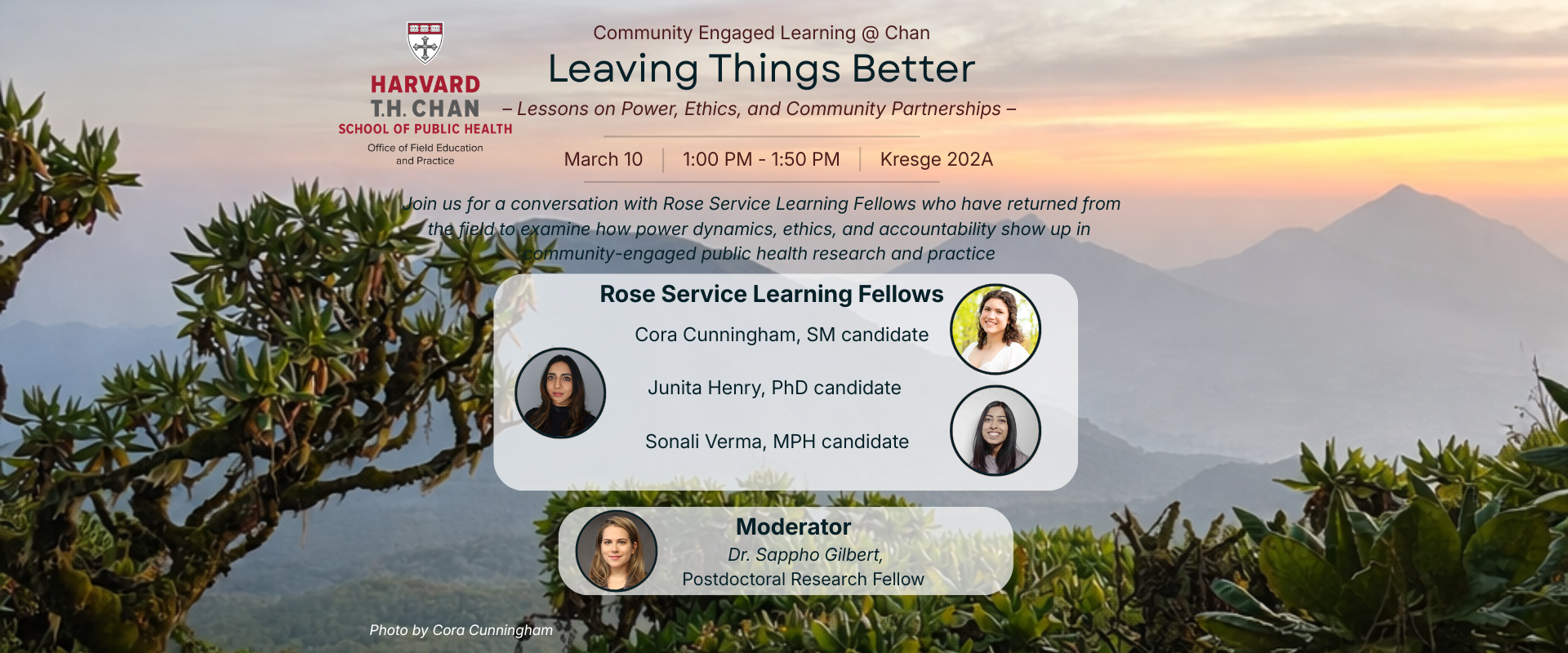
This deceptively simple question was where we landed through Leaving Things Better, a Community Engaged Learning@Chan seminar hosted on March 10. Moderated by Sappho Gilbert, a postdoctoral research fellow and CEL pedagogy fellow, the conversation brought together Rose Service Learning Fellows Cora Cunningham (SM candidate), Junita Henry (PhD candidate), and Sonali Verma (MPH candidate). Drawing on field experiences from diverse settings, the conversation explored how power dynamics, ethics, and accountability show up, and what it truly means to “leave things better” in community‑engaged public health practice.
Beyond IRB approval: ethics in the everyday
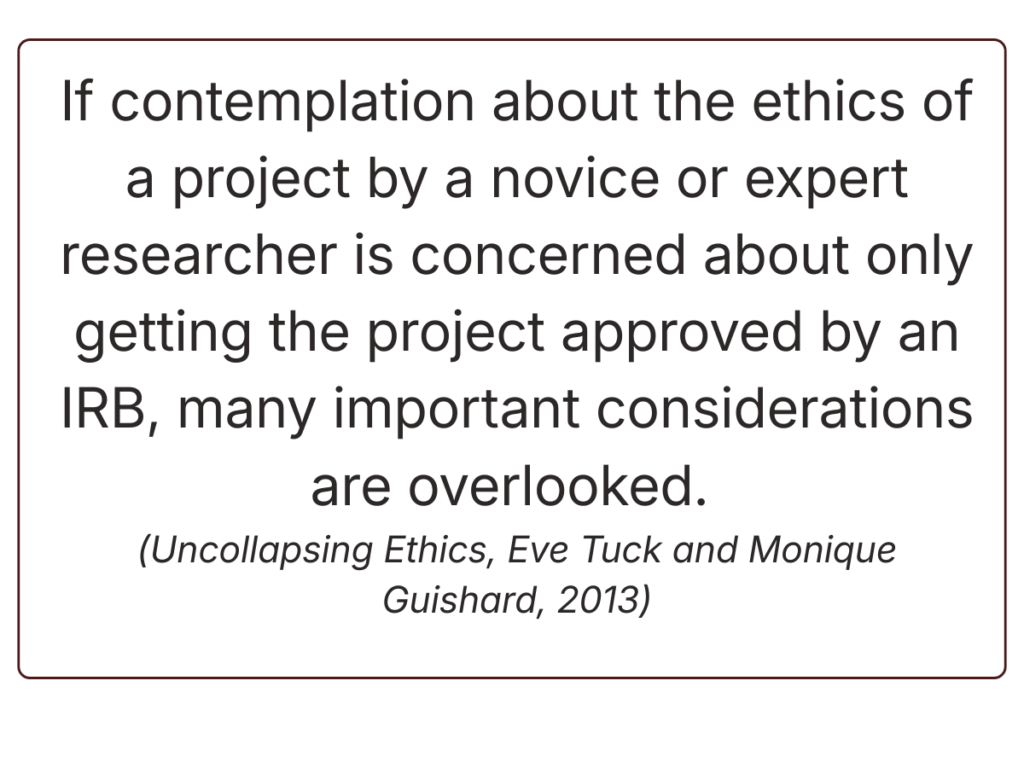
The session opened by questioning a common assumption: that once a project has Institutional Review Board (IRB) approval, the major ethical questions have been addressed. As the panelists reflected, ethics in community‑engaged work extend far beyond protocols and consent forms. Rather than treating ethics only as a hurdle to clear, they emphasized the importance of ongoing attention to relationships, responsibility, and the intended and unintended consequences of our work with communities.
Panelists also spoke about the value of formal IRB review. Cora reflected on how the IRB process can sharpen researchers’ intentions, forcing clarity about who is collecting which data, for what purposes, and with what safeguards. At the same time, Junita described experiences negotiating local review processes and navigating ethical dilemmas that were not captured by IRB protocols, while Sonali highlighted nuanced dynamics within practice‑based and service‑oriented projects that may not require formal IRB approval at all.
Positionality and the “Harvard factor”
How we relate to our partners depends deeply on who we are, where we come from, and how we are perceived. The panelists traced how awareness of power dynamics and positionality shaped their engagement in the field.
For Sonali, entering a new setting as a first‑time visitor to work with the Leo Project meant arriving as an “outsider” and being intentional about how she introduced herself. She spoke about the humility required to listen first, to learn local histories and priorities, and to be honest about what she could and could not offer within the scope of her role. In some contexts, the association with Harvard carried weight: opening doors, raising expectations, and at times added another layer of dynamics in how partners understood the project.
Junita reflected on returning home to South Africa yet still working outside of her own immediate context of Khayelitsha, Western Cape. Crossing linguistic, social, and economic boundaries, she deliberately leaned into an outsider posture to center learning and follow the lead of community partners. In her experience, the “Harvard factor” was not always the most salient identity; instead, other aspects of who she was and how she showed up in the work shaped relationships on the ground.
Cora described returning to project partners in Rwanda not only as a former student intern, but as a friend and, eventually, a board member of a partnering NGO. Her evolving role illustrated how commitments can extend beyond a semester or fellowship period, and how staying connected can deepen mutual accountability over time.
Sappho drew on a decade of partnership work in the Canadian Arctic to illustrate what enduring relationships can look like. A simple question: “When are you coming back?” captured the significance of long‑term presence and reciprocity. For partners, the expectation of return was less about specific deliverables and more about the continuity of relationships and shared work.
Being trustworthy, not just building trust
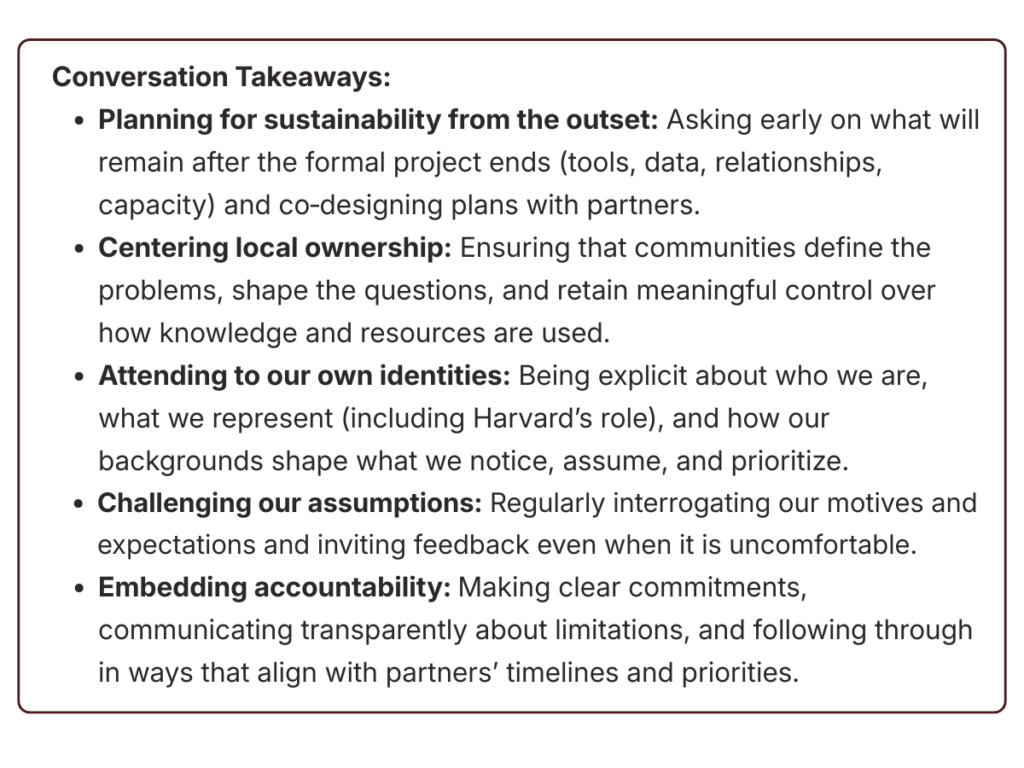
A recurring theme was the idea of “entry and exit” as ethical practices in their own right. Trust is not only built through how we arrive in a community; it is tested and revealed in how we leave. Our panelists emphasized that the story of a partnership is told as much by its conclusion as by its launch: Do we close loops with community partners? Are we transparent about what will and will not continue after students or funding cycles end? What responsibilities remain after a deliverable is submitted, or a dataset is analyzed?
These are complex, context‑specific questions without simple answers. Rather, these questions are pedagogical – they provide an opportunity to learn from one another’s experiences, including the unresolved tensions that persist after a project ends.
As the conversation closed, a subtle but powerful reframing emerged: shifting focus from “building trust” to “being trustworthy.” Trust cannot be demanded or guaranteed; it is earned over time through consistent, accountable actions.
The seminar reinforced that “leaving things better” is not a slogan or a protocol check box. It is an ongoing practice; one that requires us to continually reflect on power, ethics, and partnership, and to reorient our work toward being worthy of the trust communities extend.
Learn More about Community Engaged Learning at Chan