Responsible AI for Health Care: Concepts and Applications

Program Overview
Date: February 1–9, 2027
Modality: Online Live
Certificate of Specialization eligibility:
AI is transforming industries—understand its role in healthcare’s future.
Large Language Models (LLMs), machine learning, and other forms of artificial intelligence (AI) are reshaping how healthcare is delivered, managed, and regulated. But with this promise comes complexity and risk. Responsible AI for Health Care: Concepts and Applications is a four-day, intensive live online program that equips healthcare professionals with the knowledge and tools to critically assess, implement, and govern AI technologies in clinical, operational, and public health settings.
Led by renowned Harvard faculty and AI ethics experts, this program focuses on ethical principles, regulatory frameworks, fairness, transparency, and implementation science. Participants will examine real-world case studies—both successes and failures—to explore how to apply responsible AI in high-stakes environments while avoiding unintended harms.
Through interactive lectures, group discussion, and applied learning, participants will engage with timely questions at the intersection of innovation, safety, and health equity. The program also fosters a strong peer network, designed to support continued learning and collaboration well beyond the course.
Program Details
- Define foundational AI concepts and differentiate types of AI tools relevant to clinical, operational, and population health use cases
- Identify sources of algorithmic bias stemming from data, design, or deployment, and evaluate their impact on health equity
- Apply leading ethical frameworks to assess fairness, transparency, accountability, and safety in healthcare AI
- Compare and contrast U.S. and global regulatory approaches to healthcare AI, and assess implications for compliance and innovation
- Evaluate the trade-offs between explainability and model complexity, and explain the role of transparency in building trust in clinical AI
- Assess post-deployment risks and accountability mechanisms, including model drift, adverse event reporting, and human oversight
- Analyze real-world AI successes and failures to identify lessons learned and implementation challenges
- Develop strategies for responsible AI implementation aligned with ethical standards, clinical workflows, and organizational readiness
Tackling AI Challenges in Healthcare:
- Diagnosis: Responsible AI leverages large-scale multimodal health data to enhance diagnostic accuracy, reduce misdiagnosis, and ease clinician workload, all while prioritizing ethical data use and patient privacy.
- Precision Medicine: By enabling data-driven, patient-specific treatment plans, responsible AI shifts care from generic protocols to personalized medicine. This approach improves outcomes, optimizes resource use, and ensures equity through bias-aware, ethical design.
- Prediction Models: Ethical AI-powered prediction models support clinicians in forecasting disease progression and tailoring interventions. These models enhance decision-making, reduce risks, and promote transparent, accountable care strategies.
- Course Focus: To unlock AI’s full potential and prevent harm, practitioners must understand the responsibilities that extend beyond algorithm development. This course emphasizes pre- and post-deployment considerations, including algorithmic bias, equity, and public health impacts. Students will gain the tools to implement responsible AI solutions that improve patient outcomes and drive systemic efficiency.
This online program is designed for senior managers and executives who are responsible for developing and implementing AI strategy in their organizations and are looking to understand AI, its current state of the art, and future.
Participants will come from a range of organizational functions including health care delivery, health care technology, primary care systems, payers, and governments. Some titles represented in the program will include:
- Chief Executive Officer
- Chief Information Officer
- Chief Innovation Officer
- Chief Medical Informatics Officer
- Chief Medical Officer
- Clinician
- Data Scientist
- Director
- Engineer
- Innovation Specialist
- Finance Professional
- Product Manager
- Project Manager
- Venture Capital Investor
If your specific title is not listed above and you’re wondering if the program is right for you, know that the course is designed for those responsible for decisions around innovation, data, or technology in healthcare organizations, or want to be responsible for such decisions.
From Our Alumni
“I went in with close to zero knowledge regarding AI in health care and finished the course with a plethora of knowledge I hope to apply in my realm of practice. The future is here.”
—Deep Palikhel, Physician Assistant at Baylor Scott & White Hospital
Program Logistics
All Times are Eastern Time (ET).
| Monday, February 1, 2027 | ||
|---|---|---|
| 9:00–10:00 am | Introduction to AI I | |
| 10:00–10:15 am | Break | |
| 10:15–11:15 am | Introduction to AI II | |
| 11:15–11:30 am | Break | |
| 11:30 am–12:30 pm | Interactive Session | |
| 12:30–1:00 pm | Office Hours (Q&A) | Tuesday, February 2, 2027 |
| 9:00–10:00 am | Safety and Regulation I | |
| 10:00–10:15 am | Break | |
| 10:15–11:15 am | Safety and Regulation II | |
| 11:15–11:30 am | Break | |
| 11:30 am–12:30 pm | Interactive Session | |
| 12:30–1:00 pm | Office Hours (Q&A) | Monday, February 8, 2027 |
| 9:00–10:00 am | Algorithmic Bias | |
| 10:00–10:15 am | Break | |
| 10:15–11:15 am | Interactive Session | |
| 11:15–11:30 am | Break | |
| 11:30 am–12:30 pm | Implementing Responsible AI | |
| 12:30–1:00 pm | Office Hours (Q&A) | Tuesday, February 9, 2027 |
| 9:00–10:00 am | AI Governance in Clinical/Healthcare | |
| 10:00–10:15 am | Break | |
| 10:15–11:15 am | Implementing AI in Healthcare Organizations | |
| 11:15–11:30 am | Break | |
| 11:30 am–12:30 pm | Interactive Session and Closing | |
| 12:30–1:00 pm | Office Hours (Q&A) |
This agenda is subject to change.

Current faculty, subject to change
Ray Campbell
President
FAIR Health
Heather Mattie
Lecturer on Biostatistics, Co-Director, Health Data Science Master’s Program, Director of Community Engagement and Development
Harvard T.H. Chan School of Public Health
Co-Director, Research Education Core, The Partnership UMB-HCC
Gianluca Mauro
CEO
AI Academy
Trishan Panch
Program Director
Harvard T.H. Chan School of Public Health
Santiago Romero-Brufau
Director of AI and Systems Engineering
Department of Otolaryngology — Head and Neck Surgery
Mayo Clinic
Adjunct Assistant Professor
Department of Biostatistics
Harvard T.H. Chan School of Public Health
Harvard T.H. Chan School of Public Health will grant 1.2 Continuing Education Units (CEUs) for this program, equivalent to 12 contact hours of education. Participants can apply these contact hours toward other professional education accrediting organizations.
All credits subject to final agenda.
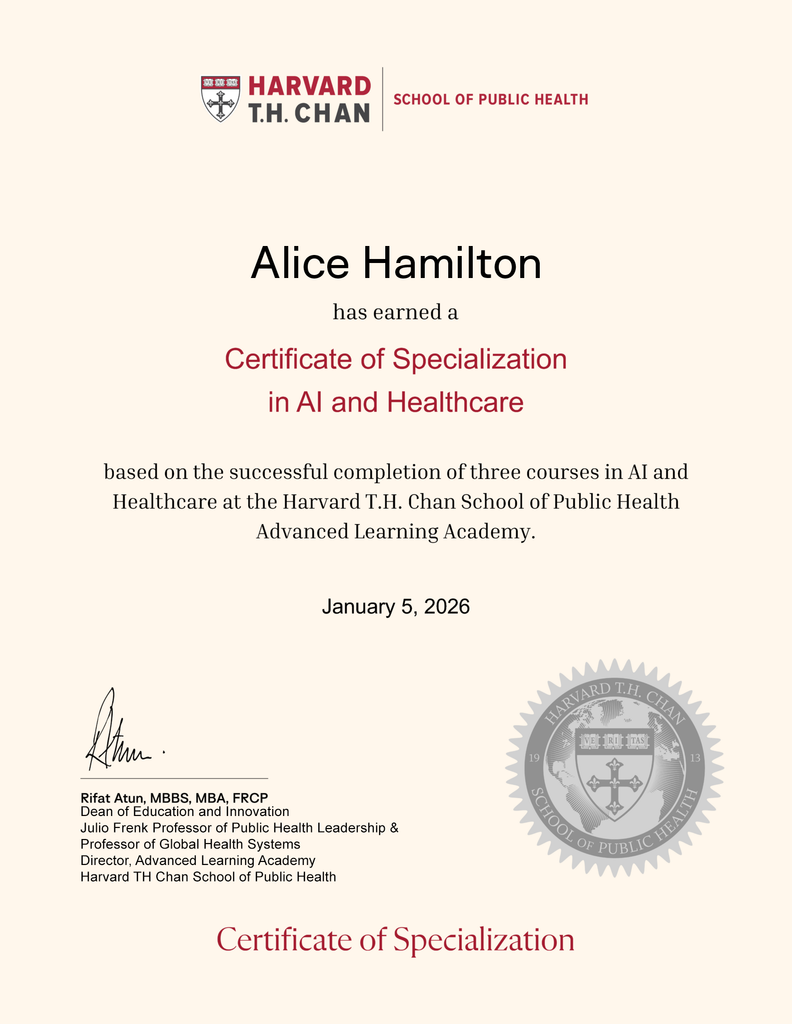
This course also contributes to the AI in Health Care Certificate of Specialization, among others. While each program can be taken independently, completing three healthcare AI courses in our portfolio earns the Certificate of Specialization.
See Our Faculty in Action
Hear from Program Directors Dr. Panch and Dr. Mattie on how AI is reshaping healthcare operations and patient care—a preview of what you’ll learn in this course.
Certificate of Specialization
Earn an AI in Health Care Certificate of Specialization
Take this program to earn a Certificate of Completion, or take 3 to earn a Certificate of Specialization. Learn more here.
Frequently Asked Questions
No. The program is accessible to professionals from clinical, policy, and administrative roles. The focus is on ethical implementation, decision-making, and leadership, tailored to healthcare and public health settings—not programming.
While on-the-job experience with AI is very valuable, it often lacks the structured frameworks, ethical grounding, and cross-sector perspectives needed to lead AI responsibly in healthcare. The Responsible AI for Health Care program from Harvard T.H. Chan School of Public Health offers structured learning guided by Harvard faculty and enriched by peers from diverse disciplines. Through interactive discussions and real-world case studies, you’ll explore what has worked (and what hasn’t) in different organizations. This shared learning helps you return to your own workplace with proven strategies, practical insights, and a stronger foundation for responsible AI implementation.
Each course within the AI for Health Care Certificate of Specialization series covers a valuable and fast-developing area.
Responsible AI for Health Care: Concepts and Applications
Focus: Governance, ethics, regulation, risk, and oversight
Audience posture: “How do we deploy AI safely and responsibly?”
Primary output: Policies, frameworks, guardrails
Implementing AI into Clinical Practice
Focus: Operational rollout inside existing institutions
Audience posture: “How do we adopt AI inside a hospital or system?”
Primary output: Implementation playbooks, change management strategies
Innovation with AI in Healthcare
Focus: Exposure to frontier innovation and leading organizations
Audience posture: “What is possible, and who is doing it?”
Primary output: Insight, inspiration, strategic awareness
Yes, we offer customized programs for organizations that can be adapted from open-enrollment courses like Responsible AI for Health Care or designed as a new, bespoke program.
- Teams of 4–20: We can offer a discounted cohort of an existing open enrollment program to accommodate your group.
- Teams of 21+ : We recommend a fully customized design—either a modified version of an existing course or a new program built around your goals.
We’d be happy to have an informal conversation about how we can help you to customize your organizational training needs. Please contact Priya Ponnappan for more information at Priya_ponnappan@hsph.harvard.edu
Advance Your Career at Harvard with Responsible AI for Health Care: Concepts and Applications
Responsible AI for Health Care: Concepts and Applications
Upcoming Program Information
View detailed information for the upcoming programs.
-
Gun prevalence and suicide rank by state
Mapping the Overlap As these maps show, the correlation between guns and suicide is strong but inexact, since both are influenced by poverty, population density, and crime. The nine states…
-
A simple checklist that saves lives
[ Fall 2008 ] Fighter pilots use checklists to avoid deadly errors. Why not surgeons, too? So complex was the new B-17 bomber introduced during World War II that a…
-
Electronic vs. personal health record
[ Fall 2008 ] What’s the Difference? Whereas an electronic health record (EHR) is a computer record that originates with and is controlled by doctors, a personal health record (PHR)…
-
The Maternal Health Task Force is Established
There is encouraging momentum underway around the world to accelerate progress toward improving maternal health, one of the most neglected challenges in global public health. I am pleased to report that, through the generosity of the Bill & Melinda Gates Foundation, a new initiative is being formed to build on that momentum by invigorating and catalyzing our collective efforts to save women’s lives.
-
Employer health incentives
[Winter 2009] Employee wellness programs prod workers to adopt healthy lifestyles A Massachusetts man lost his job at a Scotts Miracle-Gro lawn and garden center in 2006 when a routine…
-
Appointment of MHTF Director
EngenderHealth Announces the Director of the Maternal Health Task Force – Ann K. Blanc, Ph.D. – After a thorough search for the new Director of the MHTF that attracted an…
-
Launch Meeting Report
Launching the Maternal Health Task Force: Reaching Consensus on the Draft Terms of Reference, February 17 & 18, Washington, DC I am pleased to report that the launch phase of…
-
Hello & Welcome to the MHTF Online
Welcome to the Maternal Health Task Force Online! This space will function as a primary means of communication with MHTF advisors, colleagues, and friends as well as a way for…
-
High Level Leadership Group Announced
New leadership group announced to spearhead drive against maternal mortality I was delighted to represent the MHTF at a meeting recently organized by Sarah Brown, wife of UK Prime Minister…
Program Overview
Lorem Ipsum
Optional Content Section
Lorem Ipsum
Objectives & Highlights
Certificate of Specialization
Advance your Career with a Certificate of Specialization
This program contributes to the [insert CoS name here] Certificate of Specialization. [Click here for more information.]