Innovation with AI in Health Care: Agentic Operations
Program Overview
Date: December 7–15, 2026 (Live sessions on Dec. 7, 8, 14 & 15)
Modality: Online Live
Certificate of Specialization eligibility:
Innovate with AI—rethink health care operations with AI agents
AI agents can use information, work with software tools, carry out sequences of tasks and respond to results. For health care leaders, these capabilities raise practical questions about how work is organized: which operational problems are worth addressing, what people should do with agents, and where human judgment and responsibility remain essential.
Innovation with AI in Health Care: Agentic Operations is a four-day course for clinicians and business leaders who want to understand how these systems can become part of the ongoing operations of a health care organization. It builds on Building AI Solutions to Transform Health Care and the other courses in the AI in Health Care specialization.
Through faculty talks, guided demonstrations and discussion, participants explore agentic systems, operational infrastructure, patient recruitment and growth, executive leadership and team development. The final day examines AI co-scientist, AMIE, AI companions and the future of primary care.
The course connects organizational purpose with practical learning. Participants consider how leaders can act with humility, learn through repeated Build–Measure–Learn cycles, develop people and choose the technology and controls needed for responsible use. The emphasis is on familiarity with the principles and the questions to ask when applying them.
Program Details
By the end of the course, participants will be familiar with the following concepts through talks, demonstrations and discussion:
- How business goals and workflows guide the choice of an operational opportunity and the investment needed to pursue it.
- The distinction between work undertaken by people alone, people with agents and agents acting within delegated authority, and the purpose of an organizational constitution.
- The roles of reusable skills, data infrastructure, the agent harness and the model.
- Why agentic systems need regular automated evaluations and discretionary human reviews, using evidence beyond an agent’s own judgment.
- The costs of operating and evaluating agents, including tokens, tool calls, retries and human review.
- The principles of sensitive-data access, cybersecurity, audit, reversibility, approval and escalation.
- How humility, personal education and Build–Measure–Learn practice support continued learning.
- Talent development, digitally fluent generalists, a staged move toward AI-enabled teams of one where appropriate, specialist support, coaching and pathways for junior staff to develop expertise.
- Emerging clinical AI and the distinction between benchmark performance and evidence of benefit in real care.
participate
This course is designed for clinicians and business leaders who are familiar with AI and want to understand its application in health care operations. It is relevant to clinical and operational executives, practice and service-line leaders, health-system and health-plan leaders, and teams working in strategy, finance, innovation and transformation.
Participants should bring curiosity, knowledge of their organization and a willingness to learn. No coding skills or advanced AI expertise are required. Completion of a previous course in the AI in Health Care specialization is recommended, not compulsory.
The course combines four live online days over two weeks. Each day includes three sessions, dedicated questions and discussion after the first two, and discussion or reflection after the third. On the final day, the closing half hour is devoted to the course wrap-up.
Guided labs on Days 1 and 2 introduce practical methods through demonstrations and optional exercises. Participants can follow the teaching and discussion without completing assignments. Technical concepts are explained through health care examples and operational challenges.
The interactive assignments reinforce the course concepts and help participants become familiar with directing agents in a coding environment. Participants may explore organizational instructions, reusable skills, evaluation cases and short cycles of testing and revision. Coding skills are not necessary to take part.
To complete the optional assignments, participants need their own paid subscription for their chosen coding environment or AI coding agent, with access to their chosen model. Most previous participants have used Claude Code, OpenAI Codex or Google Antigravity. Other environments are also available. Setup guidance will be provided during the course.
Teaching and labs use non-confidential, synthetic or approved participant-safe examples. Participants should not upload protected health information or sensitive organizational data.
From Our Alumni
“I would strongly recommend the Innovation with AI in Health Care program to colleagues. The program’s emphasis on real-world examples ensured that I could directly apply the concepts learned to my work, driving innovation and delivering tangible results.”
—Christina Pamela Kreutzmann, Regional Ecosystem Partner, Roche
Program Agenda
All Times are Eastern Time (ET).
| Monday, December 7, 2026 | ||
|---|---|---|
| 9:00–10:00 am | Panch | Principles of Agentic Operations |
| 10:00–10:30 am | Questions and discussion | |
| 11:00–11:30 am | Panch, Mauro | Applying Agentic Operations: MCP, Skills and the Harness |
| 11:30 am–12:00 pm | Questions and discussion | |
| 12:30–1:30 pm | Panch, Mauro | Lab: Using MCP and Skills to Improve Agent Performance |
| 1:30–2:00 pm | Questions, discussion and reflection | Tuesday, December 8, 2026 |
| 9:00–10:00 am | Infrastructure for Agentic Operations in Healthcare | |
| 10:00–10:30 am | Questions and discussion | |
| 11:00–11:30 am | Agentic Operations for Growth in Healthcare Organisations | |
| 11:30 am–12:00 pm | Questions and discussion | |
| 12:30–1:30 pm | Sherman, Mattie | Lab: Implementing Agentic Operations |
| 1:30–2:00 pm | Questions, discussion and reflection | Monday, December 14, 2026 |
| 9:00–10:00 am | Brownstein | Leading AI Transformation in a Health System |
| 10:00–10:30 am | Questions and discussion | |
| 11:00–11:30 am | Bhandari | Leading AI Transformation in a Health Plan |
| 11:30 am–12:00 pm | Questions and discussion | |
| 12:30–1:30 pm | Panch, Block | Digital MD: Managing Teams with AI |
| 1:30–2:00 pm | Questions, discussion and reflection | Tuesday, December 15, 2026 |
| 9:00–10:00 am | Natarajan, Karthikesalingam | AI Co-Scientist and AMIE: Agentic AI in Discovery and Medicine |
| 10:00–10:30 am | Questions and discussion | |
| 11:00–11:30 am | AI Companions and the Patient Interface: Lessons from Microsoft Copilot | |
| 11:30 am–12:00 pm | Questions and discussion | |
| 12:30–1:30 pm | Fernandopulle, Panch | Fireside Chat: Reinventing Primary Care in the Age of AI |
| 1:30–2:00 pm | Panch | Course Wrap-up: From Insight to Action |
This agenda is subject to change.
Principles of Agentic Operations (9:00–10:00 am)
Trishan Panch
Examine the current potential and limitations of AI models and what makes a system agentic: pursuing goals, using tools, maintaining context and completing work across multiple steps.
- Begin with business goals and mapped workflows.
- Distinguish work for people alone, people with agents and agents acting within bounded authority.
- Connect organizational purpose with guide metrics for progress, guardrail metrics for unwanted consequences, and the principles of agentic operations.
Applying Agentic Operations: MCP, Skills and the Harness (11:00–11:30 am
Trishan Panch and Gianluca Mauro
Learn how agents connect to organizational information and tools, and how reusable procedures and the surrounding software shape their work.
- Model Context Protocol (MCP), reusable skills and the agent harness: context, tools, task execution, permissions and feedback.
- Reliability through constrained actions, human approval and explicit performance criteria.
- Scheduled or change-triggered evaluations and discretionary reviews of uncertainty, exceptions or new risks. Use reference cases, rules and human judgment; agreement between agents is not sufficient evidence of correctness.
- The cost of repeated runs, model-based reviewers and retries, and how evaluation frequency and depth relate to risk, expected benefit and budget.
Lab: Using MCP and Skills to Improve Agent Performance (12:30–1:30 pm)
Trishan Panch and Gianluca Mauro
Follow a demonstration of how organizational context and reusable skills can improve an agent’s work.
- Connect course knowledge resources and skills to Codex and a second selected agent environment.
- Draft an organizational constitution covering purpose, learning goals, priorities, decision rights, data permissions and boundaries for delegated work.
- Compare baseline and context-supported outputs on the same cases, using explicit acceptance criteria and recording quality and cost.
- Investigate ambiguous or conflicting instructions and revise the constitution or controls through a second Build–Measure–Learn cycle.
Infrastructure for Agentic Operations in Healthcare (9:00–10:00 am)
Gene Dolgin, Co-founder and CEO, Lumin Health
Understand the operational domains of ambulatory medicine and how to prioritize opportunities for automation with agents.
- Essential data infrastructure and multi-quarter investment in data, integrations, people, evaluation and operating change.
- Patient-data protections: minimum-necessary, role-based access; separate read and write permissions; credential protection; audit trails; cybersecurity; and incident response.
- How to assess what to build, buy or integrate, considering workflows, existing systems, data quality, accountable owners and full operating cost.
- Implementation lessons from a growing care organization, including risks from untrusted content or unauthorized disclosure and where human coordination remains essential.
Agentic Operations for Growth in Healthcare Organisations (11:00–11:30 am)
Alec Sherman, Head of Digital Marketing, Lumin Health
Use a case study of patient recruitment in interventional psychiatry to understand how AI can change marketing and growth operations.
- Identify marketing domains and map the patient journey from awareness and referral through enquiry, assessment and treatment initiation.
- Understand how an AI-enabled generalist can coordinate research, content, campaigns, follow-up and reporting, with specialist support and approval for consequential actions.
- Use AI to manage up: align marketing activity with organizational strategy and communicate priorities, progress and results.
- Measure qualified inquiries, conversion, acquisition cost and patient experience, including agent execution, evaluation and human review costs.
Lab: Implementing Agentic Operations (12:30–1:30 pm)
Alec Sherman and Heather Mattie
Through a guided demonstration and discussion, learn how an operational workflow is selected, built, evaluated and improved.
- Map the business goal, users, steps and handoffs, and allocate work among people, people with agents and agents acting within delegated authority.
- Define data access, outputs, approvals and limits on actions that are difficult to reverse; test what happens when permission or approval is missing.
- Build with synthetic data and reusable skills; combine automated evaluations with a discretionary review of a failure or uncertain result.
- Track errors, token and tool use, retries and human review time. Use the findings to plan another iteration, an evaluation schedule, spending limit, incident response and criteria for a supervised pilot.
Leading AI Transformation in a Health System (9:00–10:00 am)
John Brownstein, Senior Vice President and Chief Innovation Officer, Boston Children’s Hospital
Learn how a health system connects institutional goals and workflow needs to a portfolio of AI initiatives, with board alignment and executive sponsorship.
- Shared capabilities for data access, integration, cybersecurity and evaluation across clinical, research and administrative teams.
- Partnerships among frontline staff, technical teams, executives and external organizations, with clear responsibilities and opportunities to learn from implementation.
- Staged evidence reviews to inform funding, scaling, redesign or stopping decisions, including continuing evaluation and oversight costs.
Leading AI Transformation in a Health Plan (11:00–11:30 am)
Aman Bhandari, Chief Analytics and AI Officer, SCAN
Explore the current state of AI in health plans and the leadership commitment needed to move from early initiatives to sustained organizational change.
- Opportunities and practical constraints in member services, care coordination and administrative operations.
- Commitment from the board and executive team: direction, investment and visible leadership involvement.
- Leadership beyond governance: setting priorities, building confidence and capability, aligning incentives and helping people change how they work.
- A path forward connecting near-term learning with multi-quarter investment, workforce development, member experience and operational value.
Digital MD: Managing Teams with AI (12:30–1:30 pm)
Liz Kwo, CEO, Vanna Health, in conversation with Trishan Panch
Liz’s book Digital MD provides the starting point for a discussion of digital transformation, healthcare stakeholders and the leadership needed to turn new capabilities into practice. Liz and Trishan connect this perspective to practical uses of AI in managing and developing teams.
- How provider, payer, employer and other stakeholder perspectives and incentives shape digital transformation.
- Meeting preparation, agreed transcription, summaries and agendas; feedback for managers and team members; and continuity between one-to-one meetings.
- Proactive development plans, coaching, supervised practice and pathways to greater responsibility.
- Following through on commitments and checking results while preserving confidentiality, trust, human judgment and accountability for people decisions.
AI Co-Scientist and AMIE: Agentic AI in Discovery and Medicine (9:00–10:00 am)
Vivek Natarajan and Alan Karthikesalingam, Google DeepMind
Examine two research systems: AI co-scientist, which supports scientific hypothesis generation and refinement, and AMIE, which explores diagnostic reasoning and medical conversations.
- How multiple agents generate, critique, rank and refine hypotheses, with scientists directing the research goal and evaluating promising ideas.
- How dialogue can gather information and refine diagnostic reasoning while considering communication, empathy and uncertainty.
- Evaluation through experimental validation, expert review and simulated patient encounters.
- The distinction between research results and benefit in routine care, including questions about real-world performance, privacy, fairness, robustness and human oversight.
AI Companions and the Patient Interface: Lessons from Microsoft Copilot (11:00–11:30 am)
Dominic King, Vice President of Health, Microsoft AI
Explore how conversational AI can help people understand symptoms, health information and care options, and how longitudinal context could make assistance more relevant.
- The boundaries between information, navigation, decision support and clinical care.
- Connections to clinicians, communication of uncertainty and appropriate escalation.
Fireside Chat: Reinventing Primary Care in the Age of AI (12:30–1:30 pm)
Rushika Fernandopulle, Co-founder and CEO, Liza Health; moderated by Trishan Panch
Consider how primary care could be designed today, drawing on Rushika’s experience founding Iora Health and building Liza Health. Audience questions are included in the session.
- How teams, workflows, technology and business models might change, and where human attention should be concentrated.
- Continuity, trust and clinician agency, alongside lessons about incentives, ownership and scaling.
- What the generalist–specialist model can teach operational leaders, and how to protect clinical judgment and junior clinicians’ development.
Course Wrap-up: From Insight to Action (1:30–2:00 pm)
Trishan Panch
Revisit personal values, leadership and talent development, and technology enablers through the course examples. Reflect on what changed in participants’ understanding and what remains uncertain.
- Choose a meaningful operational opportunity, identify colleagues to learn and build with, and define the next question to test.
- Outline a first 90-day learning cycle within a multi-quarter roadmap, covering business goals, workflow, ownership, board alignment, investment, evaluation and cost, data and action controls, and criteria for proceeding.
- Identify a personal learning routine, team capabilities, specialist support and junior-development opportunities for the next stage.

Current faculty, subject to change
Aman Bhandari
Chief Analytics and AI Officer
SCAN
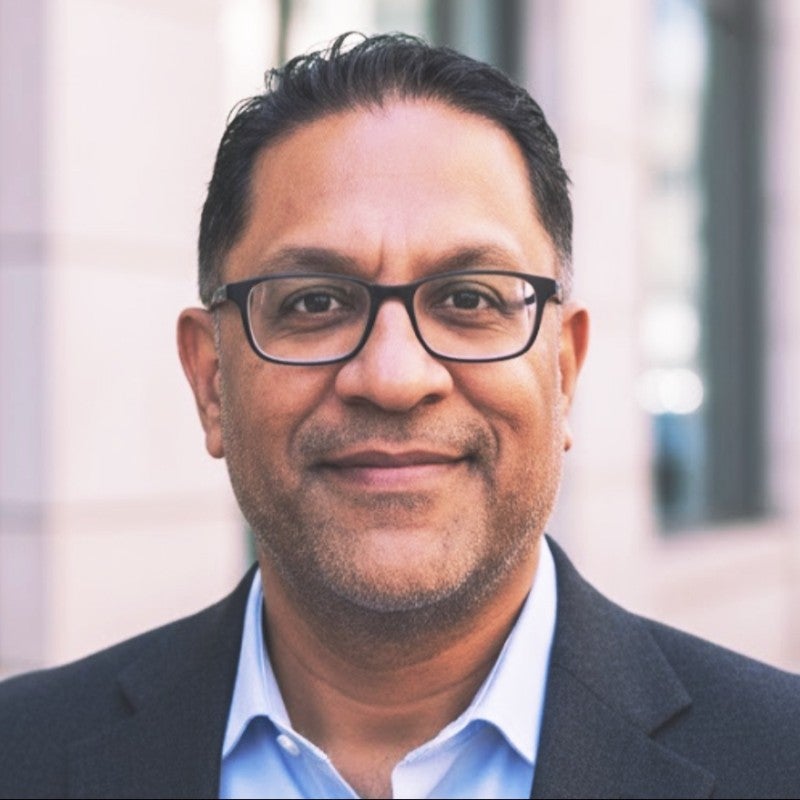
John Brownstein
Senior Vice President and Chief Innovation Officer
Boston Children’s Hospital

Gene Dolgin
Co-founder and CEO
Lumin Health

Rushika Jerome Fernandopulle
CEO and Co-Founder
Iora Health

Alan Karthikesalingam
Principal Scientist and Director
Google DeepMind

Dominic King
Vice President of Health
Microsoft AI

Gianluca Mauro
CEO
AI Academy

Vivek Natarajan
Research Scientist
Google

Trishan Panch
Program Director
Harvard T.H. Chan School of Public Health
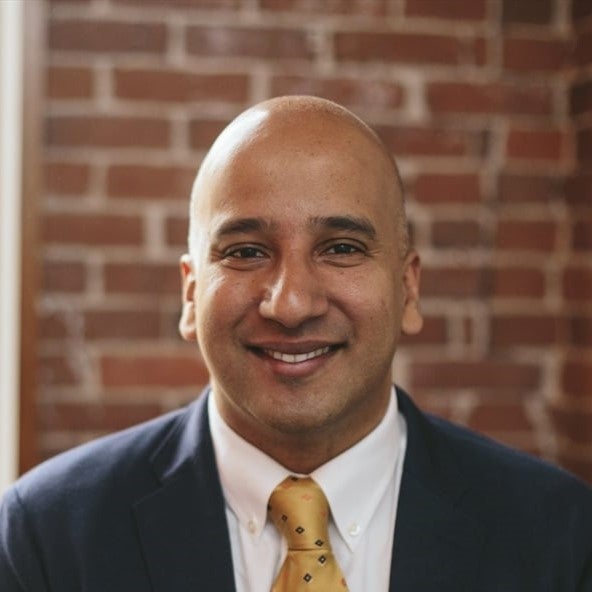
Alec Sherman
Head of Digital Marketing
Lumin Health

Harvard T.H. Chan School of Public Health will grant 1.2 Continuing Education Units (CEUs) for this program, equivalent to 1.2 contact hours of education. Participants can apply these contact hours toward other professional education accrediting organizations.
All credits subject to final agenda.
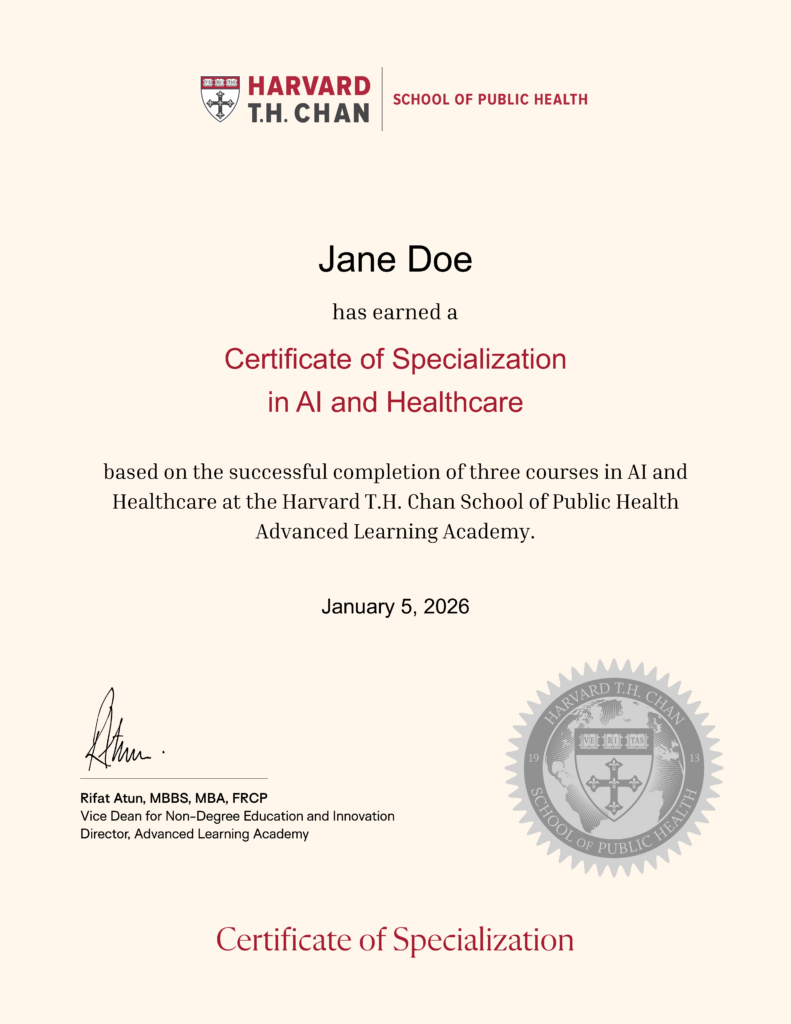
This course also contributes to the AI in Health Care Certificate of Specialization, among others. While each program can be taken independently, completing three healthcare AI courses in our portfolio earns the Certificate of Specialization.
Certificate of Specialization
Earn an AI in Health Care Certificate of Specialization
Take this program to earn a Certificate of Completion, or take 3 to earn a Certificate of Specialization. Learn more here.
Frequently Asked Questions
No. The course is designed for clinicians and business leaders, and coding skills or advanced AI expertise are not required. Technical ideas are introduced through health care examples and demonstrations.
Previous participation in the AI in Health Care specialization is recommended, not compulsory. Familiarity with your organization’s operational challenges and a willingness to learn are central.
No. Assignments are optional. They reinforce the concepts and help participants become familiar with working on operational challenges in coding environments. You can follow the teaching, demonstrations and discussions without completing them.
Your own paid subscription to a coding environment or AI coding agent, with access to your chosen model. Setup guidance is provided during the course. Use only the non-confidential or synthetic examples approved for teaching.
Advance Your Career at Harvard with Innovation with AI in Health Care: Agentic Operations
Innovation with AI in Health Care: Agentic Operations

Upcoming Program Information
View detailed information for the upcoming programs.
-
Gun prevalence and suicide rank by state
Mapping the Overlap As these maps show, the correlation between guns and suicide is strong but inexact, since both are influenced by poverty, population density, and crime. The nine states…
-
A simple checklist that saves lives
[ Fall 2008 ] Fighter pilots use checklists to avoid deadly errors. Why not surgeons, too? So complex was the new B-17 bomber introduced during World War II that a…
-
Electronic vs. personal health record
[ Fall 2008 ] What’s the Difference? Whereas an electronic health record (EHR) is a computer record that originates with and is controlled by doctors, a personal health record (PHR)…
-
The Maternal Health Task Force is Established
There is encouraging momentum underway around the world to accelerate progress toward improving maternal health, one of the most neglected challenges in global public health. I am pleased to report that, through the generosity of the Bill & Melinda Gates Foundation, a new initiative is being formed to build on that momentum by invigorating and catalyzing our collective efforts to save women’s lives.
-
Employer health incentives
[Winter 2009] Employee wellness programs prod workers to adopt healthy lifestyles A Massachusetts man lost his job at a Scotts Miracle-Gro lawn and garden center in 2006 when a routine…
-
Appointment of MHTF Director
EngenderHealth Announces the Director of the Maternal Health Task Force – Ann K. Blanc, Ph.D. – After a thorough search for the new Director of the MHTF that attracted an…
-
Launch Meeting Report
Launching the Maternal Health Task Force: Reaching Consensus on the Draft Terms of Reference, February 17 & 18, Washington, DC I am pleased to report that the launch phase of…
-
Hello & Welcome to the MHTF Online
Welcome to the Maternal Health Task Force Online! This space will function as a primary means of communication with MHTF advisors, colleagues, and friends as well as a way for…
-
High Level Leadership Group Announced
New leadership group announced to spearhead drive against maternal mortality I was delighted to represent the MHTF at a meeting recently organized by Sarah Brown, wife of UK Prime Minister…
Program Overview
Lorem Ipsum
Optional Content Section
Lorem Ipsum
Objectives & Highlights
Certificate of Specialization
Advance your Career with a Certificate of Specialization
This program contributes to the [insert CoS name here] Certificate of Specialization. [Click here for more information.]