Implementing Health Care AI into Clinical Practice

Program Overview
Date: June 7–15, 2027 (Live sessions on June 7, 8, 14, & 15)
Modality: Live Online
Certificate of Specialization eligibility:
Master AI applications—bring AI into clinical workflows
Medicine, at its core, is an information processing science. The more patient data we have, the clearer and easier it is to define health outcomes. As AI technology grows, its use in health care settings can accelerate information processing to improve patient care efficiency. However, integrating AI into a provider’s practice or health care system is a large undertaking. Implementing AI in Clinical Practice equips clinicians and stakeholders with the necessary and timely skills to develop these processes in-house.
Through case studies, small group discussions, and interactive sessions led by Harvard faculty, you will gain hands-on experience in each step of the AI implementation process. You will learn how to design an effective implementation strategy by building your skills in four key areas:
- Workflow assessment and system engineering, in which you identify the tasks you need automated and decide the structured sequence of operations to do them
- Accuracy evaluation and model selection, or choosing the best AI or machine learning model for a specific task and test its effectiveness
- Machine Learning Operations, commonly known as MLOps, covers model deployment and long-term maintenance
- Change management for your health care setting, preparing the team and your systems for the move to an AI-led workflow
Through these lenses, participants will develop and tailor AI solutions that will work best for their health care setting and situation. By the end of the program, you will develop skills in multiple disciplines—including data science, user-centered design, and change management—to ensure AI solutions are implemented successfully in clinical practice.
Program Overview
By the end of the program, you will be able to:
- Analyze clinical workflows with a focus on the clinical decision that can be improved with AI, and design new AI-enhanced workflows.
- Understand the nuances of different metrics to assess the performance of different AI models for specific use cases
- Grasp the concepts of MLOps and machine learning model deployment
- Identify the potential for model drift and how to account for it in a model maintenance plan
- Plan and conduct change management for AI-powered process changes
- Identify what team members—data engineers and scientists, MIOps specialists, and others— you need to fully implement a clinical AI project
During this program, you will:
- Hear from experts in the implementation of AI into clinical practice, from healthcare institutions to healthcare tech CEOs
- Work through a real-world case study with the guidance of experts in the implementation of AI solutions into clinical practice
- Network with like-minded leaders from across the world through small group discussions in an interactive virtual environment.
This online program is designed for clinicians, administrators, and executives who are responsible for implementing AI solutions in their organization.
Participants will come from a range of organizations including health care delivery (hospitals, clinics, primary care systems, and other health care delivery companies or institutions), health care technology, payers, and governments. Some titles represented in the program will include:
- Clinician
- Physician Leader
- Chief Executive Officer
- Chief Information Officer
- Chief Innovation Officer
- Chief Medical Informatics Officer
- Chief Medical Officer
- Data Scientist
- Director
- Innovation Specialist
- Implementation Specialist
- Product Manager
This program is designed for those who have either a background in data science or a general understanding of how artificial intelligence works; as well as a general understanding of the health care system. It is recommended that those with no artificial intelligence background or knowledge take the first program in the AI Certificate of Specialization series, Responsible AI for Health Care: Concepts and Applications, before enrolling in this program.
From Our Alumni
“AI is here and it won’t go away. We need people that can lead AI implementation projects, so AI can help improve clinical workflows and decision-making processes.”
—Mr. Gijs van Praagh, Medical Physicist resident, University Medical Center Utrecht
Program Details
All Times are Eastern Time (ET).
| Monday, June 7, 2027 | ||
|---|---|---|
| 9:00–10:15 am | Introduction – Health Care AI as the Science of Decisions | |
| 10:15–10:30 am | Break | |
| 10:30–11:45 am | Workflow Mapping | |
| 11:45 am–12:30 pm | Lunch | |
| 12:30–2:00 pm | Guided Team Project: Workflow Map | Tuesday, June 8, 2027 |
| 9:00–10:15 am | Accuracy Metrics | |
| 10:15–10:30 am | Break | |
| 10:30–11:45 am | AI Governance & Regulation | |
| 11:45 am–12:30 pm | Lunch | |
| 12:30–2:00 pm | Guided Team Project: Accuracy Metrics and Model Discussion | Monday, June 14, 2027 |
| 9:00–10:15 am | ML-Ops and Architecture Design | |
| 10:15–10:30 am | Break | |
| 10:30–11:45 am | Case study | |
| 11:45 am–12:30 pm | Lunch | |
| 12:30–2:00 pm | Guided Team Project: ML-Ops | Tuesday, June 15, 2027 |
| 9:00–10:15 am | Study Design and Change Managemen | |
| 10:15–10:30 am | Break | |
| 10:30–11:45 am | Guided Team Project: Change Management and Study Design | |
| 12:30–2:00 pm | Course Summary and Q & A |
This agenda is subject to change.
Current faculty, subject to change
Joshua Wesley Ohde
AI/ML Engineer, Mayo Clinic, Rochester, MN
Assistant Professor of Clinical Translational Science, Mayo Clinic College of Medicine and Science, Mayo Clinic, Rochester, MN
Santiago Romero-Brufau
Director of AI and Systems Engineering
Department of Otolaryngology — Head and Neck Surgery
Mayo Clinic
Adjunct Assistant Professor
Department of Biostatistics
Harvard T.H. Chan School of Public Health
Alexander Jay Ryu
Vice Chair of AI Innovation
Department of Medicine and Innovation Committee Chair
Mayo Clinic- Rochester
The Harvard T.H. Chan School of Public Health is accredited by the Accreditation Council for Continuing Medical Education (ACCME) to provide continuing medical education for physicians.
The Harvard T.H. Chan School of Public Health designates this live activity for a maximum of 16 AMA PRA Category 1 Credits™. Physicians should claim only the credit commensurate with the extent of their participation in the activity.
The American Medical Association (AMA) has an agreement of mutual recognition of continuing medical education (CME) credit with the European Union of Medical Specialties (UEMS). Additional information regarding this agreement may be found on the American Medical Association (AMA) website.
Harvard T.H. Chan School of Public Health will grant 1.6 Continuing Education Units (CEUs) for this program, equivalent to 16 contact hours of education. Participants can apply these contact hours toward other professional education accrediting organizations.
All credits subject to final agenda.
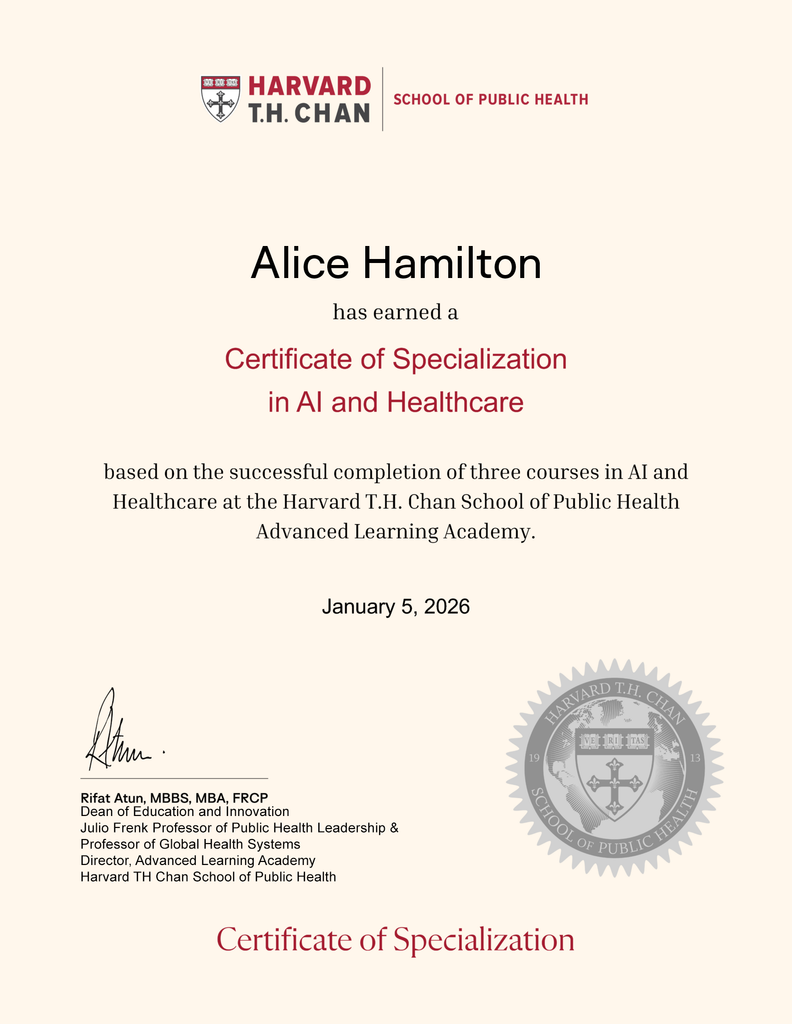
This course also contributes to the AI in Health Care Certificate of Specialization, among others. While each program can be taken independently, completing three healthcare AI courses in our portfolio earns the Certificate of Specialization.
See Our Faculty in Action
Hear from Program Director Dr. Santiago Romero-Brufau on how AI is reshaping healthcare operations and patient care—a preview of what you’ll learn in this course.
Certificate of Specialization
Earn an AI in Health Care Certificate of Specialization
Take this program to earn a Certificate of Completion, or take 3 to earn a Certificate of Specialization. Learn more here.