What Counts as Knowledge?
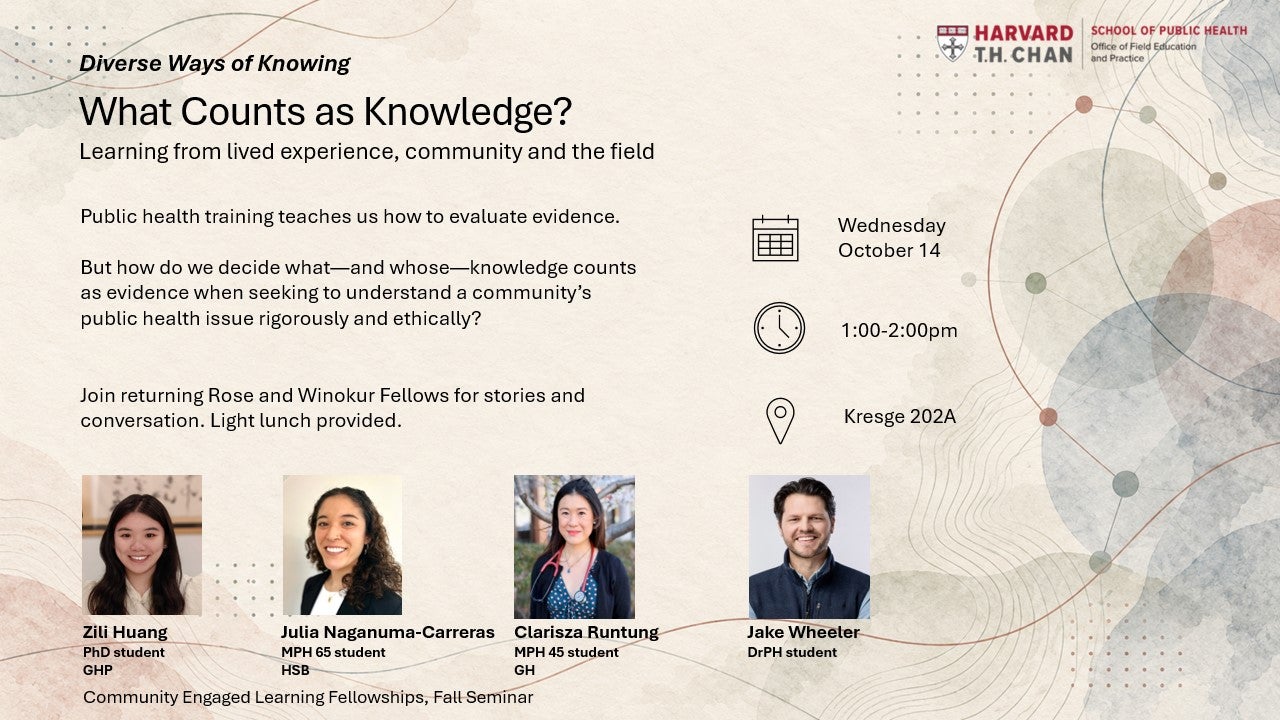
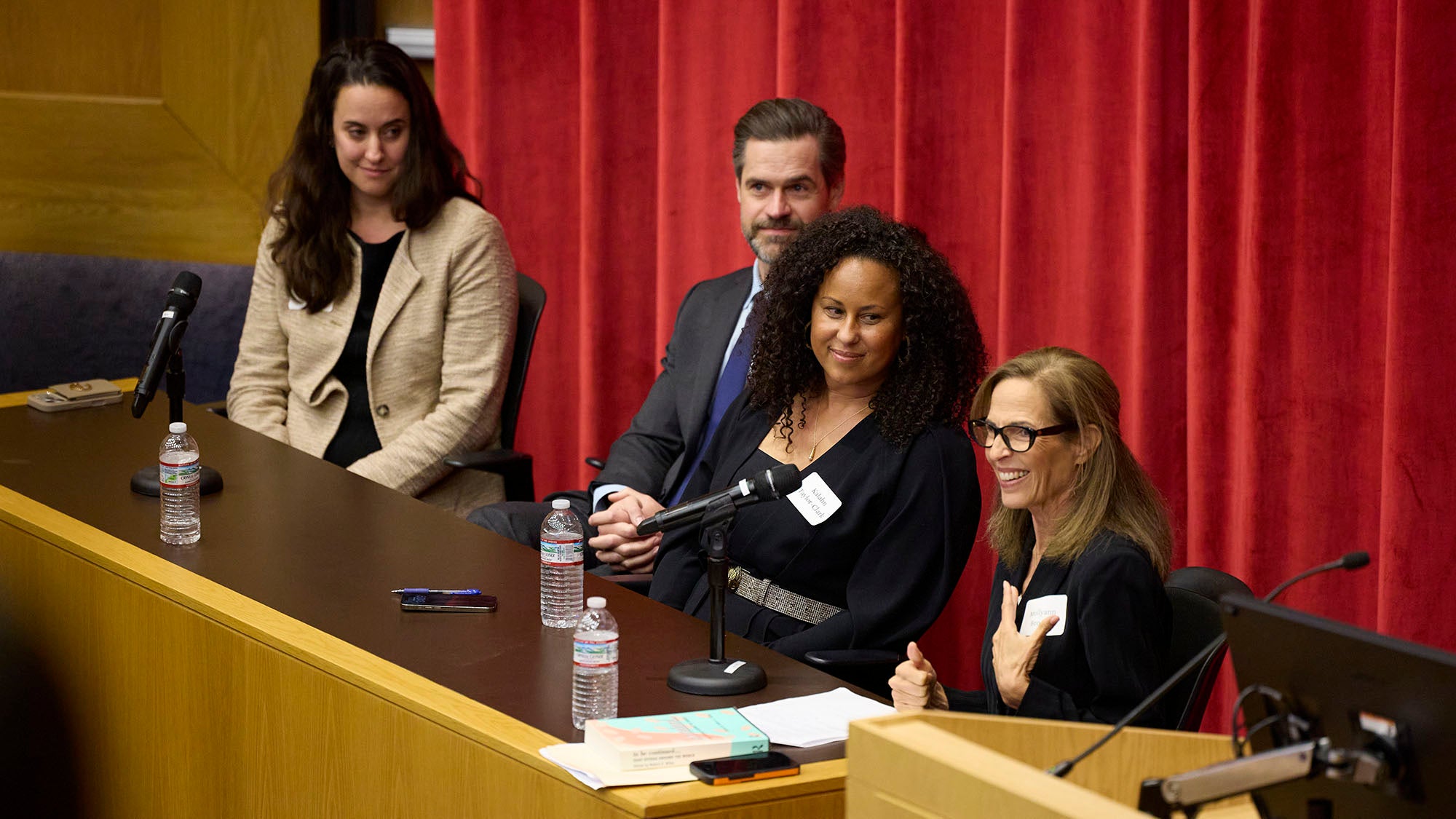
On October 14, the Community Engaged Learning Fellowships program convened the Harvard Chan community to explore how we decide what—and whose—knowledge counts when seeking to understand a public health issue more rigorously and ethically.
Returning Rose and Winokur Fellows Julia Naganuma-Carreras, Zili Huang, Jake Wheeler, and Clarisza Runtung shared stories of their community-engaged experiences from Chile, Central Java, and Mississippi. Participants then reflected on the forms of knowledge that exist outside academic settings, what their own training may lead them to overlook, and how different ways of knowing might be engaged in public health research and practice.
What we heard:
- 1. Knowledge is lived, embodied, and carried
- Participants recognized lived experience as expertise and extended the conversation to embodied knowledge. Knowledge does not reside only in the mind or in academic texts. People carry it in their bodies, memories, relationships, narratives, and everyday practices. It develops over a lifetime through experiences such as migration, caregiving, illness, work, cultural practice, and community life.
- This raises a question about authority: Why does knowledge that people already possess often become valued only after an institution documents, translates, or credentials it?
- 2. Knowledge takes many forms
- Participants identified practitioner and frontline expertise, intergenerational learning, social knowledge, traditional healing practices, storytelling, and the knowledge held in community relationships.
- Art was lifted up not simply to communicate research findings, but as a possible origin of knowledge and starting point for inquiry. Art, music, literature, and fashion can reveal culture, history, experience, meaning, and questions that conventional research approaches may not make visible.
- 3. How we come to know affects what becomes visible
- Language, disciplinary frameworks, and professional categories shape what researchers can hear and recognize. Proximity and immersion can deepen understanding by helping us learn about a community’s history, communication, relationships, and ways of organizing. Yet physical presence alone does not remove bias. Researchers must remain attentive to how their own identities, training, and institutional position affect interpretation.
What now? Begin with proximity, listening, and context
Participants were challenged to reconsider the usual sequence of public health research inquiry. Rather than entering the field with a fully formed problem definition and research framework, we need to create space for engagement to shape the questions and methods from the beginning.
- Enter as a learner. A literature review can tell us what has already been written, but it cannot substitute for listening before we decide which questions to ask. Begin with listening, observation, and relationship-building.
- Learn the context. Engage with community history, art, communication, social relationships, and existing practices.
- Attend to language and interpretation. Ask what words and concepts mean locally rather than assuming that academic categories translate directly.
- Keep frameworks flexible. Allow community knowledge to challenge the original question, method, or definition of success.
- Keep knowledge holders present. Use direct quotations and involve storytellers and community members in interpreting meaning and deciding how their knowledge will be represented, both during and after the phase that we are involved in.
Why this matters for community-engaged learning
Community-engaged learning decenters expertise from academic spaces alone. It asks us to examine how power determines what counts as knowledge and who is authorized to produce it, while refocusing our attention on the wisdom and expertise already present in communities.
This orientation broadens our understanding of the world by bringing different ways of knowing into public health research and practice. It strengthens rigor by revealing context, meaning, relationships, and assumptions that predetermined frameworks may obscure. It supports more ethical and equitable practice by allowing community knowledge to shape how an issue is understood, studied, interpreted, and represented.
Continuing the conversation
As CEL fellowships program continues its yearlong exploration of Diverse Ways of Knowing, we invite you to return to the three questions that guided our conversation:
- What types of knowledge come from non-academic settings?
- What is a form of knowledge that your own training does not count?
- What are practical ways we could include different forms of knowledge in our work?
What are practical ways we could include different forms of knowledge in our work?
Resources for further learning:
- Blog posts: read stories from the field by Rose and Winokur fellows.
- Julia Naganuma-Carreras: Centering Humanity in Public Health: Reflections on Healing, Connection, and Care in Chile
- Zili Huang: On Someone Else’s Terms
- Jake Wheeler: Unloading
- Learn more about Community Engage Learning Program
- Fellowships
- Learning Resources