Recalling health policy giant Bob Blendon
Articulate. Thoughtful. A brilliant intellectual. A humanitarian. A confidence-builder for students. Kind and caring.
That’s how former Harvard T.H. Chan School of Public Health colleagues and students of the late Bob Blendon described him at an event celebrating his life. They also fondly recalled his quirks, from his trademark sweater vests to his love of Diet Coke.
Blendon, Richard L. Menschel Professor of Public Health and professor of health policy and political analysis, emeritus, passed away on June 17. On Oct. 28, a celebration of his life was held in Kresge’s Snyder Auditorium, featuring seven speakers who highlighted Blendon’s intellectual prowess and his unfailing kindness.
“Today, we celebrate a giant in our field and a generous friend,” said Meredith Rosenthal, C. Boyden Gray Professor of Health Economics and Policy and chair of the Department of Health Policy and Management, who moderated the event. Citing a sample of Blendon’s accomplishments, she noted that he spent 35 years with the department, including a decade as its chair; played a key role in the founding of the Harvard PhD Program in Health Policy and its political analysis track; built the Harvard Opinion Research Program (HORP) into a national institution; and created the Harvard Chan Studio and the Menschel Senior Leadership Fellowship program.
“Any one of those accomplishments would be a career’s worth,” she said. “But I don’t think any of those accomplishments really demonstrate Bob’s true superpower—opening doors. Bob had an uncanny eye for talent … in places others didn’t always think to look. First-generation students [and] students from backgrounds still rare in academia found in Bob someone who saw their potential right away. Then he made phone calls, introductions, found funding, and quietly cleared the path. Many of those doors opened without the student ever knowing Bob had been the one to open them.”
Strategic, smart, and quirky
Drew Altman, founding president and CEO of KFF (Kaiser Family Foundation) and executive publisher of KFF Health News, recalled working with Blendon at the Robert Wood Johnson Foundation (RWJF) in the 1980s. He called Blendon “the finest strategic thinker then in the entire foundation world, responsible for almost all of RWJF’s very distinguishing strategies.”
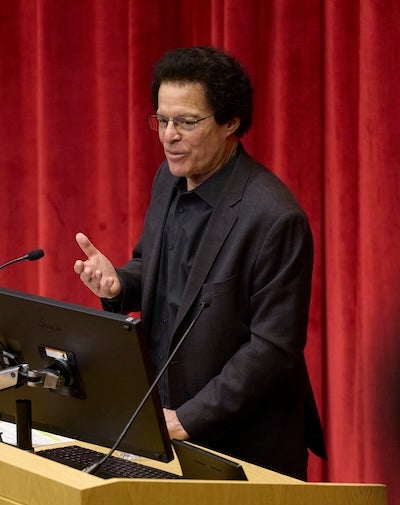
Altman also praised Blendon’s “fundamental contribution to polling.” He said that Blendon, who co-directed polling projects with KFF, was “an unequaled public opinion analyst with a unique talent for looking across multiple polls to see the trends in public opinion and what they meant. … He felt strongly that understanding where the public was could help leaders avoid really big and catastrophic mistakes.”
Altman elicited chuckles from the audience when he dubbed Blendon “the world’s sweater vest supermodel” and recalled his signature tan briefcase, tan Wallabees, “endlessly long raincoat with the even longer belt,” and the small refrigerator where he kept an unlimited supply of Diet Coke.
Clifton Gaus—chair of Power2Patients, co-founder and former CEO of the National Association of Accountable Care Organizations (NAACOS), and former administrator of the Agency for Healthcare Research and Quality (AHRQ)—recalled even earlier experiences with Blendon: They shared a cubicle when they were both doctoral students in health policy at Johns Hopkins University.
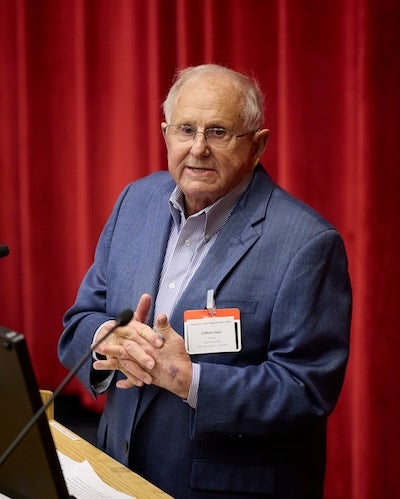
While Gaus and Blendon were working on their dissertations in 1968, they also worked with then-Hopkins medical school dean Dave Rogers on a project to re-evaluate the university’s service to the Baltimore community. As part of that work, they decided to do a survey—“Bob’s very first survey,” Gaus said—to find out where residents of East Baltimore were getting their health care. “You can guess who designed the instrument,” Gaus said. “It wasn’t me.”
The survey found that the nearby residents were not being adequately served by the university. The findings, Gaus said, “contributed immensely to the change in the mission of Hopkins … to create all kinds of programs in the community.”
‘Seeing the brilliance in everyone’
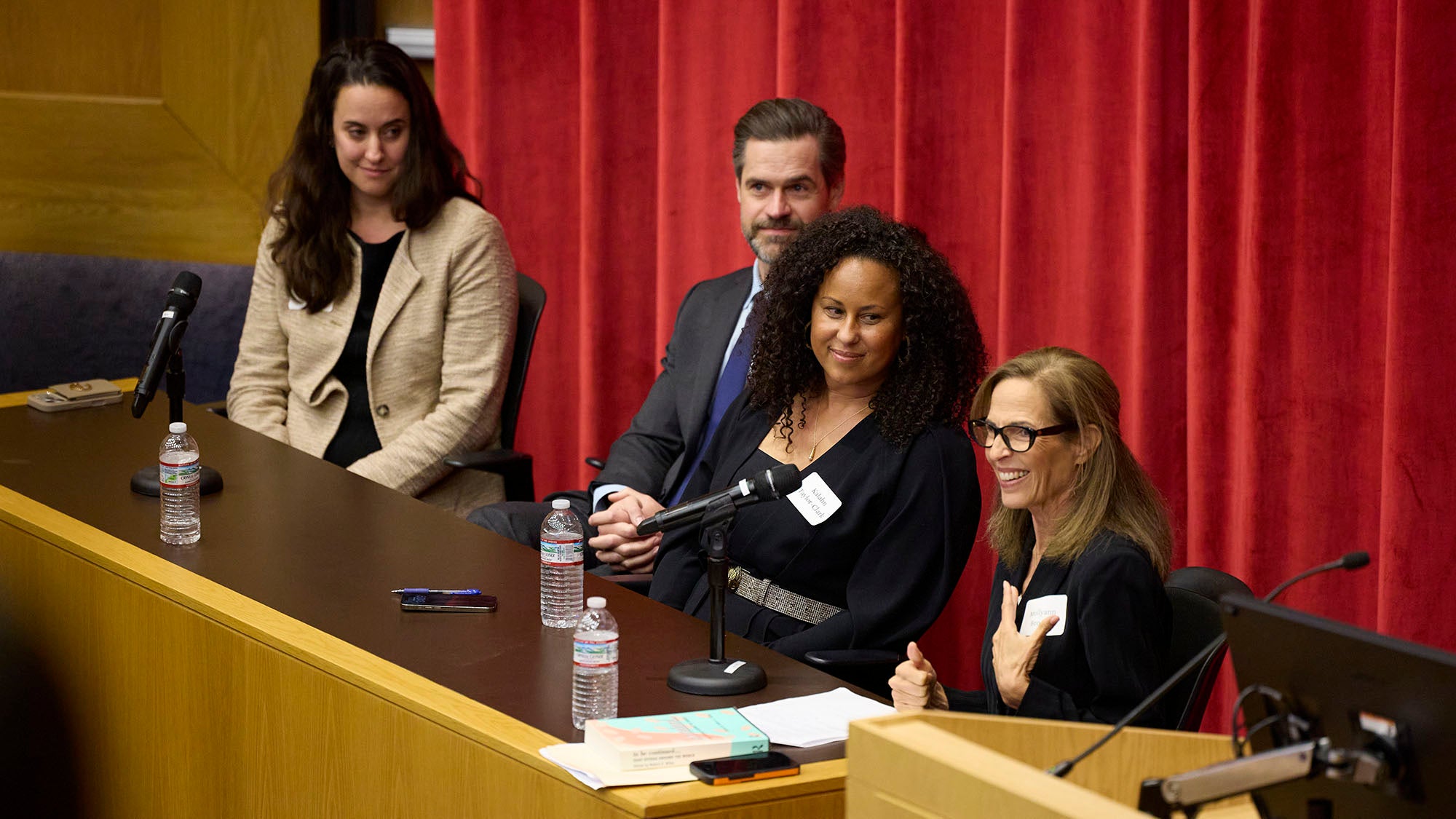
A panel discussion featuring four of Blendon’s former students was moderated by Mollyann Brodie, executive vice president and COO of KFF and executive director of its public opinion and survey research program. Brodie and the panelists all spoke about how Blendon supported them, boosted their confidence, and helped spur their careers.
“Bob really created me,” said Kalahn Taylor-Clark, vice president and head of social impact and sustainability at Merck & Co, who studied under Blendon about two decades ago. “He allowed me to feel like I belonged, which was such an important thing, especially [at that time] … as a Black woman in particular. He had an eye toward seeing the brilliance in everyone and really bringing that out in us.”
John Connolly, temporary commissioner and state Medicaid director of the Minnesota Department of Human Services, said, “Bob gave me the roadmap for being the best type of public servant. He taught me that it’s important to focus first on human impact … that it’s our job to be communicative with the public but also responsive … understanding what their priorities are, their anxieties, their worries, their hopes. Also, no matter what your station and what your title is, to be a human being and be kind in every single interaction, whether it’s at a community clinic in Duluth or leading your executive team or briefing the governor or just at the grocery store.”
“I feel like I owe my career to Bob,” said Adrianna McIntyre, assistant professor of health policy and politics at Harvard Chan School. “One of the things I hear from colleagues is ‘I’m so glad Bob took a bet on me’—but I don’t think of Bob as a gambling type. I think he found a way to help us see in ourselves why he chose us. … I think he found a way to help us find our confidence in our place in this world.”
Brodie said that she and Blendon had scheduled a call for the Friday when he was hospitalized. “I was going to tell him the news that … the board of trustees of KFF had made the decision to appoint me as the next president of KFF, following in Drew’s footsteps when he steps down in January,” she said. “I never got to tell Bob that. And I think he would be so proud and so happy and so thrilled for me—and also thrilled for Drew, for what they were able to build together.”
‘Magical impact’
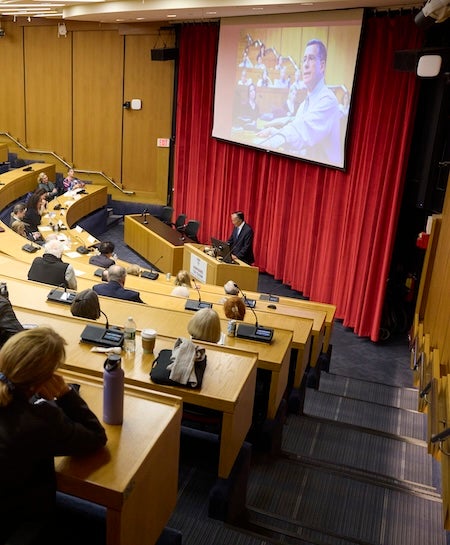
Howard Koh, Harvey V. Fineberg Professor of the Practice of Public Health Leadership, had an office next to Blendon’s for many years. In closing remarks, he spoke about their deep friendship and their hundreds of discussions about public health and politics. “We bonded so instantly because we both knew that public health could only be understood by first understanding its politics—with the term politics being defined as the art of the possible,” Koh said.
Koh said that he had “a front row seat to witnessing [Bob’s] magical impact on literally everyone he met. An unending stream of policymakers, government officials, media leaders, faculty, students, among others, came by to pay their respects.” Whenever Blendon hosted a meeting, “volcanic peals of laughter would erupt from his office,” said Koh.
“I found that despite all the ongoing threats to public health, year in and year out, Bob could mobilize, catalyze, and galvanize us all to dream together better in ways that were both glorious and hilarious, punctuated … by Bob’s trademark wit, wisdom, and humor,” said Koh. “His team enjoyed a camaraderie in those meetings that was joyous and palpable. We called it Camelot.”
Photos: Kent Dayton / Harvard Chan School