DrPH student uses storytelling, art to improve health
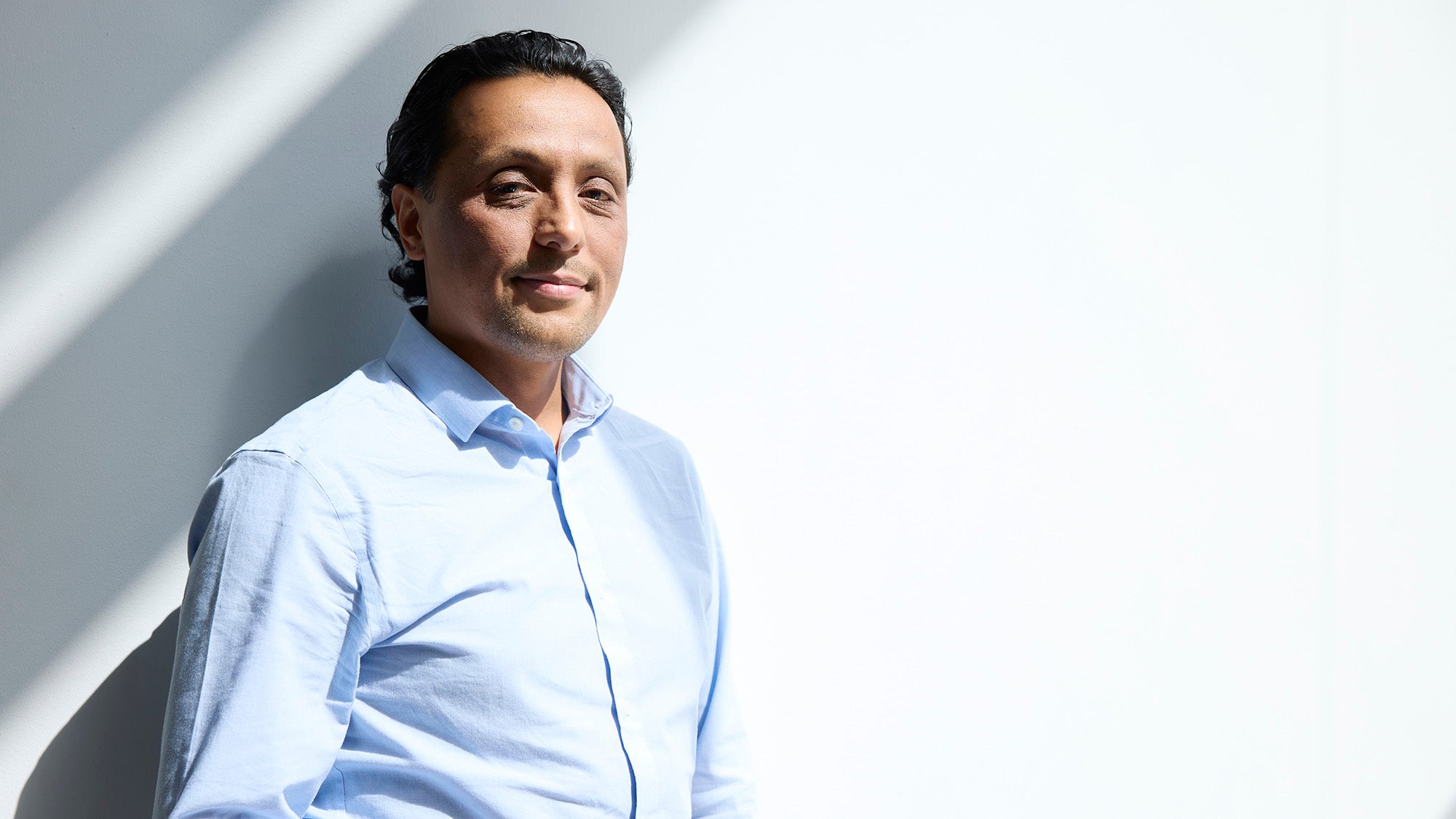
Germán Chiriboga’s interest in health started early.
As a young person in Ecuador, he got sick a lot. But his bouts of ill health sparked his curiosity. He wanted to know what made people feel good or bad. When he and his siblings got measles vaccines, he wanted to know how they worked. “My curiosity about how our bodies stay healthy activated my imagination,” he said.
Chiriboga created a lot of art as a child. It was an outlet for his emotions, an antidote to a cultural landscape that frowned on people expressing their feelings, especially boys—and he had, he said, “plenty of feelings.” His emotions about health worked their way in to his art. “Sometimes I used art to envision myself being strong or healthy, especially during times when I was not feeling well,” he said.
These days, Chiriboga still creates art. Now he uses it to promote health. He’s also found another strategy—using the stories people tell about their own lived experiences—to further the same goal.
As a program director in the population and quantitative health sciences department at UMass Chan Medical School in Worcester, Mass., he helps design and evaluate research that tests storytelling interventions, tailored to the cultures of underserved groups, that aim to improve their health. In addition, he’s a multimedia artist who has created works to increase understanding of public health issues.
Chiriboga used to joke around with his siblings and friends about going to Harvard, but “that was always this very distant, impossible kind of idea,” he said. But now, decades later, the dream is real: He’s a student in Harvard T.H. Chan School of Public Health’s Doctor of Public Health (DrPH) program, slated to graduate in May 2027. He hopes his degree will advance his leadership and research skills so that he can contribute to improving health equity for vulnerable populations.
How social determinants impact health
Chiriboga initially thought he’d become a doctor. He started medical school right after finishing high school in Ecuador (a bachelor’s degree isn’t required) but he soon became disillusioned with the culture surrounding physicians. “I started calling it ‘eminence-based medicine’ instead of ‘evidence-based medicine,’ because there was a lot of ego,” he said. He wound up transferring to Worcester State University, where he studied biology and psychology.
While in college he worked part-time as a medical interpreter for the University of Massachusetts Memorial Medical Center. In that role, listening to people’s stories, he began to see how factors other than biology—like poverty, lack of education, lack of adequate housing, or language issues—could impact health. For instance, in working with Spanish speakers, he realized that how medications are labeled could actually be dangerous for them. “Take the expression ‘once a day’,” he said. “The spelling O-N-C-E in Spanish means eleven.”
He also saw that some patients would defer to doctors and not ask many questions, likely because of cultural practices among people from Latin American countries to not appear disrespectful to people considered knowledgeable and powerful. He felt that these conversations would be more productive if people shared their experiences more fully and had a real give-and-take with their doctor. The imbalance, and the implications for patients’ health, troubled him.
He wanted to know more about the disconnect between what people expressed directly and what they left unsaid in talking about their health. He eventually decided to pursue a master of public health at the University of Massachusetts Amherst to train in qualitative research and to learn more about health disparities.
Why storytelling is important
Over the course of a 15-year career at UMass Chan Medical, Chiriboga has worked closely with Jeroan Allison, professor and chair of the population and quantitative health sciences department, on a number of studies that have shown the importance of considering people’s narratives when it comes to improving health.
In one study, for example, Chiriboga and colleagues examined why pregnant Hispanic women in the San Diego area were missing doctor’s appointments. The study was funded by an insurance company that wanted to find out why the women were being “noncompliant.”
Through listening to the women’s stories, the researchers learned that they had been having difficulty scheduling appointments at the local clinic. “But they were so concerned about their own health and the health of their babies that they’d cross the border to Tijuana and pay out of pocket for checkups with doctors there,” he said.
The women were actually doing what they were supposed to—paying attention to their health and the health of their unborn children—”but in a way that the insurers’ data had not been capturing,” Chiriboga said.
For another project, Chiriboga and colleagues looked at whether using a storytelling intervention could help lower hypertension rates among a group of adults from four rural communities in Vietnam. In a randomized study, the researchers found that, among patients in the intervention group—who were shown videos featuring others in their communities talking about their experiences managing hypertension—blood pressure levels dropped.
The study suggested, Chiriboga said, that when you’re exposed to the experiences of others, “you seem to be in a better position to start behavior change. We’ve done a series of studies and interventions with this concept and we’ve found that it has high success for other chronic diseases.” He added, “People seem to digest information better when it comes from someone they can identify with.”
Art that educates, heals
Art is another form of storytelling that Chiriboga has used to help address public health issues.
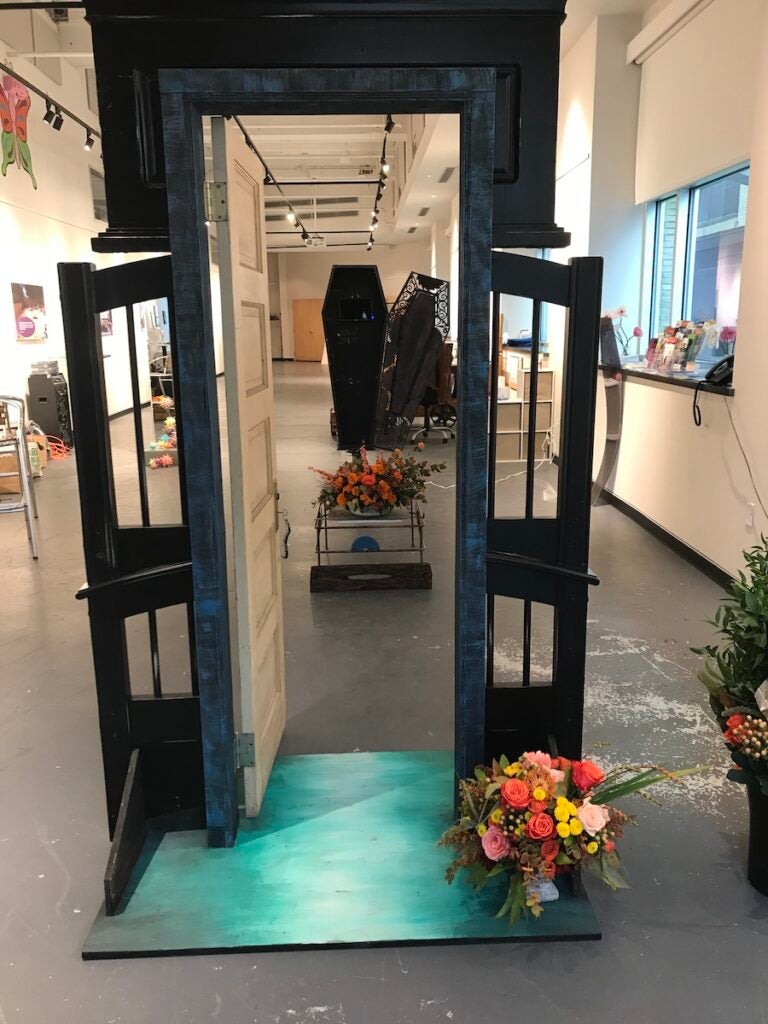
During the pandemic, for instance, he and his art partner José Criollo created a COVID-themed multimedia installation, funded by a grant from a Worcester nonprofit. The installation, which was displayed during the Casita Cultura Latina celebrations of Día de Los Muertos in Worcester, Mass. in 2021, aimed to prompt discussion about the disproportionate impact of COVID on Latinos. It included three sections. In one section, a door fashioned from a bed frame paid homage to those who were convalescent and isolated during the pandemic. A second section honored the memory of a Worcester man who died during the pandemic with an altar, similar to the type of altar used in Mexican Day of the Dead celebrations. A third section featured a coffin with a mirror that gave viewers the perspective of a person lost to the pandemic. On some days a vaccination booth offering COVID shots was set up just beyond the installation.
In another health-themed artwork, Chiriboga and Criollo fashioned a metallic piece called Paz, featuring a dove wrapped in red maple leaves. The work, unveiled in May 2025 in Worcester’s Peace Park, aims to help transform a neglected space, which had seen past violent incidents, into a peaceful spot for art and reflection. In creating Paz, Chiriboga and Criollo explored public health research on how the built environment can affect health. “There’s increasing evidence that creating beautiful spaces for people can actually have an impact on things like violence reduction and stress reduction,” Chiriboga said. “We’re hoping that this piece has that kind of impact.”
The value of human connections
As he enters his final year of the three-year DrPH program, Chiriboga admits that the first two years—juggling family, in-person classes, and work—was tough. “I had to commute an hour or so each way,” he recalled. “I’d wake up early, cook for the kids, drop them off at school and race to get to on the road and to class. There were long days and I was tired. After the first year I remember telling Rick [Siegrist, director of the DrPH program] that I felt like I was stretching myself too thin. But eventually I got into a groove.”
It helped that Chiriboga has had people cheering him on: his father, who was so proud of him that he printed out a copy of Chiriboga’s Harvard ID and keeps it in his wallet; his wife and two kids; and his boss at UMass Chan Medical, who has given him plenty of flexibility. “All the support fed my soul,” he said.
A summer immersion experience at the Costa Rica-based Health Equity Network of the Americas, where he helped support research projects to boost migrant health, has been a highlight of the program. He’ll build on that work for his doctoral thesis, which will explore the experiences of pregnant migrants in Costa Rica as they navigate health systems, and use their stories to inform changes in health-system practices and policies.
Chiriboga says the DrPH program has helped him see the importance of both technical know-how in public health as well as human connections. “Connecting at a human level with your teams and the communities you serve has as much value—and sometimes more—than keeping up with the latest frameworks, data analysis methods, or whatever AI has to offer,” he said. “Cultivating and maintaining your humanity and the humanity of others is a very difficult but crucial part of the job.”