Strategies for improving women’s health explored at student-led summit
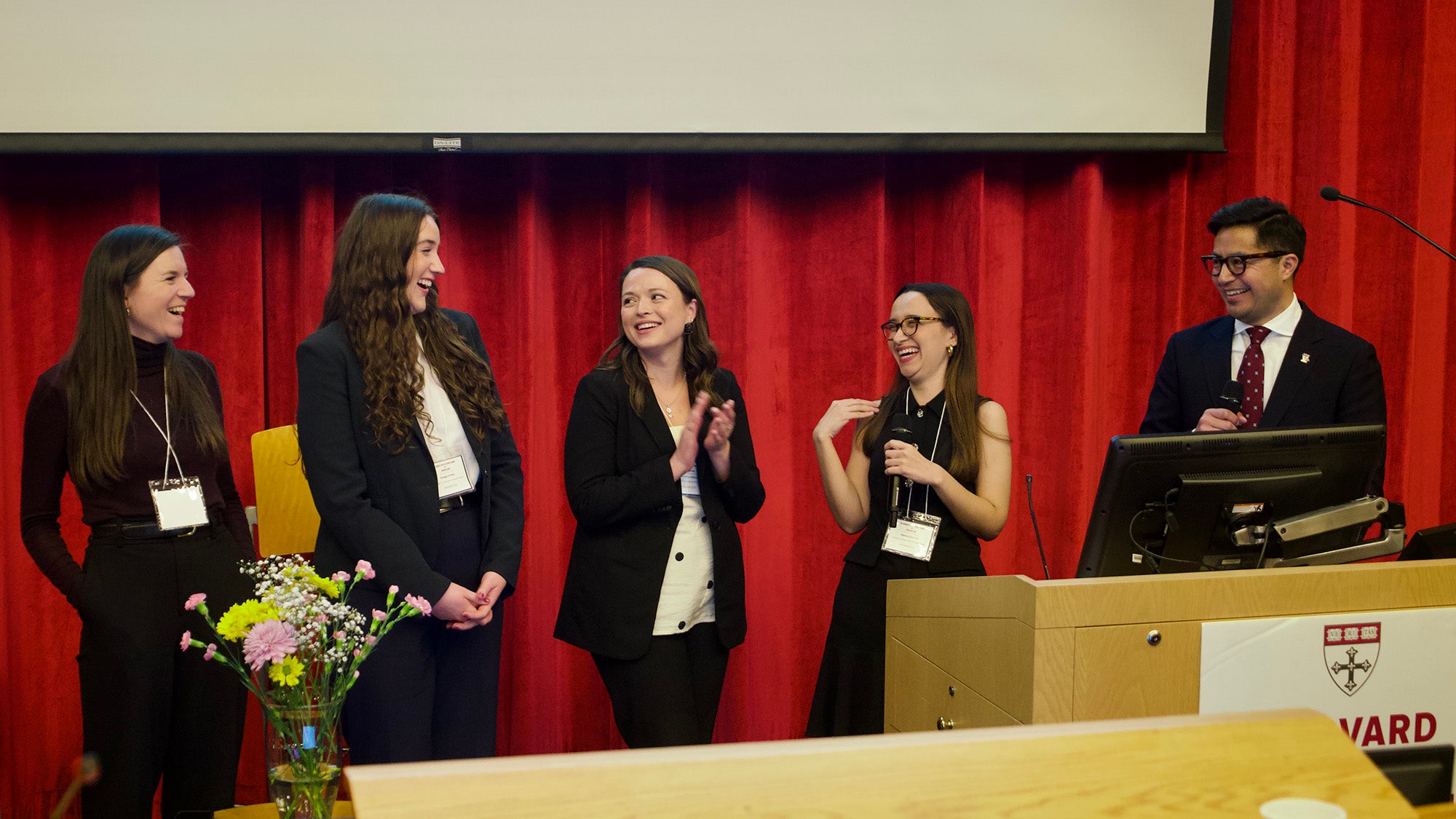
The first Women’s Health Student Summit at Harvard T.H. Chan School of Public Health brought together researchers, clinicians, advocates, and policy experts for a day of discussions and networking. A key theme heard throughout the event, held May 9 in Kresge G1, was the need for a new approach to the way women’s health is studied and clinically practiced—one that ensures that the focus is not just on reproductive health but encompasses the wider range of health concerns affecting women across different life stages.
The event was organized in conjunction with the Office for Student Affairs and the Harvard Chan Student Government Association and led by a team of students: co-chairs Betzael Bravo, MPH ’26, and Aracely Guzman, MPH ’26, and Lyndsey Garrett, MPH ’27, Christina Nielsen, MPH ’27, Bridget O’Kelly, MPH ’27, Jill Siedman, DrPH ’27, Rachel Sulla, MPH ’26, and Robin Vergouwen, MPH ’26.
“Women spend years navigating systems that often fail to recognize how conditions affect them differently, uniquely, or disproportionately. And yet, our responses remain fragmented,” Guzman, a physician from Mexico, said in her opening remarks. “We separate maternal health from chronic diseases. We separate sexual and public health from mental health. We separate clinical care from the social realities that shape health in the first place. But women do not experience life inside silos, and their health should not be siloed either.”
The summit featured panels organized around the event’s five pillars: research, medical education, policy, delivery, and communications. Business leaders joined researchers, advocates, and other experts as panelists. In addition, Dame Lesley Regan, England’s first Women’s Health Ambassador, gave a keynote address on her work spearheading her government’s Women’s Health Strategy. Additional sessions covered menopause and the power of prevention.
Speakers on a panel about neglected areas in women’s health noted multiple barriers to improvement such as inadequate training for surgical residents on uterine fibroids and endometriosis, and cultural taboos around discussing women’s health.
Another barrier is lack of data, said Jorge Chavarro, dean for academic affairs and professor of nutrition and epidemiology at Harvard Chan School. Chavarro is principal investigator on the Nurses’ Health Study 3, the third cohort in a long-running investigation of risk factors for major chronic diseases in women. “It is very difficult to make policy decisions and understand consequences of something that hasn’t been measured,” he said, citing infertility and menopause as two examples. Chavarro also noted that the National Institutes of Health doesn’t allocate much grant funding for women’s health issues other than cancer.

While women largely still trust their doctors for health information, they increasingly rely on social media creators, especially those with lived experiences who can provide a sense of solidarity, said Amanda Yarnell, senior director of the Center for Health Communication, in the summit’s closing discussion. She noted that in the U.S., half of adults get health information from social media and that number is higher for younger women and women of color. Yarnell said that she launched a creator program at the School to help foster the sharing of evidence-based health content online.
Other Harvard Chan School panelists included Margaret McConnell, Katherine Semrau, Lia Tadesse Gebremedhin, Alicia Yamin, and Winnie Yip.
The summit’s student organizers plan to release a report over the summer including key insights and recommendations from the speakers. They said that the event sparked meaningful conversations at the School and online, with numerous individuals sharing personal stories about their struggles with disease and health system frustrations. The summit will return next spring, they said.