Guidelines for Laboratory Design: Health and Safety Considerations

Program Overview
Date: June 7–11, 2027
Location: Harvard T.H. Chan School of Public Health in Boston, MA
Certificate of Specialization eligibility:
Best Practices in Laboratory Design for Health, Safety & Sustainability
Laboratory design and construction, regardless of its use, involves many stakeholders. While providing a safe environment for laboratory users to perform their work is imperative, competing stakeholders’ needs often cause health and safety considerations to be overlooked.
Participating in Guidelines for Laboratory Design: Health and Safety Considerations will help you address this issue by providing you with an understanding of how lab design options impact the health and safety of laboratory users and the environment. With this knowledge, you will be able to incorporate the needs of all stakeholders and ensure your labs are safe, free of health hazards, and promote a healthier environment.
Participants in this program will explore and address health and safety considerations for diverse laboratory types and gain the skills they need to create a safe laboratory environment. This program covers general laboratory design challenges, as well as issues specific to chemistry, microelectronics clean room, engineering, animal, biosafety, clinical, and sustainable laboratories. Participants also address issues with new laboratory construction, renovation, and decommissioning.
This course provides a unique opportunity for architects, EHS professionals, engineers, lab users, and lab managers to collaborate on laboratory design.
Program Details
Learn practical and cost-effective solutions to renovation and reconstruction issues including:
- Green design and construction
- Decontamination of an existing facility
- Special health and safety precautions in partially occupied buildings undergoing renovation
- Adding energy conservation features
- Case studies of successful reconstructions and details of decisions not to reconstruct will also be presented
- Laboratory ventilation including fume hoods and other exhaust requirements
- Safety design features include fire protection, electrical systems, emergency equipment and controls, and chemical storage
Architects will be able to:
- Valuate laboratory design options related to health, safety, and environmental considerations using risk assessment and cost-effectiveness parameters
- Apply appropriate design information for laboratory types used in industry, academia, and hospitals
- Demonstrate familiarity with mechanical systems vital to state-of-the-art laboratory functions
- Understand the primary principles of safety, health, and environmental responsibilities and the impact of these considerations on the planning and sustainable design of laboratory facilities
- Learn details of laboratory systems and planning strategies to reduce risks to occupants of laboratory facilities
- Learn to plan laboratories so that chemical fume hoods and other potentially hazardous processes and equipment perform safely
- Decommission, decontaminate, renovate, and reconstruct old laboratories
Design and facility engineers will be able to:
- Apply laboratory design information regarding heat loads from research equipment, ventilation requirements, optimum air flows, and contamination control through air pressure regulation
- Identify recent developments in the design of HVAC systems for laboratories, including variable air volume (VAV) systems, high-performance hoods, air exchange rates, ductless hoods, recirculation of air, and the application of energy conservation measures
- Become familiar with computational fluid dynamics (CFD) analysis to improve the performance of chemical fume hoods
- Incorporate into practice important information about the design of hazardous waste-handling facilities, safety shower and eyewash stations, and research support facilities
Occupational health and safety professionals will be able to:
- Complete structures that are safe and free of health hazards by consulting ( instead of consulting maybe use “ partner” or collaborate” ) with architects, contractors, owners, and users during program scope definition, design, and construction.
- Identify design features that provide solutions for the unique health and safety hazards associated with laboratories used for different functions
- Become familiar with CFD and how it is used in laboratory design
- Provide detailed specifications regarding laboratory support facilities for hazardous waste storage, packaging, and shipping
- Identify the unique needs of specific types of laboratories such as biosafety, chemistry, microelectronics, animal facilities, and engineering
- Understand the perspectives and constraints of architects and engineers, and the need to communicate with them from the earliest stages of the project through the completion
This program is designed for any professional involved in designing, constructing, renovating, or managing laboratories, including:
- Architects and designers
- Construction managers
- Environment, health, and safety professionals
- Facilities managers
- Laboratory managers
- Laboratory planners
- Project managers
- Scientists, researchers, and other laboratory users
Guided Laboratory Tours
The on-campus program includes two guided tours at leading Boston institutions. This year’s tours will focus on a nanotechnology facility and a newly developed research and teaching laboratory, giving participants firsthand exposure to contemporary laboratory design, safety, and operational practices. These experiences enable participants to connect course material directly to their own facilities and projects.
Previous guided tours include clinical laboratories at Brigham and Women’s Hospital, open labs at the MIT Koch Institute, clean rooms at Harvard University, and more.
Program Logistics

Current faculty, subject to change
Jack T. Dennerlein
Adjunct Professor of Ergonomics and Safety
Harvard T.H. Chan School of Public Health
Professor
Northeastern University
Louis J. DiBerardinis
Instructor in Industrial Hygiene
Harvard T.H. Chan School of Public Health
Nicolas Kielbania
Sr. Director
Environmental Health & Safety
Boston Children's Hospital
Michael R. Labosky
Director of Safety and Environmental Programs
Massachusetts Institute of Technology
Thomas C. Smith
President & CEO
3Flow
Adrian Oliver Walters
Principal, Science and Technology Market Leader
SMMA
Uri Yokel
Principal
Louviere, Stratton & Yokel, LLC
This program does not offer continuing education credit.
Take this program to earn a Certificate of Completion, or complete multiple to earn the Environmental Health Certificate of Specialization.
June 2027
Please check back for updated information.
From Our Alumni
“The program will definitely benefit me and my organization in various lab renovations we are doing and in building our new institute which we are processing right now. The program far exceeded my expectations.”
—Samaila Shawulu, Architecture, Design and Construction, Institute of Human Virology Nigeria
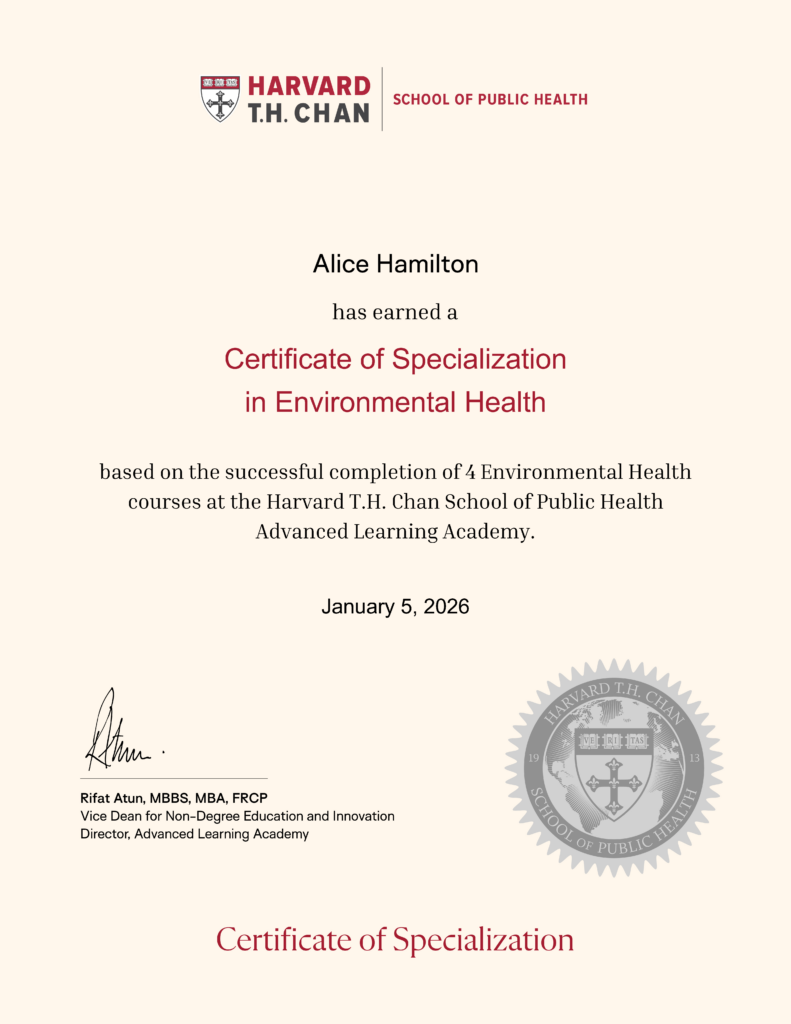
Certificate of Specialization
Earn an Environmental Health Certificate of Specialization
Take this program to earn a Certificate of Completion, or take 3 to earn a Certificate of Specialization. Learn more here.