Why AI Strategy should be about people first

For four years I’ve taught in Harvard Chan Advanced Learning Academy’s AI in Health Care programs. It has become my metronome for AI. Every six months a new cohort of healthcare executives arrives, and our mandate is always the same: teach them what they need to be at the frontier of AI today. That forces us to keep asking where AI actually is.
The answer is never the same twice. Early cohorts learned what generative AI could do. Then came prompting and copilots. This December we teach agentic operations: agents, tool use, oversight and data permissions. Every six months, completely different concepts.
After eight cohorts, three things have become clear about closing the AI skills gap in health care.
1. The real barrier to AI adoption in health care is people, not technology
Any organization can buy the latest AI: models, harnesses, agents and tools can be a procurement decision away. What stands between technology and real impact is people. Getting real value from AI takes three kinds of human change:
- Adoption. Getting people to actually use AI, and use it well, without flooding the organization with AI slop.
- Process redesign. Rebuilding workflows around AI. Without it, value stays at the individual level and gets lost at the organizational one: a clinician documents faster, but if the care pathway and team structure stay the same, the organization captures little of it.
- Work redesign. Further out, rethinking what people do once AI makes them dramatically more productive. That freed-up capacity has to be steered toward higher-value work, which often needs skills the organization doesn’t have yet.
Few organizations are there yet. Deloitte’s 2026 Global Human Capital Trends report found that only 6% of organizations are making meaningful progress in designing how people and AI work together.
Human change, not AI, is the rate-limiting step.
2. AI upskilling is a moving target
AI evolves in months. Humans change, and organizations design change initiatives, orders of magnitude more slowly.
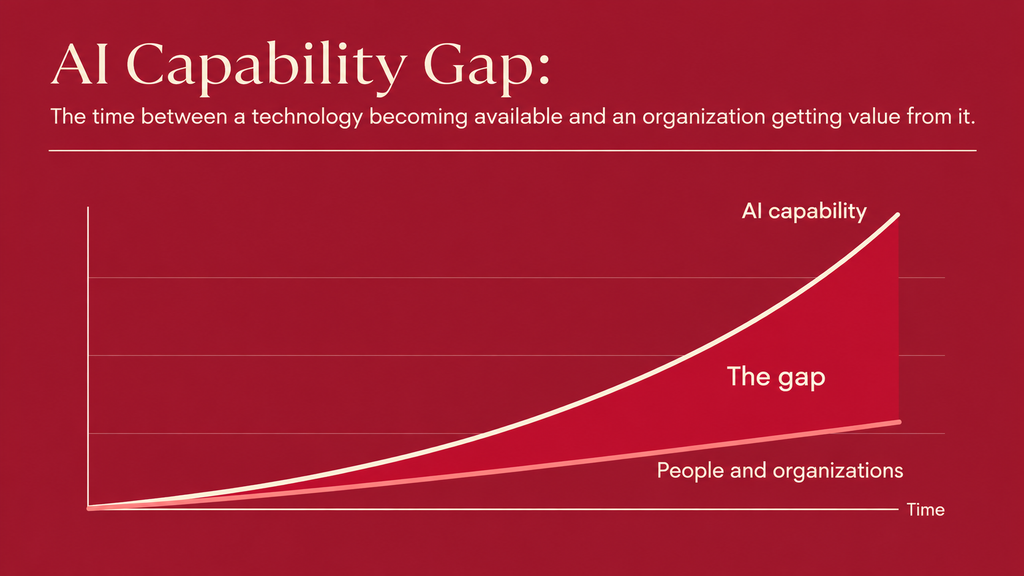
That creates two challenges. First, organizations have to be able to react to change much faster; more on that in point 3. Second, even a fast upskilling effort only brings your people up to where the technology was at one point in time. By the time a program lands, the goalpost has moved. I see it every six months at Harvard, and every organization faces the same moving target. That’s why learning can’t be a one-off intervention and has to be a continuous process.
Most organizations still treat it as one. In DataCamp’s 2026 survey of 500+ enterprise leaders, 82% offer some kind of AI training, but only 35% report a mature, organization-wide AI upskilling program.
3. From training to capability building
Closing the gap between how fast AI evolves and how fast people and organizations adapt is a capability problem. And capability doesn’t come from information alone. Information and education are not the same thing: anyone can share a link to an AI tutorial, but building capability means changing how people work.
That is the job of learning and development (L&D), the function that owns upskilling inside organizations. L&D professionals understand how adults learn, and a well-functioning L&D team excels at what the field calls the ADDIE process: analyze the operational or clinical problem, design a solution (usually some form of training), develop it, implement it, and evaluate whether it worked. Done properly, most of the value sits in analysis and design: understanding the challenge and designing for real behavior change, not just distributing content.
But too often, two things hold them back. The first is positioning: L&D is seen as a support function that builds courses on request, rather than a strategic driver of organizational impact. The second is tools. The core L&D system, the learning management system (LMS), was built to distribute content. It’s a glorified video player. It doesn’t help design learning that drives impact at scale, and it can’t measure whether learning changed anything that matters.
That’s why organizations need to move from training to capability building. Training delivers content; capability building starts from a real organizational problem and ends with people performing differently. To get there, leaders have to turn L&D into a strategic, value-creating function that:
- Starts from operational and service problems, not training requests
- Partners with transformation leaders driving AI adoption to redesign workflows and roles, not just teach tools
- Cuts time to capability from months to weeks, with tools built for capability building at the speed of AI
- Runs capability building as a continuous process, not a series of one-off programs
The healthcare organizations that win with AI won’t be the ones with the best tools. They’ll be the ones whose people and teams change as fast as the tools do.
Join the next cohort
Innovation with AI in Health Care: Agentic Operations runs live online December 7-15, 2026, for leaders closing the AI skills gap in health care. No coding required. Every six months the metronome ticks again; the question is whether your organization keeps time.
Gianluca Mauro is faculty in the program. He is the founder of AI Academy, which delivers AI adoption services to enterprises, and of Epiphany, the platform that helps L&D teams build capability at the speed of AI.
AI is a fast-moving field. This explanation reflects our class discussions and related material at the time of writing. Terminology, capabilities and tools may change.
I reviewed this on publication. If you have any suggested additions or corrections, please email me at tpanch@hsph.harvard.edu.
Dr. Trishan Panch
Program Director, AI in Health Care
Harvard T.H. Chan School of Public Health — Advanced Learning Academy