What is marketing? A guide for health care leaders adopting agentic operations

If you’re a health care leader, a term you’re most likely going to keep coming across is agentic operations, i.e. running parts of an organization’s work through AI agents – software that pursues a goal through actions and feedback – with humans setting the goal and checking the result. Those agents are starting to take on real work inside health care organizations, and most of it is the unglamorous kind that takes friction out of operations and ultimately shows up on the bottom line – assembling a prior authorization packet, for example, or chasing a referral that’s been sitting in the fax queue since Tuesday.
Marketing is on that list of operations to AI-ify too, and it’s the part I know best. I’ve worked in marketing since the early 2010s, and since 2018 almost entirely in mental health care, starting as the first growth hire for the biggest interventional psychiatry chain at the time in North America. Today, agents do a good share of my legwork.
I’d argue marketing is one of the better places to start onboarding agentic operations, because results show up in the data quickly and the work runs in short cycles, so you can change course before much has been spent, but that doesn’t make it risk-free. Marketing mistakes happen in public, and in health care they can carry regulatory and patient consequences, which is exactly why the guardrails matter as much as the tools themselves. These guardrails themselves are a big enough topic that they’ll get their own post later in this series.
Before any of that agentic work is useful, though, it’s worth exploring what marketing actually is. I wrote this for clinical and operational leaders who oversee marketers or sit beside them and have never had a reason to learn the field. It’s part of a series that will culminate in my session and real-world data lab in Innovation with AI in Health Care: Agentic Operations at the Harvard Chan School Advanced Learning Academy.
What is marketing?
Ask most people what marketing is and they’ll almost certainly myopically focus on just advertising: the billboard on the highway, the Facebook Reel, the pop-up that appears just as you’re trying to check out. Advertising is a very important part of marketing, but it’s just the most visible part rather than the whole of it.
My operating definition of marketing is the discipline of shaping an offer that meets a real need and then taking the steps to get the offer in front of the right people in a way they can act on. The American Marketing Association’s formal definition is a little broader – “the activity, set of institutions, and processes for creating, communicating, delivering, and exchanging offerings that have value for customers, clients, partners, and society at large” – but for health care leaders the previous version is usually the more practically useful one.
For example, it might mean noticing that people need help with depression that hasn’t responded to medication, but aren’t searching for a treatment name, because they’ve never heard of it. From there, the marketing angle and respective campaigns, landing pages, etc. pivot from saying “here’s what we do” to “here’s how we can help you” – which marks a material shift in perspective, of which advertising is but one part.
What do marketers actually do?
To oversimplify, the work tends to fall into five jobs that typically run as a loop:
- Research: finding out who needs the offer and how they think about the problem they’re experiencing in their own words.
- Positioning: using the research to decide what’s being offered and why the right person should choose your offering over the alternatives – including doing nothing, which in health care is often the biggest competitor.
- Reaching people: using the positioning to choose the channels and putting the right content in them. This is the advertising step that most people see and overindex on.
- Conversion: making the introduction between patient and clinic organization easy: a phone call, form, you name it. A person who wanted to get in touch with your clinic and couldn’t is the easiest person to help, so it’s usually where I look first. It’s also an easy first job to hand an agent, i.e. flagging any inquiry that’s gone a business day without a reply so a human can follow up.
- Measurement: tallying up what happened, working out what met the goals and feeding that back into the next round of research.
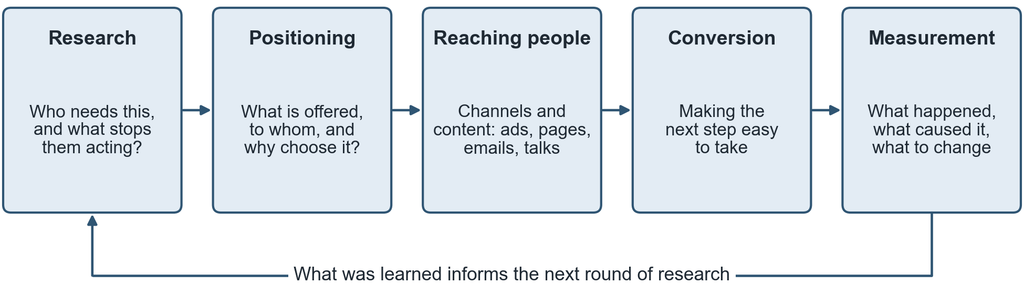
Figure 1. The five jobs of marketing, repeated as a cycle.
Each pass should leave the team a little more informed than the last, though in my experience measurement is the step that gets the least time and budget.
This loop is also where agents have earned their keep in my own work. In the research step, for example, an agent can pull search and competitor data on a schedule and draft what it found for a person to check, which leaves the team’s time for the positioning calls that actually need real judgment.
Note that there’s an absolutely vital step 0 that’s not listed as it’s not a part of the traditional loop because it is only done once per planning cycle: goal-setting. Knowing how many inquiries the business needs to maintain its healthy pipeline gives marketers a north star to aim for in all work, which informs how to allocate financial and work-hour resources.
Marketing channels, simplified
A channel is a route to a person, and marketers usually sort channels by who controls the placement:
- Paid: you buy the placement, as with search ads or social media ads.
- Owned: you control it, as with your website or your email list.
- Earned: someone else chooses to mention you, as with press coverage or a referral from a colleague who trusts your organization and its leaders.
The more useful split for a leader is whether a channel captures demand or creates it, as both are typically required in some ratio that’s unique to both your offering and the market you operate in. Paid search mostly captures demand, i.e. the person already has a question and is looking for an answer, while social media and events mostly create it by getting compelling content in front of people who may not know the solution even exists to search for. There are key risks in overindexing on one side of this dyad: a plan built only on capture eventually runs out of people who are already searching, and a plan built only on creating demand struggles to show results inside a budget cycle, so most healthy programs run both.
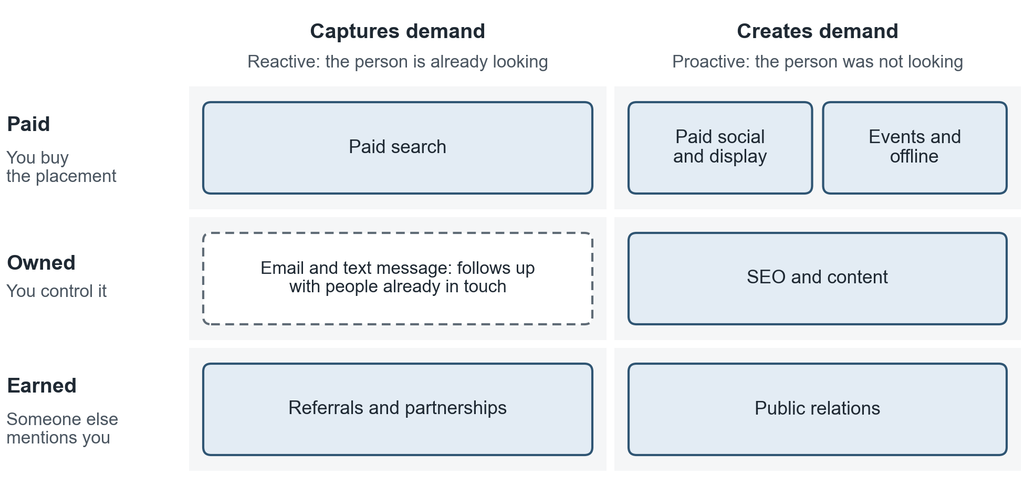
Figure 2. Common marketing channels, by who controls them and the kind of demand they serve. Many channels do more than one job.
Search itself is changing quickly – to get meta about it, you may not have found this very article on Google at all (which a few years ago would have been a shoo-in). Pew Research Center found that people who saw an AI summary on Google clicked a traditional result in 8% of visits, against 15% without one, and a KFF poll in early 2026 found one in three US adults had used AI chatbots for health information. Being cited accurately in these AI overviews and chatbot answers now matters as much as ranking in traditional search results.
How to tell whether marketing is working
Sooner or later, every leadership team inevitably asks marketing some version of the same question: what’s actually driving new patients, and what should we do differently to reach our goals? The main tool for answering these questions is attribution, i.e. a set of rules for deciding which ad or channel gets credit when someone becomes an inquiring patient prospect. It’s one of the most important tools marketing has, because without it you’re allocating budget and work cycles on instinct – which can’t scale an organization.
Even well-built attribution has blind spots, though. Modern attribution is designed to be able to tell you which ad someone clicked last before reaching out, but it may not tell you whether that individual ad is the reason they came, or just the last thing they saw after weeks of reading about the treatment and talking it over with their doctor, family, etc. In one large study, when researchers compared common measurement methods against 15 large randomized experiments at Facebook, the usual methods often got the ad’s effect wrong, and mostly overstated it. So the more weight your decisions put on attribution, the more it matters to know exactly where its blind spots are – which is what the questions below are for.
If you oversee marketing, these are the questions I’d ask first:
- How do we define a qualified inquiry, and who owns that number as a business metric?
- How many qualified inquiries do we need, and over what period to grow at a rate we can actually sustain?
- How do those inquiries get managed, and how reliably do they turn into patients?
- What does a new patient cost us in total, counting people and tools used as well as media spend?
- Have we ever switched a channel off in one market to see what happens?
If nobody has tested that last one, the attribution report is a well-formatted guess – which isn’t a reason to throw it out, but it is a pretty good place to design the next experiment.
None of this goes away when AI agents arrive; if anything it matters more, because an agent will optimize whatever number you point it at. If the definition of a qualified inquiry is fuzzy, it will get very efficient at producing fuzzy inquiries.
Another post in this series looks at building a marketing strategy around the patient’s journey, and I’m excited to cover all this and more in my course with Dr. Trishan Panch: Innovation with AI in Health Care: Agentic Operations, which runs online on December 7, 8, 14 and 15, 2026.
About the author
Alec Sherman leads digital marketing at Lumin Health. In Innovation with AI in Health Care: Agentic Operations, he brings a practitioner’s perspective on using AI agents in patient recruitment and growth operations.
Sources
American Marketing Association. Definitions of Marketing.
Gordon BR, Zettelmeyer F, Bhargava N, Chapsky D. A comparison of approaches to advertising measurement: evidence from big field experiments at Facebook. Marketing Science. 2019;38(2):193–225.
KFF. New KFF Tracking Poll on Health Information and Trust Finds One in Three Adults Have Used AI Chatbots for Health Advice. March 26, 2026. Fielded February 24 to March 2, 2026.
Pew Research Center. Google users are less likely to click on links when an AI summary appears in the results. July 22, 2025.
AI is a fast-moving field. This explanation reflects our class discussions and related material at the time of writing. Terminology, capabilities and tools may change.
I reviewed this on publication. If you have any suggested additions or corrections, please email me at tpanch@hsph.harvard.edu.
Dr. Trishan Panch
Program Director, AI in Health Care
Harvard T.H. Chan School of Public Health — Advanced Learning Academy