Epidemiology instructor brings knowledge, warmth, and enthusiasm to the classroom
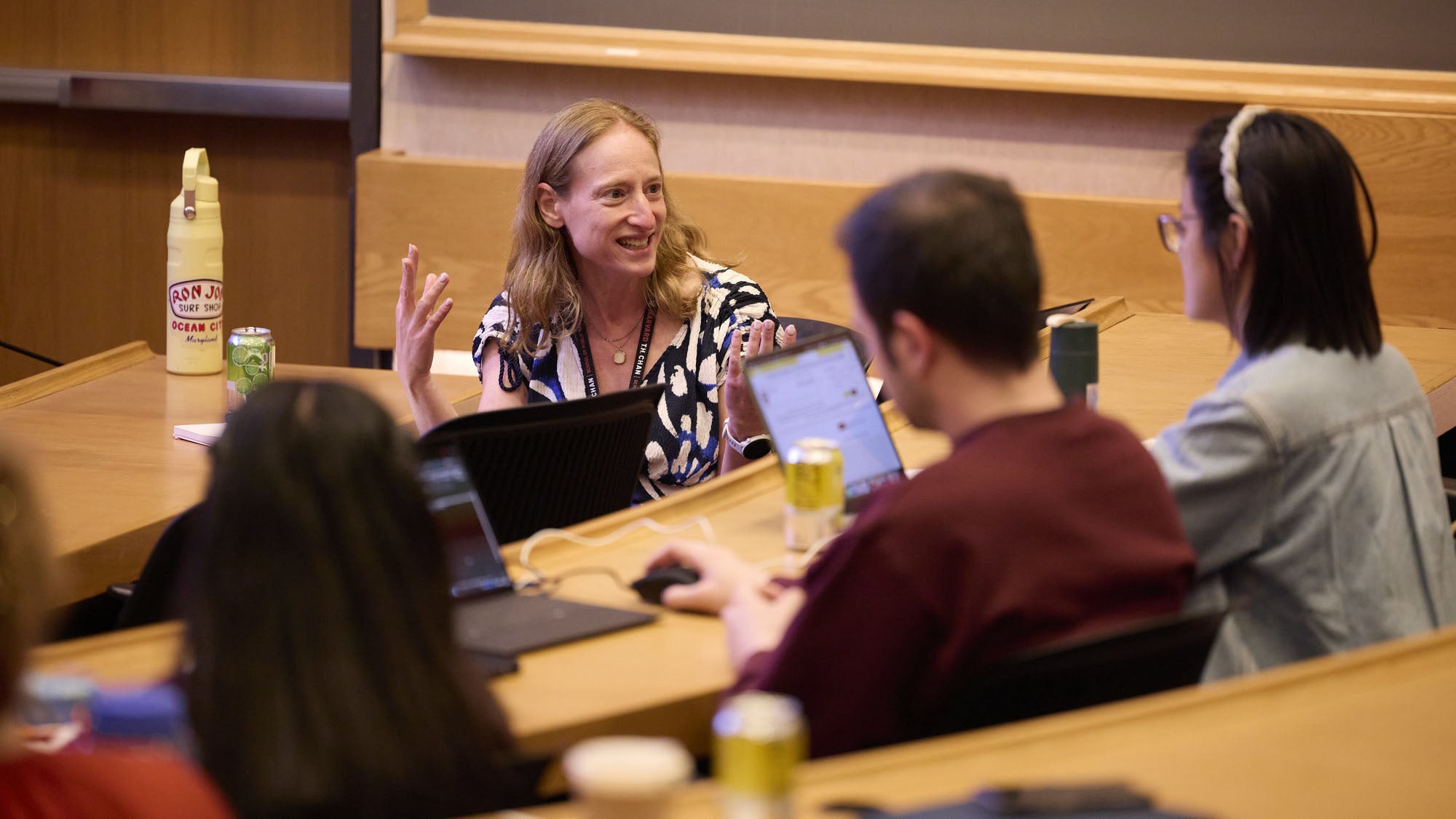
Heather Baer is an associate professor in the Department of Epidemiology at Harvard T.H. Chan School of Public Health. As a researcher, she focuses on the role of modifiable risk factors in chronic disease and strategies for addressing overweight and obesity in primary care. She’s also an award-winning teacher and an educational leader at the School, where she serves as faculty director of the Master of Public Health (MPH) in Epidemiology program and field of study leader for the MPH in Clinical Effectiveness program and teaches courses (both on-campus and online) in epidemiologic methods
Baer recently spoke about why she loves teaching at Harvard Chan School, and what surprises students about the School’s faculty.
Teaching takes a lot of time and effort, but it’s one of the parts of my work I enjoy the most. I like thinking about how to explain something clearly and helping students make sense of a challenging concept.
I’m grateful for the teaching awards I have gotten, and I especially appreciate personal emails and thank-you notes that I receive from students, even many years later. It means a lot to hear that something helped them.
The most rewarding part of teaching is the students I get to work with. They’re thoughtful and kind, and I really appreciate their genuine interest in learning and putting what they learn into practice.
I teach epidemiology, which is about methods. These methods are the tools that we use to design, conduct, and interpret studies of health and disease, including studies of what causes disease and how well different treatments work. The majority of the students I teach in the MPH in Clinical Effectiveness are physicians, and they come from different specialty areas and have very specific research interests. Sometimes, a student will ask a question and start to get into fine details about their work. It’s fun to hear about different clinical contexts. I didn’t go to medical school myself, but I’ve learned a little about a lot of different aspects of medicine from my students, and I try to connect those specific questions back to the methods we’re learning.
Students in the hybrid MPH in Epidemiology program come from a wider range of professional backgrounds. Many are physicians, but others work in the business or tech side of health care or come from a basic science background. Again, the methods are the common denominator. Epidemiology is so logical. You can apply it to any question. It doesn’t have to be a clinical question. It can be a question in your daily life.
The first class that I taught as a faculty member was Introduction to Clinical Epidemiology [Epi 208] in 2009, which I still teach. I had done some teaching as a graduate student at the School, but this was the first time I had to give a lecture in front of 175 students. At the time, I wasn’t much older than many of the students, so that was a bit intimidating. I remember being very nervous, and I totally overprepared. I spent so much time on my slides. But one thing that helped me was to think about the element of teaching that is performance—keeping people engaged. I’d been involved with theater and music in high school and college, so that gave me something familiar to draw on.
It was a lucky situation for me because I was able to start with just a few lectures and build up my confidence. Then gradually, I took on more from the senior faculty involved in the course.
One of them was Fran Cook. He was my very first professor when I started as a master’s student at the School in 1999, and my first epidemiology professor. Later when I became faculty, he was my mentor and colleague. He’s definitely the one I’d say inspired me the most with teaching, and whom I have tried to model myself after.
Fran had so much knowledge about the content he was teaching, and he had a real gift for taking complex concepts and breaking them down into manageable-sized pieces. And he always wanted to make learning fun. He was also so warm and welcoming. Fran is retired now, but I still talk to him and consider him to be a wonderful mentor.
I find that if I’m enthusiastic and excited about what I am teaching, that can be contagious. Even when the material is challenging, that enthusiasm can help students get interested and stay engaged. Another element that I think is very important is to be very organized about the concepts you’re conveying and in how the course is run. And like Fran, I always think about being kind to students. If you’re kind and warm, students feel comfortable asking quetions, and that helps them learn.
I try to keep things interactive in class. For example, we use software called Poll Everywhere that lets you ask questions of your class, and you can see their responses in real time. It’s nice because it forces a pause. If you’re lecturing, you can just keep talking, but I’d rather check in to make sure students are following what I’m saying.
I think students value having accessible faculty. I’ve heard students say that they initially felt intimidated about approaching Harvard faculty. I’m glad when they discover they can ask questions and reach out for help.