A physician scientist’s perspective on changing the name of PCOS to be PMOS
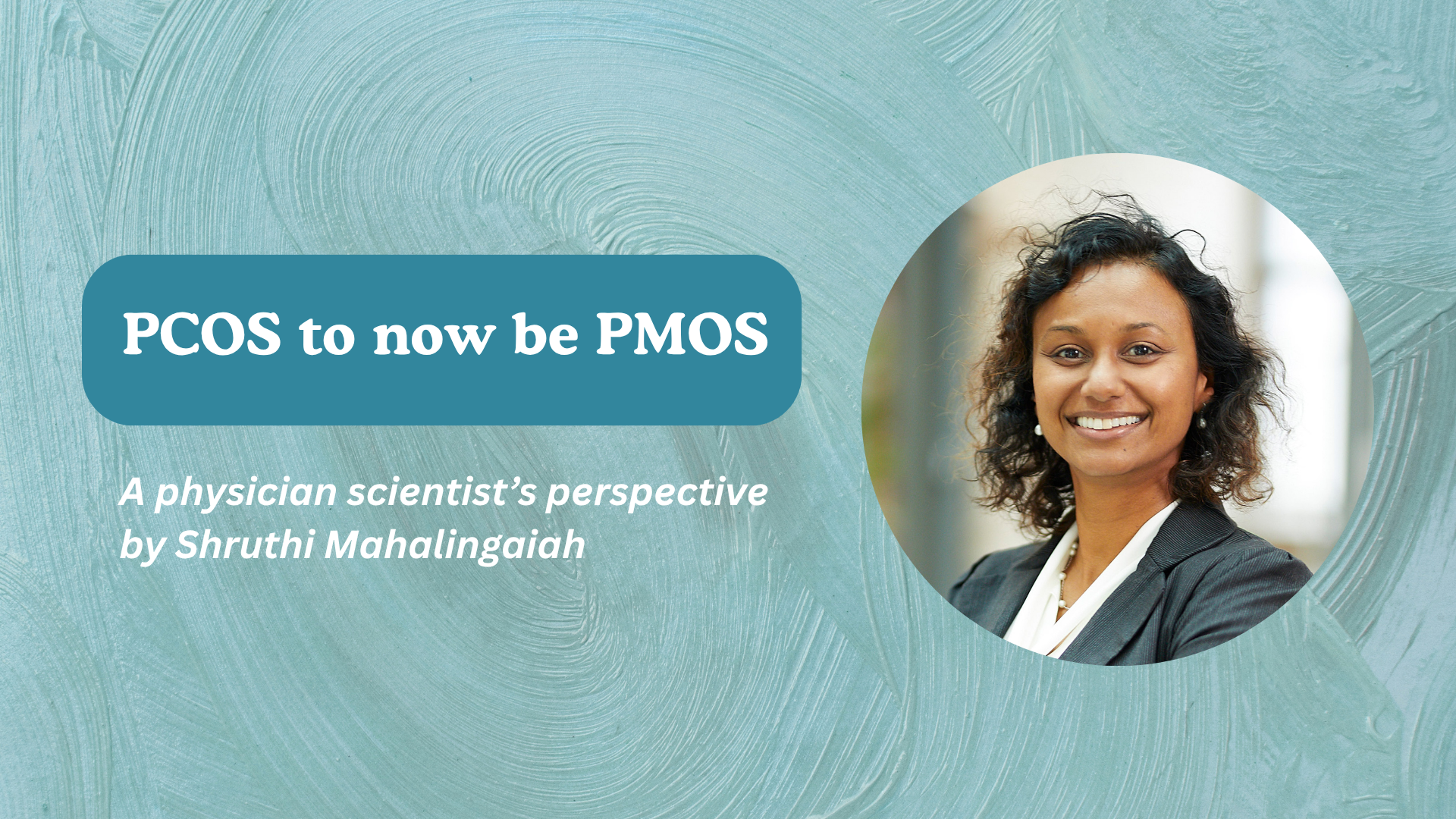
In a new landmark publication in The Lancet, a global effort involving academic, clinical and patient organizations has moved the needle on recognizing the whole-body impacts of Polyendocrine Metabolic Ovarian Syndrome (PMOS) – formerly known as Polycystic Ovary Syndrome (PCOS).
Having the name of a condition reflect the impact it can have on the entire body is important. Anyone who lives with the condition or treats patients with it regularly can tell you: it can be very difficult to live with. It’s not something that just causes infertility, or something that only affects reproductive health (although both of those things can cause their own struggles). Ovulation disorders impact far more than ovulation, and across different life stages, such as menarche1, mid-reproductive2, maternal3, and menopause.
For example, while not all patients will develop additional health issues, many do. Recent research from the Apple Women’s Health Study discovered that having PCOS/PMOS or persistently irregular menstrual cycles) is linked with increased risk for cardiometabolic conditions like heart attack, hypertension, stroke, and diabetes (including gestational diabetes during pregnancy4). Additionally, our team found that, on average, people diagnosed with PCOS/PMOS tend to get conditions like prediabetes and heart disease earlier than those who aren’t diagnosed with the condition. Other recent research has found that the condition is linked with additional mental and physical health outcomes, like depression, anxiety, sleep apnea, and more5.
While the name of the condition has changed to highlight the known underlying whole-body experience, something I want to acknowledge is that the average delay in diagnosis has not changed overnight. In fact, still up to 70% of patients worldwide remain undiagnosed entirely6.
Having this name change can help to highlight how ovulation health relates to other chronic conditions across life stages, like with risks during pregnancy, or during menopause.
The transition to the new name is expected to take over three years, with wide-ranging implications for health-care systems, policy, and research. As a community, we clearly still have work to do, but we can also celebrate the long overdue improved understanding of something that impacts so many people and so deeply.
References
1: R. Mortimer, G. Asokan, D. D. Baird, A. J. Wilcox, K. Abrams, C. L. Curry, J.-P. Onnela, B. A. Coull, R. Hauser, M. A. Williams, Z. Wang and S. Mahalingaiah, “Variability of menstrual cycles by age, polycystic ovary syndrome, and early-life cycle irregularity in the apple Women’s Health Study,” Am J Obstet Gynecol, vol. 234, no. 4, pp. 1042-1069, 2025.
2: A. T. Wolf, Z. Wang, J.-P. Onnela, D. D. Baird, A. M. Z. Jukic, C. L. Curry, T. Fischer-Colbrie, M. A. Williams, R. Hauser, B. A. Coull and S. Mahalingaiah, “Signs of Potential Androgen Excess Across the Lifespan in a US-based Digital Cohort Study,” J Clin Endocrinol Metab, vol. 110, no. 6, pp. 1667-1679, 2025.
3: E. Peebles, M. Mitsunami, B. Zhang, J. Chen, B. A. Coull, T. James-Todd, J. E. Chavarro, J. E. Hart, F. Laden and S. Mahalingaiah, “Preconception, gestation, and childhood exposure to air pollution and risk of polycystic ovary syndrome (PCOS) in a US girls cohort study,” Environ Int, 2025.
4: Z. Wang, D. D. Baird, M. A. Williams, A. M. Z. Jukic, A. J. Wilcox, C. L. Curry, T. Fischer-Colbrie, J.-P. Onnela, R. Hauser, B. A. Coull and S. Mahalingaiah, “Early-life menstrual characteristics and gestational diabetes in a large US cohort,” Paediatr Perinat Epidemiol, vol. 38, no. 8, pp. 654-665, 2024.
5: A. Shukla, L. I. Rasquin and C. Anastasopoulou, “Polyendocrine Metabolic Ovarian Syndrome,” StatPearls [Internet], 2025.
6: World Health Organization, “Polycystic ovary syndrome,” 22 January 2026. [Online]. Available: https://www.who.int/news-room/fact-sheets/detail/polycystic-ovary-syndrome.