India Research Center marks 10 years of public health impact
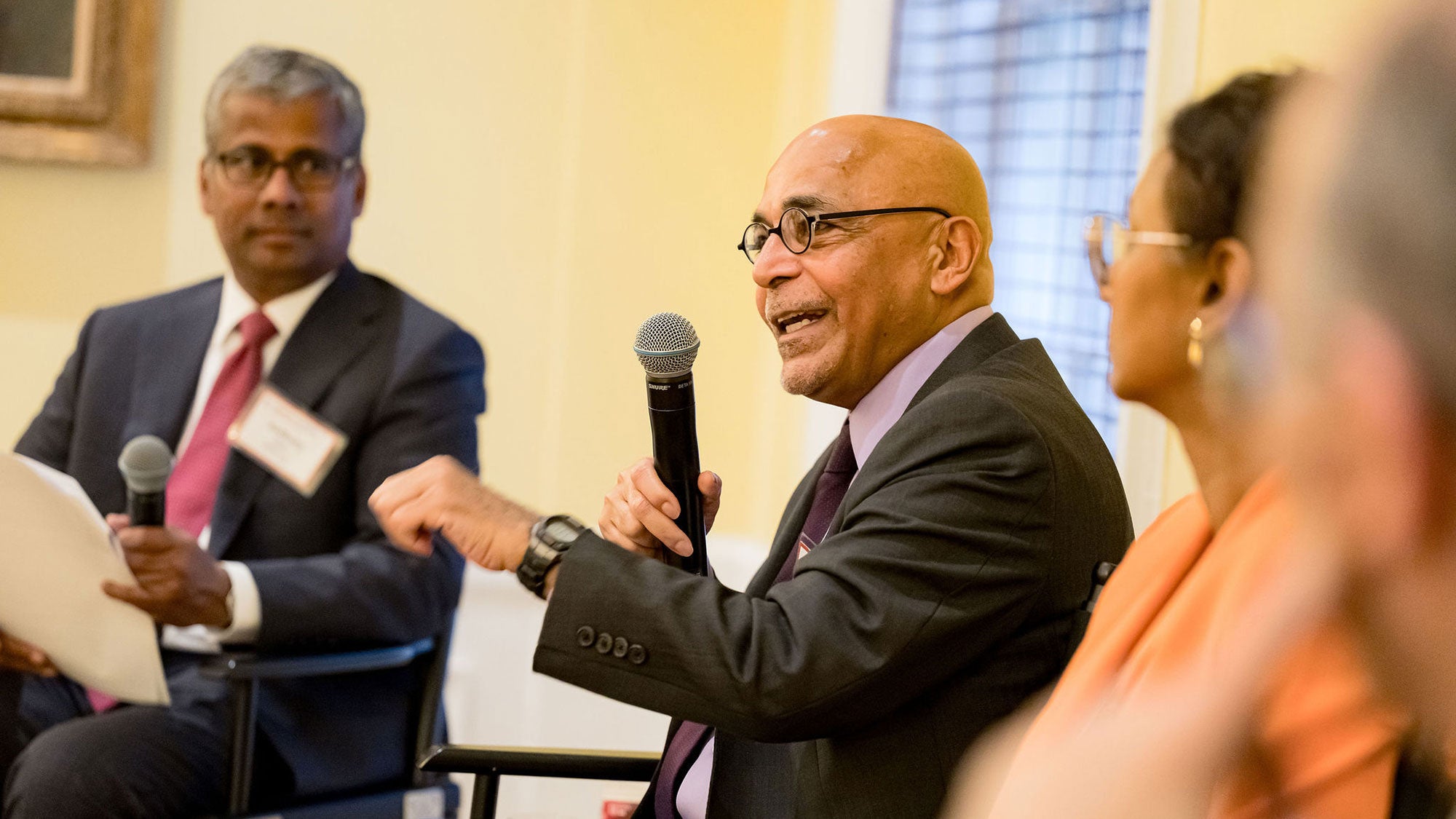
Harvard T.H. Chan School of Public Health’s India Research Center launched in Dec. 2015 as a hub connecting Harvard Chan researchers with partners across India to address some of the world’s most pressing public health challenges. Following recent events in Cambridge and New York marking the Center’s 10th anniversary, Director Vish Viswanath, Lee Kum Kee Professor of Health Communication, reflected on how it has evolved into a platform for research, training, and public health research translation.
Q: How did the India Research Center get started?
A: Harvard Chan School has had a longstanding relationship with India. Individual faculty members have worked for decades researching, collaborating with Indian stakeholders, teaching, and making significant contributions to understanding public health conditions in India. For example, our late former Dean Barry Bloom began his work in India in the ’60s on tuberculosis and played a role in starting the Public Health Foundation of India. And the late Richard Cash did some of his early work on developing Oral Rehydration Therapy [a combination of sugar, salt, and water that proved remarkably effective at rehydrating people suffering from cholera and other diarrheal diseases] in India.
In 2015, the School received a philanthropic gift to fund an effort to build on these connections in an institutionalized way and facilitate faculty and student research in India. Dean Julio Frenk asked me to lead the initiative, and I worked with his successor, Dean David Hunter, to develop the vision—which also came to include public health training opportunities and programs focused on translating research into policy and practice.
From the beginning, we have worked closely with Indian partners in state and federal governments, health ministries, universities, non-profits, and foundations.
Q: Where has the Center focused its research efforts?
A: Our initial focus was infectious diseases, but we have also been paying attention to the country’s increasing chronic disease burden. Some people call India the ‘diabetes capital of the world.’ More than 100 million people have been diagnosed, and more than 100 million people may have prediabetes. Heart disease and tobacco consumption are also major burdens, so we have been funding seed grants in these areas and also holding forums to bring together Harvard Chan researchers and Indian partners around these topics.
Q: How has the Center provided training?
A: We have worked with several Harvard Chan students who’ve had Rose Fellowships and helped find them hosts for their work experiences. For example, Monica Nirmala [MPH ’20] worked with the Apollo Hospital System’s foundation on its health promotion work. She conducted interviews with women who were beneficiaries of the foundation’s program—work that led to the development of a case study by Rick Siegrist that we published.
We have also held dozens of training workshops in India, led by Indian and Harvard Chan experts on topics such as pollution, health communication, and implementation science. Participants have included government officials, representatives from non-governmental organizations doing public health work, and corporate and hospital leaders. We are also funding postdoctoral fellows in India who are being mentored by Harvard Chan faculty.
Q: What has public health research translation looked like in practice?
A: We hold almost monthly webinars featuring Indian and Harvard experts, which draw hundreds of participants. The goal is to inform policymakers and practitioners about important public health research and how they can use it. For example, we held many during the COVID-19 pandemic around the science of the disease, prevention steps, and policies. Currently, we are doing a lot of work on climate change and health outcomes—including mental health outcomes—and nutrition and chronic diseases.
Q: Health communication is one of your own key research focuses. What are some of the challenges and opportunities in this area?
A: It is both challenging and rewarding to work in an extremely diverse and heterogeneous system such as India. For example, there are more than 22 scheduled languages and more than a thousand dialects. Another major challenge in India is always the scale. Any communications effort has to include thousands or tens of thousands of people.
We have worked with the Ministry of Women and Child Development on developing communication plans and campaigns around health during a child’s first thousand days. We also developed a communication campaign plan for the health ministry when they enacted some significant bills to promote mental health.
Q: On a personal level, what has been gratifying about leading the Center?
A: The tremendous interest both at Harvard Chan School and in India has been very gratifying. We’ve helped foster bidirectional learning and relationships between Indian scholars and Harvard Chan faculty and students. You can learn a lot in India about how to do work at scale—the country is so large that if you can move the needle in public health in India, you can impact global statistics.
At the same time, our work is challenging. We are one school that is working in a country of 1.4 billion people.
But I’m profoundly grateful for the opportunity I have been given to build a program in a very important country—Harvard Chan’s first global platform outside the US. I’m very proud of the faculty who stepped forward to do the work in India because they believe in it, and the School leaders and Indian philanthropists who have supported it.