Doctors Without Borders receives Elisabeth B. Weintz Humanitarian Award
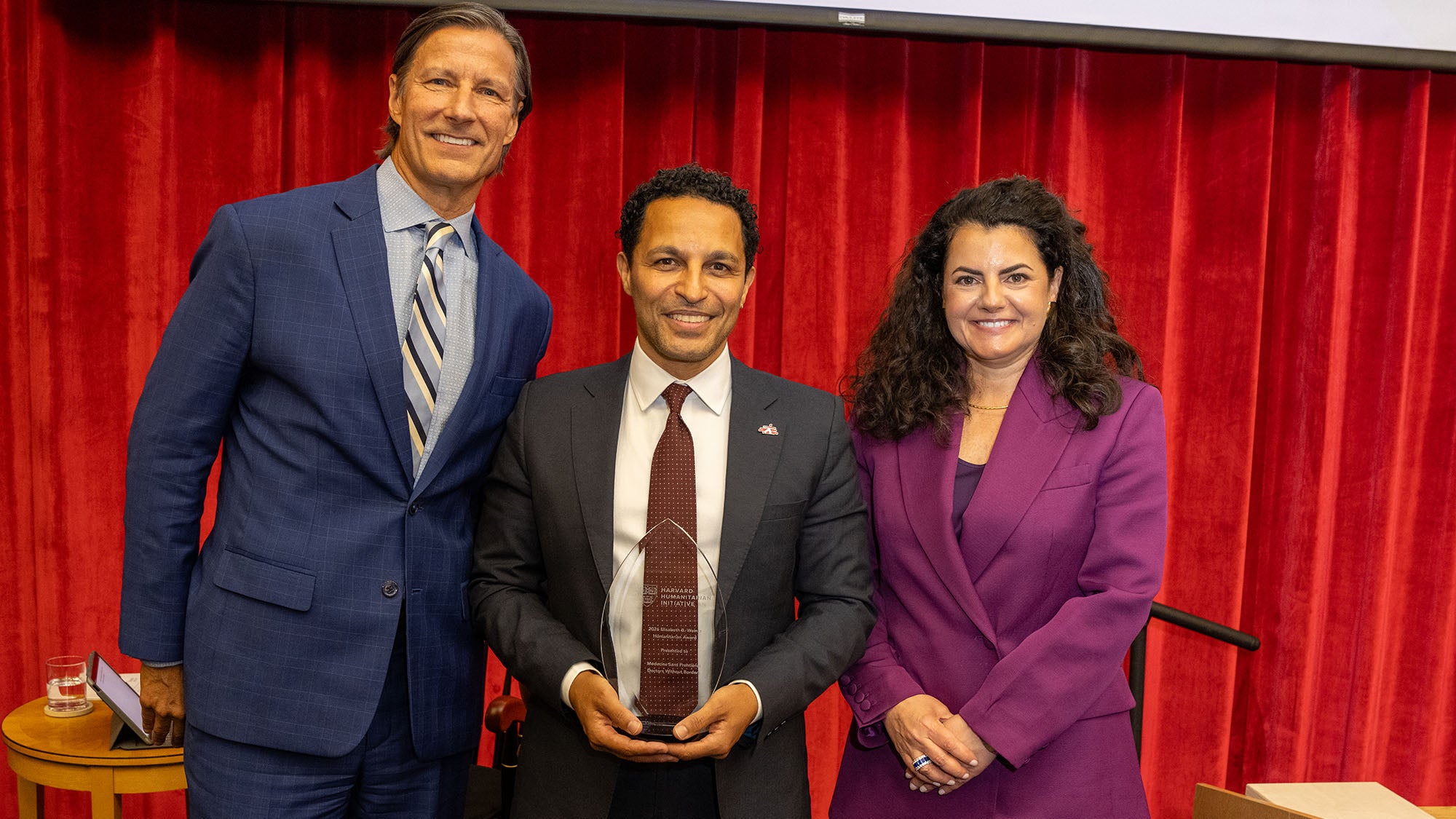
The Harvard Humanitarian Initiative (HHI) honored Doctors Without Borders / Médecins Sans Frontières (MSF) with its 2026 Elisabeth B. Weintz Humanitarian Award in recognition of the international non-profit organization’s leadership and contributions during humanitarian crises. MSF International President Mohamed Javid Abdelmoneim accepted the award during an Oct. 6 ceremony and lecture at Harvard T.H. Chan School of Public Health.
HHI Director Michael VanRooyen began his remarks with appreciation for the award’s late namesake, an early supporter of HHI’s vision to professionalize humanitarian work by bridging academic expertise and the realities of organizations working in the field.
VanRooyen noted that MSF was being honored not just for the critical care it provides during wars and disasters but also for its willingness to speak out and call attention to the problems driving emergency needs. This is more important than ever as the humanitarian field faces threats from funding cuts and violence against civilians is becoming more common, he said.
“MSF actually bears witness when civilians are being harmed, when access to humanitarian assistance is limited or obstructed, when hospitals are attacked, when health workers are being killed for what they do in the field, and when organizations, governments, and militias directly target civilians to make them suffer,” VanRooyen said.
As an independent organization that takes less than 1% of its income from governments, MSF has not been directly affected by cuts to international aid, Abdelmoneim said. Still, it is feeling the impact as local aid organizations cease being able to provide services. He highlighted severe funding cuts to sexual and reproductive health programs which amount to a “war on women and girls.”
While it can be difficult under such circumstances, he said, “I still hold out hope that this world is not devoid of solidarity.”
He noted that MSF was founded on the idea that humanitarian action is neutral, impartial, and separate from political influence. He said the organization is in the field for everyone, and he believes small acts of care can make a huge difference.
Following his remarks, Abdelmoneim joined VanRooyen for a fireside chat about the evolving humanitarian landscape.
Abdelmoneim said all aspects of humanitarian work involve negotiation and described his work with MSF as translating people with different points of view to each other. When it comes to making decisions at MSF, he said, “There’s no right decision most of the time. There’s just the point where we land and where we understand each other.”
When asked for his advice to students, he said that the field requires not only technical skills and scientific expertise, but also soft skills such as cultural competency and tenacity. Being willing to sleep anywhere and eat anything helps, he joked.
Two of the most important soft skills are humility and curiosity, he said. Every health minister or checkpoint guard a humanitarian worker encounters has a reason for positions they are taking, Abdelmoneim said. “Be humble and be curious, and that will go a long way,” he said.