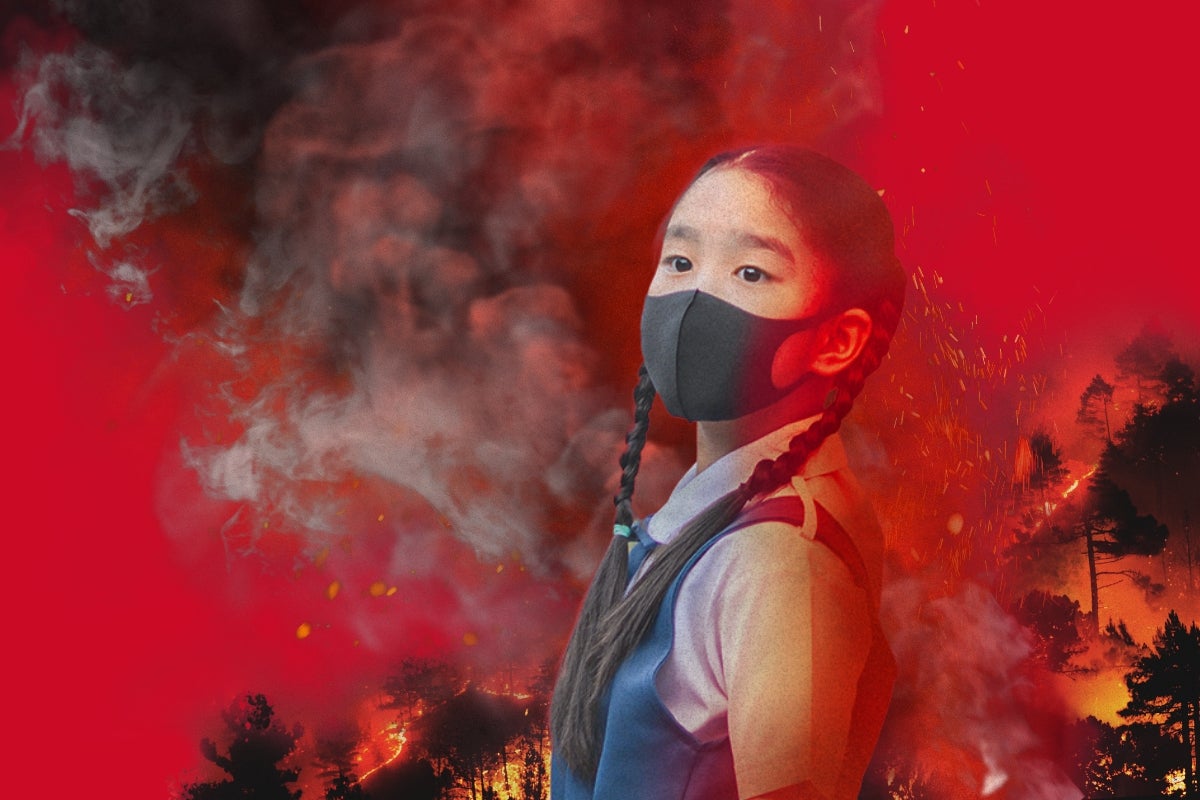
Wildfire smoke: How to protect yourself, according to experts
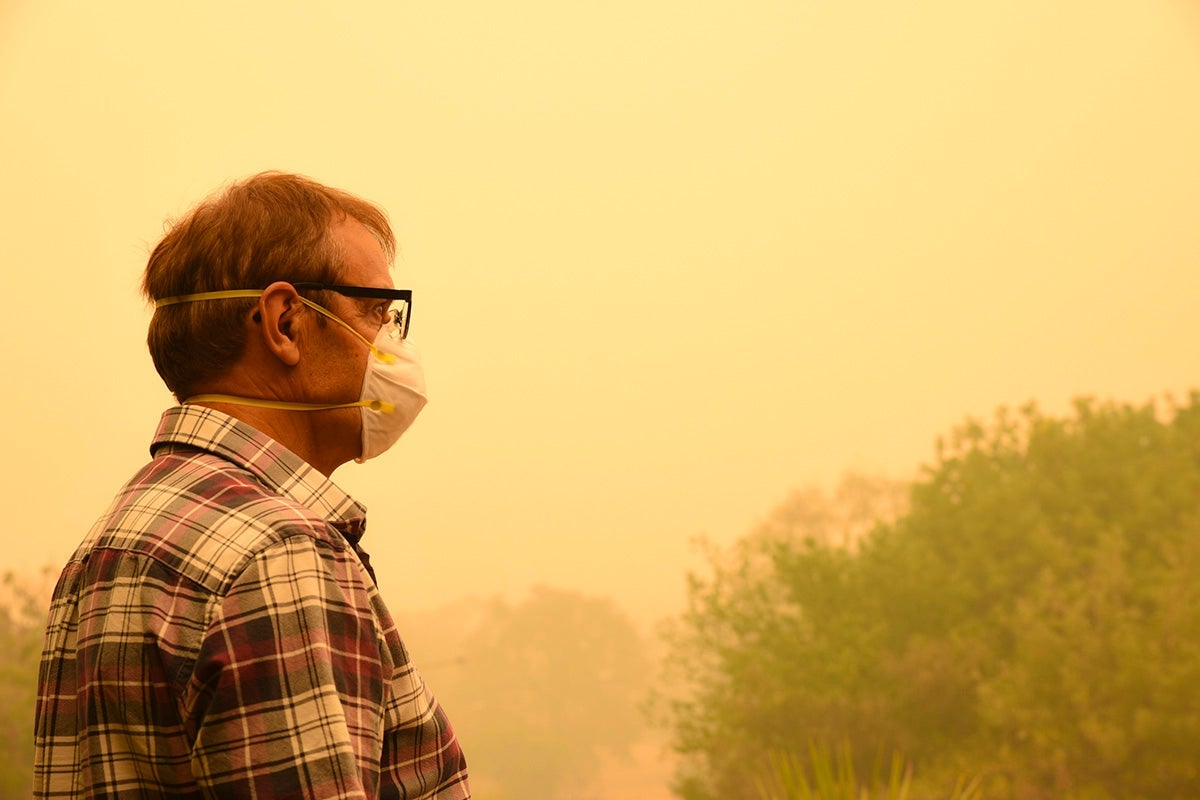
Smoke from wildfires burning in Ontario, Canada, continues to travel down to the U.S., degrading air quality across the Great Lakes, Northeast, and mid-Atlantic. Environmental health experts from Harvard T.H. Chan School of Public Health laid out the health stakes of this smoke-filled air—and shared methods to help stay safe and healthy.
Mary Johnson, principal research scientist in the Department of Environmental Health, explained in a July 17 Associated Press article that while individuals with respiratory conditions like asthma are most vulnerable to breathing troubles from wildfire smoke, anyone can suffer symptoms. “Even in individuals that don’t have asthma, the air can be so irritating that you could have difficulty with your respiratory system regardless, whether it’s coughing, whether it’s chest tightness, whether it’s sore throat, headache,” she said.
Johnson added that every system in the body—not just the respiratory system—can be harmed by wildfire smoke, as smoke triggers the immune system and causes inflammation.
In a July 16 interview with GBH, Joe Allen, professor of exposure assessment science, quantified the impact on the cardiovascular system, for example. In Boston, he said, air pollution levels were recently four to five times higher than usual due to the wildfires—and “if you look at some of the health effects data, we know that for every 10-fold increase, the heart attack risk increases by about 2.5%.” With current air pollution levels, that translates to an overall 10% increase in heart attack risk, he said, adding that the risk is exacerbated among seniors and people with pre-existing heart conditions.
To minimize the health risks of wildfire smoke—which many experts predict will be an ongoing issue—Johnson said that staying away from the smoke should be people’s top priority. That means minimizing time outdoors during hazy, smoky days and, if necessary, wearing an N95 or KN95 mask when going outside. Allen noted that if these masks are well-fitted— flush along the face—they capture at least 95% of harmful smoke particles.
He also noted that while staying inside is a good first line of defense, additional protective measures should still be taken, given that outdoor pollution can seep into homes, schools, and offices. “If you have a central air conditioning system, you want to increase the filter to what’s called a MERV 13 filter,” said Allen, who’s also the director of the Harvard Healthy Buildings Program. “Or if you have a portable air cleaner or portable air purifier with a HEPA filter, these can be really effective.”
Read the Associated Press article:
Wildfire smoke kills tens of thousands of people a year. Here’s how it attacks the body
Read or listen to the GBH interview:
Harvard public health expert explains the Canadian wildfire smoke over Massachusetts
Learn more:
Staying safe from wildfire smoke (Harvard Chan School news)
The health effects of wildfires (Harvard Chan School news)