New Publication from Hotamisligil Lab!
Researchers from the Hotamisligil Lab in the Department of Molecular Metabolism have uncovered a novel cholesterol-sensing mechanism that links hepatic lipid metabolism to metabolic dysfunction-associated steatohepatitis (MASH). In a study published in the Journal of Clinical Investigation, Shijun Deng and colleagues identified nuclear factor erythroid 2-related factor 1 (NFE2L1) as a critical regulator connecting cholesterol sensing to VLDL-mediated lipid export in the liver.
MASH affects 1.5%-6.5% of the global population, and cholesterol overload is known to be a key driver of disease progression, yet the mechanisms sensing and responding to cholesterol levels in the liver remain not completely understood.
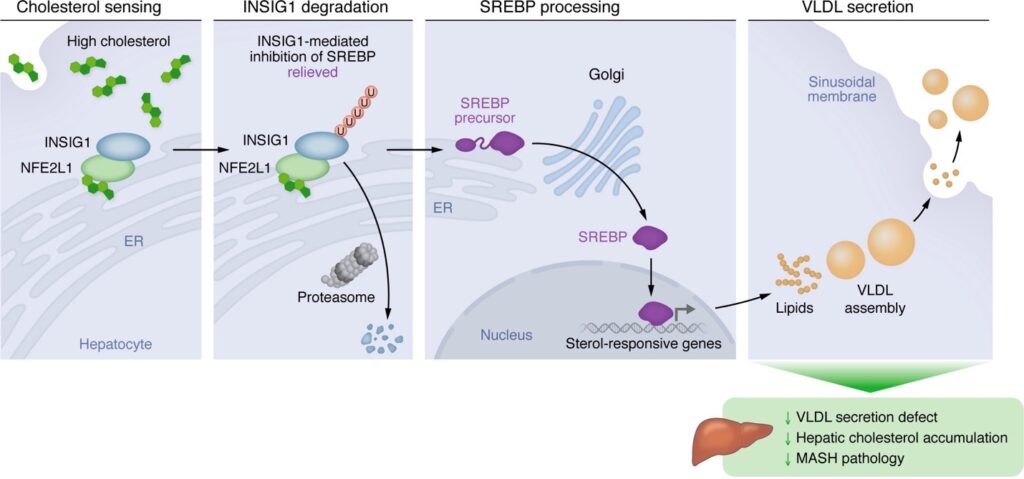
Figure: Schematic depicting the NFE2L1-INSIG1 cholesterol-sensing mechanism. NFE2L1 binds INSIG1 in a cholesterol-dependent manner, promoting its degradation and sustaining SREBP activation and VLDL secretion to maintain hepatic lipid homeostasis (adapted from the accompanying Commentary by Zang and Li, J Clin Invest, 2026).
In this study, the researchers found that NFE2L1 interacts with insulin-induced gene 1 (INSIG1) and promotes its degradation in hepatocytes in a cholesterol-dependent manner. This NFE2L1-INSIG1 interaction sustains SREBP activation and VLDL secretion, allowing the liver to continue exporting lipids and maintain systemic lipid homeostasis even under cholesterol overload.
The team further demonstrated that hepatic overexpression of NFE2L1 decreases INSIG1 levels and ameliorates MASH progression in preclinical models, without increasing atherogenic lipoproteins, highlighting NFE2L1 as a promising new therapeutic target for MASH.
Collectively, these findings reveal a previously unrecognized cholesterol-sensing pathway that helps balance lipid synthesis and export in the liver, offering new insight into MASH pathogenesis and a potential avenue for future therapeutic strategies.
The work was also featured in an accompanying Commentary in the Journal of Clinical Investigation, which highlighted the novelty of the NFE2L1-INSIG1 mechanism and its therapeutic implications.
Congratulations to Shijun Deng, Gökhan S. Hotamisligil, and colleagues within the Hotamisligil Lab, the Department of Molecular Metabolism, and collaborators from the greater research community!
Publication link: https://www.jci.org/articles/view/197094
Commentary link: https://www.jci.org/articles/view/206628