Can humans age healthier? Researchers see promising paths.
A variety of interventions, ranging from drug therapies to dietary alterations to behavioral changes, may help humans live healthier lives as they age, according to researchers at Harvard T.H. Chan School of Public Health.
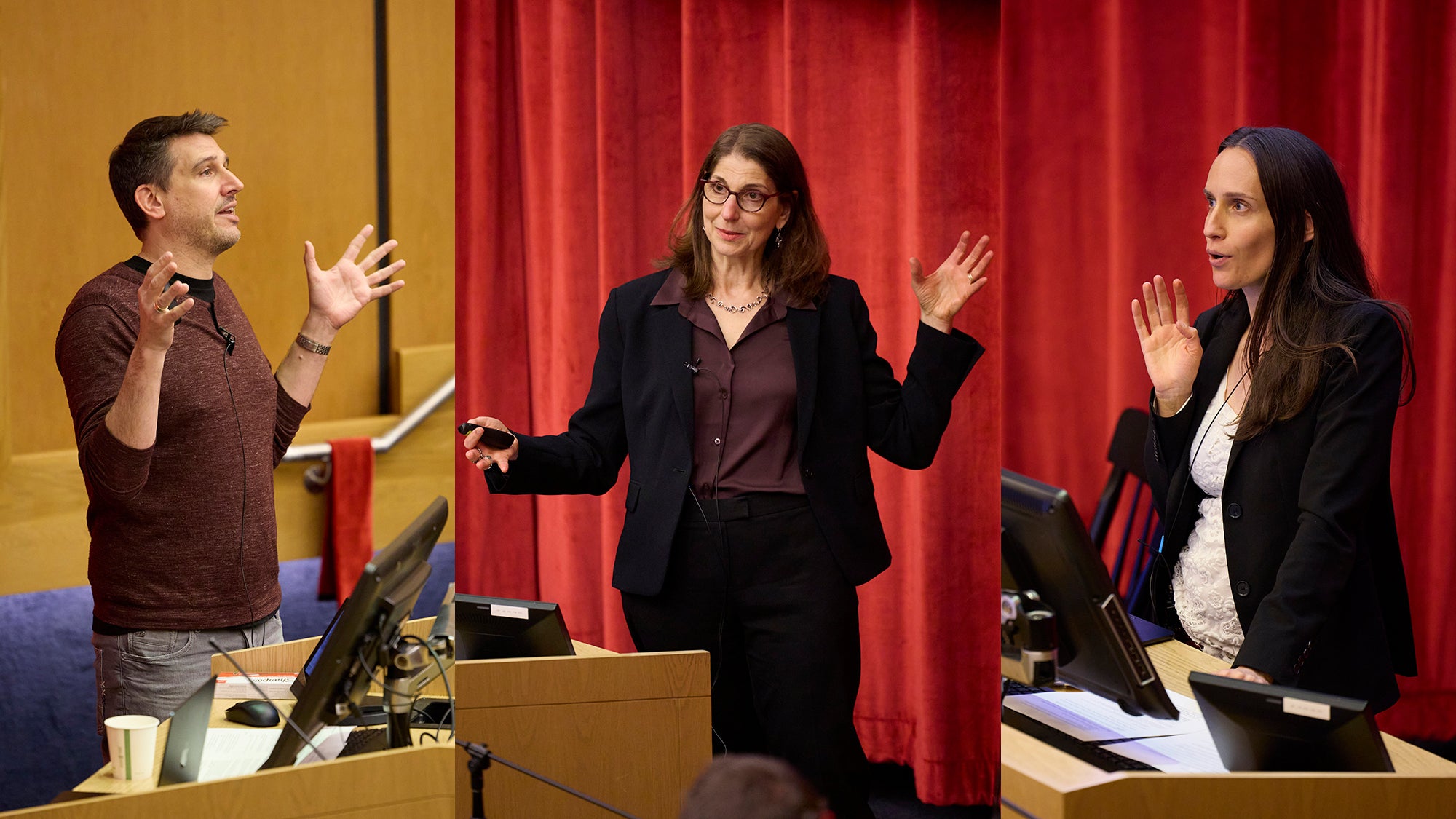
At a May 6 seminar titled Aging Reframed: Bridging Disciplines for Healthy Aging, three faculty members from different fields—molecular biologist William Mair, nutrition researcher Courtney Peterson, and social scientist Laura Kubzansky—spoke about their efforts to better understand aging, how to mitigate its health impacts, and opportunities for interdisciplinary collaboration.
Introducing the event, Dean for Academic Affairs Jorge Chavarro noted that the seminar was the first of a planned series focusing on public health challenges that Harvard Chan School can address through multiple disciplines. “I’m seeing this as a great opportunity to move beyond silos, to … build something together that is greater than each of us could have achieved by staying within our own lanes,” he said.
Aging’s molecular mysteries
Mair, professor of molecular metabolism, noted that over the past century, public health’s mission to improve life expectancy—through efforts such as better sanitation and improved prevention of infectious diseases—has been very successful. But with people living longer, their risk increases for illnesses that often accompany old age, such as neurodegenerative disorders, cardiovascular diseases, cancer, and metabolic diseases. Accordingly, public health has increasingly focused on addressing aging itself as a risk factor for disease, seeking ways to make people’s later years healthier.
“Not only will this [approach] have the best bang for your buck for promoting health in old age, it will also change our societies, change our health systems, and enable more of us than we ever thought possible to live independently into old age,” he said.
In the Mair lab, researchers try to understand molecular-level factors that play a role in aging, with the goal of developing therapeutics that may prevent old-age-related disease. Mair and colleagues study metabolism and aging in nematode worms, which have a two-week lifespan and similar genes to humans. For example, they give the worms drugs that mimic the effects of dietary changes—such as intermittent fasting and dietary restriction—to see how those changes affect the worms’ rate of aging.
The researchers are also interested in metabolic flexibility—the body’s ability to efficiently switch between periods of feeding (when the body mostly burns carbohydrates) and fasting (when the body burns mostly fat). Metabolic flexibility tends to work efficiently in younger people but less so in older people, Mair noted. “The thesis of my lab is that inability to move between these states underlies a lot of the aging-related diseases,” he said. To learn more, he and his colleagues have looked closely at cellular mechanisms involved in feeding versus fasting states, how those mechanisms shift as the worms age, and whether the mechanisms can be targeted to promote healthy aging.
They’ve found that, with dietary changes, nematode worms’ lifespan can be increased from two weeks to 10 weeks—and that, for most of those additional weeks, the worms remain youthful, with metabolic flexibility. “This is a really powerful model for us to get at causality … and target things that are related to the aging process itself,” Mair said.
From worms to humans
If Mair and his colleagues can coax nematode worms toward longer, healthier lives, can the same be done in studies involving humans?
Peterson, associate professor of nutrition, is collaborating with Mair to find out. She conducts clinical trials to study dietary interventions such as calorie restriction as well as daily intermittent fasting (also known as time-restricted eating, or TRE), which her lab defines as fasting for at least 14 hours per day. “The goal of this intermittent fasting is to shift from burning carbohydrates to burning fats for fuel,” she said. “We have dubbed this ‘the metabolic switch,’ and we think it’s responsible for favorable health effects.”
Work conducted by Peterson’s lab, as well as other labs around the country, has uncovered “pretty good evidence that intermittent fasting improves cardiometabolic health,” Peterson said. She and her team have found that fasting leads to roughly 5-7% loss in body weight over 6-12 months—not as dramatic as the weight loss many experience from GLP-1s, but “a pretty robust modest to moderate effect,” she said. Beyond that, she noted, intermittent fasting has been linked with significant improvements in blood pressure, glucose levels, and metabolic flexibility.
Looking ahead, Peterson plans to seek funding from the National Institute on Aging to conduct a large multi-center trial at sites across the U.S. to test nutritional interventions aimed at slowing the aging process in adults over a five-year period—the longest such trial so far. She hopes to study both calorie restriction and eight-hour TRE—eating restricted to an eight-hour period each day—and look for impacts on various indicators of aging.
Connecting socially, staying healthy
Kubzansky, professor of social and behavioral sciences, looks at how social environments influence the biology of aging.
Factors such as socioeconomic status, race, ethnicity, and other structural factors can impact how people age, she noted. So can factors such as loneliness, depression, anxiety, and other forms of psychological distress. Kubzansky cited two publications she co-authored that contributed to this evidence base: a 2009 study that found that people with high levels of loneliness had a 76% increased risk of heart disease, and a 2021 American Heart Association scientific statement outlining links between various forms of psychological distress and health issues such as cardiovascular disease.
On the flip side, positive psychological factors—such as social connection or volunteering—have been linked with health benefits. Kubzansky cited three publications she was a co-author on: a 2020 study that found that higher social integration was linked with greater longevity; a 2023 study that found a connection between prosocial behavior and lower levels of chronic pain in older adulthood; and a 2023 commentary arguing that prosociality—behaviors such as altruism, cooperation, and compassion—should be a public health priority.
Kubzansky acknowledged that, one day, there may be new therapeutics than can slow aging. But in the meantime, she noted, “We know a lot about drivers of healthy aging that we can leverage now.”
During a closing panel discussion, Kubzansky said that she thinks Harvard Chan School, with experts in a broad range of fields—including bench science, unusual for a school of public health—is uniquely situated to find new pathways to healthy aging. “We’re well set up for this work,” she said.