Transforming Health Care Education: The Science of Learning and Art of Teaching
This new course is currently in development. Click subscribe to be notified when the course is open for enrollment.
Program Overview
Teaching is a powerful tool that can be a transformative agent, promoting social changes when used correctly. To learn how to teach, however, you first must understand how people learn. Transforming Health Care Education: The Science of Learning and Art of Teaching will show how both these abilities intersect—with neuroscience, motivation, and technology—enabling participants to become more effective teachers in the healthcare field.
Transforming Health Care Education: The Science of Learning and Art of Teaching will introduce you to theoretical aspects of learning and the principles of effective teaching, focusing on novel methods to enhance long-term retention and learning. From understanding the basics of neuroplasticity, to the preparation for a Socratic discussion, this 12-week program delivered will enhance your teaching effectiveness.
In addition to the challenges mentioned, we have observed a significant change in student engagement and attention span, likely influenced by the pervasive impact of the digital world and social media. Today’s students navigate a constant stream of information and distractions, making it increasingly difficult to capture and retain their attention during traditional educational activities. It is crucial to understand how these shifts in behavior affect learning processes and outcomes. This program will also examine the effects of digital and social media influences on students so we can develop more effective educational strategies and interventions.
You will also have the opportunity to apply your knowledge to real-world projects. In the end, participants will develop their own educational initiative, which could be a course, app, systematic review, or a master’s or PhD project. Several alumni have implemented their course projects within their practice to great success.
Program Details
- Understand how learning occurs (from basic neural mechanisms to behavioral changes)
- Understand how to assess learning effectiveness
- Identify limitations and challenges of the current model of medical teaching
- Identify and understand the main teaching models (e.g., student-centered, teacher-centered)
- Identify and understand the main concepts and tools for effective teaching/learning
- Identify and understand how to effectively use educational tools
- Develop critical thinking on how to design an effective online course that aims to result in long-lasting learned skills for participants
“It was a wonderful experience! In my opinion, a dynamic learning strategy, together with interesting materials, insightful conversations, and enriching lectures, are the key elements that make this course unique, allowing us to carefully analyze the topics, fully understand how we learn, and develop critical thinking. It has also given me many great teaching strategies to apply in my field. I also had the chance to interact with colleagues from around the globe and share knowledge and experiences. So it´s totally worth it and highly recommended!”
—Julia Minetoo, MD, Transplant Team, Garraham Hospital
“Taking the TLI course with Professor Felipe Fregni has been a transformative experience for my career. I always believed that the skills to give great presentations were something you were born with, but this course has shown me that anyone can learn to deliver outstanding lectures. […] Since completing the course, I’ve noticed a remarkable shift in my lectures. They are no longer just presentations; they are dynamic interactions where students are engaged, asking questions, and truly invested in the material. The feedback from my audience has been overwhelmingly positive—they’re excited to learn, and I owe much of that to the insights I gained from this course. […] I wholeheartedly recommend the TLI course to anyone looking to enhance their teaching skills. It’s an investment that pays off in immeasurable ways, and I am incredibly grateful for the knowledge and support I received.”
—Siham Shweiki, MPH, BSC, Deputy District Pharmacist, Ministry of Health
“Participating in the Teaching, Learning and Innovation (TLI) program has been a turning point in my academic career. It’s beautiful to understand and value the different approaches to teaching (and learning) that actually make a difference in students. As a teacher I better understand the neurobiological pathways involved in long-term learning and I can apply these concepts in my strategy with students. Putting the effort into what is demonstrated to work is wonderful. It´s been enlightening to look at teaching from another angle and realize that purpose and meaning are crucial if we truly want to have an impact in students. I’m so grateful for the opportunity to participate in this program!”
—Daniela Masoli, MD, Neonatologist, Clinica Alemana
This program is designed for individuals who are passionate about teaching and learning within the health care field, with an emphasis on fostering critical thinking, collaboration, and reflective observation. Ideal participants include:
- Educators and professors at universities and teaching hospitals who are eager to deepen their understanding of learning and teaching methodologies, with a focus on health care education.
- Health professionals, including clinicians, physicians, and nurses who are involved in teaching and mentoring peers, residents, and fellows, and seeking innovative strategies to enhance their educational impact.
- Health care executives and administrators who are interested in the intersection of teaching, learning, and cutting-edge technology, aiming to foster an environment of growth and learning within their organizations.
- Professionals in pharmaceutical, biotechnology, or related industries who strive to better communicate complex scientific concepts and foster learning among colleagues and audiences.
Program Logistics
Current faculty, subject to change
Felipe Fregni
Professor of Physical Medicine & Rehabilitation
Harvard Medical School
Professor of Epidemiology
Harvard T.H. Chan School of Public Health

Program Time Commitment: Outside of the live sessions, participants must commit 3-5 hours total each week to weekly required readings, discussion posts, module reports, individual project preparation, and any assignments due that week.
Program Assignments
| Canvas Discussion Posts | Participants must submit 5 discussion posts per week |
| Module Reports | 3 Modules Reports in total |
| Live Participation / Class Attendance | Live class participation and weekly attendance is required |
| Individual Project | Includes First draft submission deadline + Final version submission deadline |
| Creative Activity | Graded with Final version submission deadline |
| Peer Feedback | Participants must provide feedback on 2 of their colleague’s final individual projects |
| 1 minute Pitch Video (Part of Individual Final Project) | As part of the Individual Project grade, participants will need to record a 1-min video |
Attendance and Certificate of Participation
Attendance in the live sessions is another important component of the program. Participants must successfully complete 70% of the program assignments and attend at least 9 live sessions to complete the course and receive a Certificate of Participation. Class participation during the live lectures will also count towards attendance. Watching the recorded lectures is supplemental and does not count towards weekly attendance.
Harvard T.H. Chan School of Public Health will grant 1.2 Continuing Education Units (CEUs) for this program, equivalent to 12 contact hours of education. Participants can apply these contact hours toward other professional education accrediting organizations.
All credits subject to final agenda.
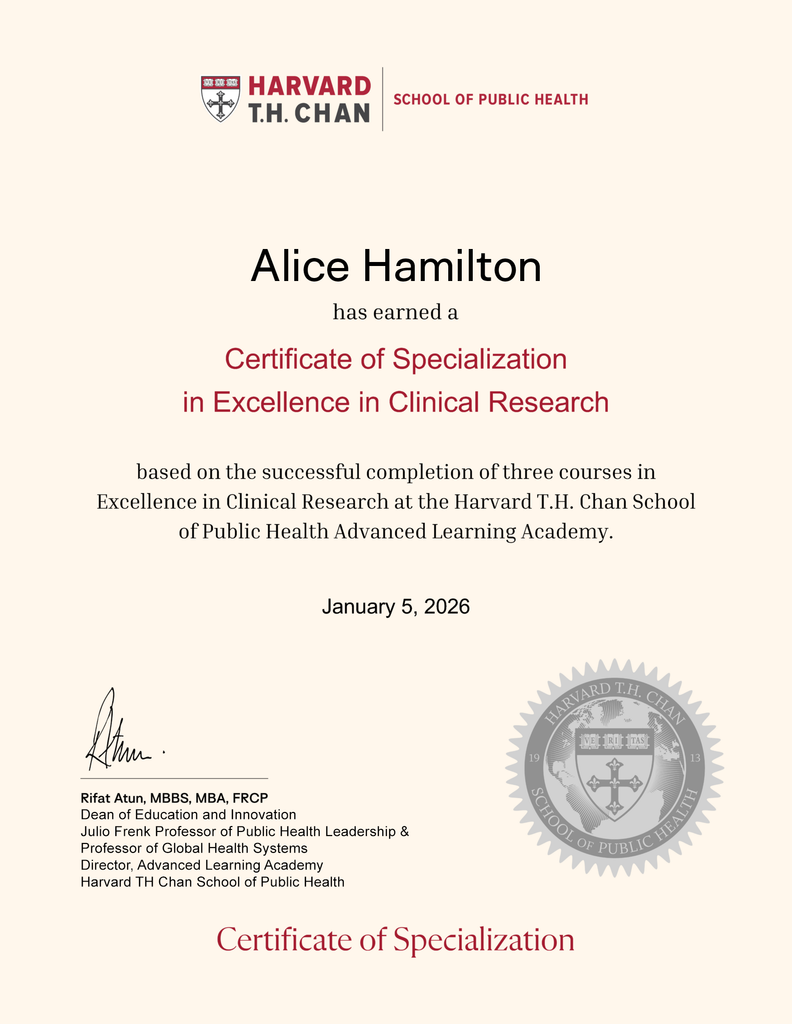
This course also contributes to the Excellence in Clinical Research Certificate of Specialization. While this course can be taken independently, completing it along with Principles and Practice of Clinical Research earns you the Certificate of Specialization.
Curriculum
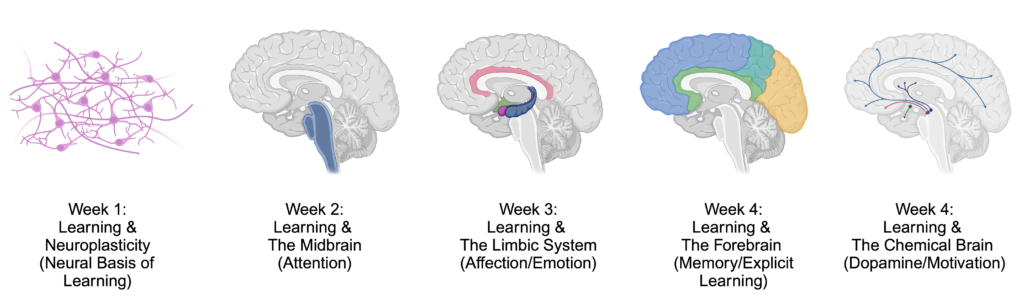
The figure above exemplifies active brain areas involved in the learning process.
- Week 0: Tutorial Lecture
This session will introduce the program, providing an overview of the key learning modules and goals. Participants will be guided through the objectives of the course and the importance of understanding how learning and teaching intersect with neuroscience, motivation, and technology. This will set the foundation for the journey ahead, preparing participants to reflect on their teaching practices and how they can evolve.
- Week 1: Neuroscientific Basis of Learning (Learning & Neuroplasticity)
Understanding the basics of neuroplasticity to design effective educational programs. - Week 2: Getting Ready and Engaging Attention in Learning (Learning & the Midbrain)
How to engage students’ attention during the learning process using bottom-up (multi-sensory) and top-down strategies, managing cognitive overload, and understanding priming and pre-exposure. - Week 3: Interaction and Relationships in the Classroom (Learning and the Limbic System)
Understanding the biology of emotions and relationships and their impact on learning, the effects of stress, and the power of peer collaboration. - Week 4: Consolidation of Learning (Learning and the Forebrain)
Understanding memory consolidation and strategies to enhance it (retrieval, spaced learning). - Week 5: Learning and Motivation (Learning and the Chemical Brain/Dopamine)
How motivation works and what motivates students. Explore intrinsic and extrinsic motivation systems, and strategies to enhance student motivation.
- Week 6: Using the Traditional Lecture in an Effective Manner
Preparing and delivering effective lectures, incorporating active breaks, student participation, mini-lectures, and experiential learning techniques (simulation, games, role-playing, service learning). Introduction to the flipped classroom and project-based learning. - Week 7: Teaching to Promote Critical Thinking
Learn the four elements (analogy) of critical thinking and how to design your program to foster critical thinking skills among students. - Week 8: Teaching with Team-Based Learning
Collaborative and peer tutoring learning techniques. Learn about the ideal size and duration of group activities, individual accountability, and preparing students for real-life projects through group learning. - Week 9: Teaching with Socratic Discussions and Seminars
Preparing for a Socratic discussion, using kinesthetic warm-up activities, ideal class sizes, and incorporating the case method into teaching.
- Week 10: Technology and Innovation in the Classroom
Explore technologies to enhance teaching (learning management systems, social media, student interaction apps, and educational apps for lectures). Understand how to effectively design distance-learning online programs. - Week 11: Assessment, Grading, and Feedback
Why do we often get assessments wrong? Consider the motivational systems when designing evaluations. Understand how to use feedback as a form of assessment, explore new assessment tools using technology, and the challenges of measuring learning accurately. - Week 12: The Final Class – Transformative Teaching and Learning
Reflecting on the “why” behind teaching, connecting to the first class, and discussing the importance of physical, social, and emotional well-being as a teacher.
Week 13: Final Presentation
Certificate of Specialization
Earn an Excellence in Clinical Research Certificate of Specialization
Take this program to earn a Certificate of Completion, or take 2 to earn a Certificate of Specialization. Learn more here.