How pollutants interact inside the body to impact health
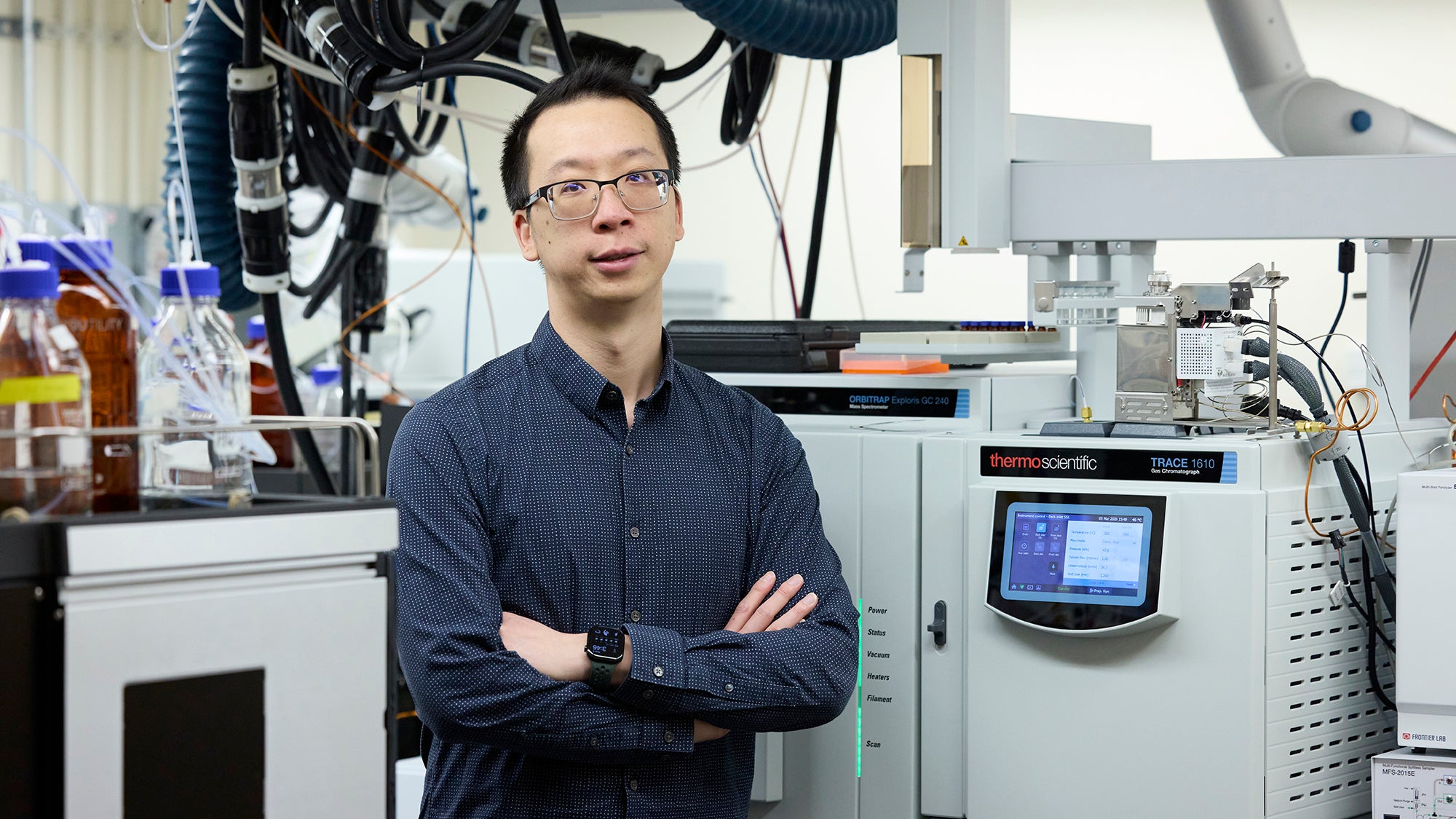
Peng Gao, assistant professor of environmental health and exposomics, studies the “exposome”—the measure of an individual’s total environmental exposures over the course of their life and how those exposures impact biology and health. Here, he describes what’s involved with his work.
Why is it important to study the exposome?
Every day, we’re exposed to thousands of chemicals in the air we breathe, the products we use, the water we drink, and the food we eat. Most of these exposures are invisible, unmeasured, and unregulated. My lab’s mission is to make the invisible visible: We use advanced analytical and computational tools to capture a person’s full chemical fingerprint and connect it to what’s happening inside their body at the deepest biological level.
What happens when substances mix in the body that makes it dangerous to health?
Research from the broader field, including work from my lab, has shown that a single chemical may have little or no measurable effect in a cell line or animal model, but a mixture can produce a very different outcome. We call that a synergistic effect. In other words, it’s not simply one plus one equals two—chemicals can interact in ways that make the combined effect substantially more harmful.
In addition, pollutants do not interact only with one another; they can also interact with biomolecules such as proteins, RNA, and DNA. Alcohol is one example. It is classified as a carcinogen, and when our enzymes biotransform it, it produces acetaldehyde, a highly reactive compound that can damage DNA. That kind of damage can contribute to the accumulation of changes that increase cancer risk, especially if normal repair and immune surveillance processes do not fully eliminate abnormal cells.
Another example is a group of chemicals called polycyclic aromatic hydrocarbons, or PAHs. They are typically products of fossil fuel combustion from vehicles and power plants. By themselves, many PAHs are not in the most biologically reactive form. But once they enter the body, enzymes biotransform them in an effort to make them more water-soluble so they can be excreted. In the meantime, some of these biotransformation products become more bioreactive and can bind to DNA, which is one reason PAH exposure is linked to cancer risk.
How do you tease apart all the environmental exposures that different people may have, and their impact on health?
My group studies the health impacts of a wide range of chemical exposures, including both legacy and emerging pollutants such as pesticides, PAHs, PFAS, and other xenobiotics — chemical substances that are foreign to the human body, such as synthetic drugs or food additives. Depending on the cohort, our team collects different types of samples, such as biospecimens like blood, tissue, or urine, and analyzes them using high-resolution mass spectrometry. That tool is especially important in my lab because it can profile thousands of small molecules in a sample at once. We also use mass spectrometry to analyze biological molecules in the samples, such as metabolites and proteins, that may be altered by environmental exposures. This is called a multi-omics approach because we integrate data from multiple fields, including exposomics, metabolomics, and proteomics. It helps us understand the complex relationships between external exposures and internal multi-level molecular changes.
Once the samples are analyzed, we look for patterns linking specific exposures to specific health outcomes. Depending on the study design, that may mean comparing people with and without a disease; comparing participants across different levels of symptoms, subgroups, and risks; or just monitoring the same group of people over time. We then use epidemiologic and computational analyses to prioritize the chemicals that seem to matter most, and we follow up in the lab—often using human cell or animal models—to test whether those candidates may play a causal role.
What are some of your current projects? Do any findings excite you?
One project I’m enthusiastic about involves exploring how environmental exposures contribute to asthma severity. We give study participants wearable personal samplers—think of them as chemical sponges that soak up everything they’re breathing throughout a normal day. What we’re finding is striking: It’s not just one pollutant driving symptoms, but specific cocktails of chemicals that cluster together and track with how well someone’s asthma is controlled. Some of these airborne exposures had never been flagged before. This suggests we need to rethink how we monitor air quality at the personal level, moving beyond fixed outdoor stations and toward personalized approaches that capture what people are actually breathing, especially in indoor environments.
We’re also tackling one of cancer’s biggest mysteries: Why do people who have never smoked get lung cancer? By profiling hundreds of chemicals in never-smoker lung cancer patients’ blood and tumor tissue, we’ve begun to identify previously unreported environmental carcinogens that appear linked to specific mutation patterns in tumors. If this holds up, it could open entirely new avenues for early detection and prevention in a population that current screening guidelines largely overlook.
In our Alzheimer’s research, we’re uncovering something surprising through the gut. Our analyses suggest that gut bacteria can transform certain pesticides into more neurotoxic compounds, meaning the path from environmental exposure to brain disease may run through the microbiome. This could reshape how we think about dementia prevention.
Finally, after the 2023 East Palestine, Ohio, train derailment, our team deployed to the area to monitor chemical contamination in soil, sediment, air, and water. That work is important not only because it provides affected communities with longer-term exposure and risk data, but also because it demonstrates how a multi-media exposomics approach can be deployed quickly after a disaster and then extended into longer-term follow-up. We hope that kind of framework can inform future environmental emergency response efforts.
The thread connecting all of this work is a fundamental shift in how we study environmental health, from measuring one pollutant at a time to capturing the full picture of real-world exposures, and from population averages to individual-level precision. The ultimate goal is to identify who is most at risk, what specific exposures are driving that risk, and how we can intervene, especially in communities and populations that bear a disproportionate burden.