Tianxi Cai named 2026 Mosteller Statistician
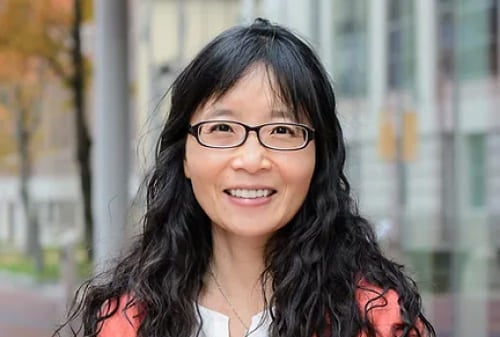
We are pleased to share that Tianxi Cai has been named the 2026 Mosteller Statistician of the Year.
This award recognizes outstanding contributions to the field of statistics. Dr. Cai’s research develops practical statistical methods that strengthen medical research and improve patient care, bridging rigorous methodology with real-world applications.
She was also recently named Co-Editor of the Theory and Methods section of the Journal of the American Statistical Association (JASA), one of the leading journals in the field — a testament to her leadership in advancing statistical science.
Please join us in congratulating Tianxi on this well-deserved honor.
Dr. Cai was recently interviewed by her colleagues, Associate Professors Rui Duan and Junwei Lu on her research, collaborations, mentorship, and the evolving future of biostatistics. See interview below.
How has the rise of large-scale real-world data and AI changed the kinds of statistical problems you find most important to study?
It has fundamentally expanded the horizon of my research. The rise of AI and real-world data has opened the door to multi-modal sources that we previously couldn’t touch (for example unstructured text, medical imaging, and genomics). But this shift also forces us to look upstream. I’ve become deeply interested in the entire data pipeline, from the rawest form of data collection to the final research-ready dataset. We realize now that every step in that pipeline, preprocessing, cleaning, extraction, can introduce bias or error. Consequently, developing statistical and machine learning methods that ensure data quality and reliable inference from these ‘messy’ sources has become just as fascinating to me as the final analysis itself.
How do you envision the future role of a statistician as we are approaching a future where data-driven discovery from real-world evidence will be trusted on par with traditional trials?
I don’t see them as competitors, but as synergistic partners. Real-world evidence allows us to generate robust hypotheses that can then be tested in trials, or even used to emulate trials via instrumental variable approaches and other novel designs. This makes our evidence generation more reliable and, crucially, more generalizable to the actual population. Furthermore, I envision a future of ‘hybrid’ designs where we integrate small, rigorous clinical trials with large-scale real-world studies. This integration is the key to making clinical research more efficient, less costly, and faster to deliver patient impact.
In your experience, what is the key to transforming a relationship with clinical collaborators into a shared scientific discovery process rather than just as technical service providers?
My philosophy is simple: we must be scientists before we are data scientists. To transform a service relationship into a partnership, you have to be genuinely curious about the actual problem the collaborator is trying to solve, not just the math behind it. I love talking to my clinical colleagues; they have taught me so much about the science of medicine. When you take the time to learn their language and understand the nuance of their domain, you stop being a ‘provider’ and become a co-investigator. That shared intellectual curiosity is the foundation of a great team.
Looking back on your career, what has been the most significant challenge you’ve faced, and how did you navigate it?
The structural uncertainty of research funding has been a persistent challenge. In our field, building substantial, long-term infrastructure—like maintaining complex data pipelines or long-standing cohorts—requires consistency. The current funding landscape is forcing us to think in short-term bursts, which makes it difficult to plan for the kind of decade-long initiatives that are necessary to solve the hardest problems in healthcare.
What emerging areas of statistical research are you most excited about over the next decade?
I am most excited about the transition from theoretical models to deployed solutions, taking an idea all the way to a product that tangibly changes society. This is a long, complex process, but the statistician’s quantitative mindset, our natural instinct for distinguishing true signal from noise and bias, is critical at every step. However, we cannot do it alone. I see the future as deeply interdisciplinary. We need to work seamlessly with engineers and domain experts to build ‘full pipelines.’ I want to see us move beyond just publishing papers to building systems that ultimately make the world a better place to live.
What advice would you give to early-career researchers hoping to make impactful contributions to the field?
I want to challenge the next generation to fundamentally shift their mindset: stop confining yourself to the traditional role of a statistician. We need to be brave enough to step out of our comfort zones and lead the entire project, not just the analysis phase. Don’t be afraid to wear an ‘engineering hat’ or to expand your scope into other areas of data science. If a problem requires complex infrastructure, learn those engineering skills, or hire computer scientists to work with you. We should be the architects of these teams, not just the service providers.
Nothing should be ‘beneath’ you—I cleaned my own data for decades, and that granular understanding is exactly what gave me the instincts to identify the most critical scientific problems. So, be adventurous, ignore the ‘fashion’ of the moment, and have the courage to own the full pipeline. There is no reason why a statistician cannot be the one leading the charge to change the world.