Parmigiani Research Group
Dana Farber Cancer Institute
Harvard T.H. Chan School of Public Health
Projects
Aladynoulli
Understanding how chronic disease patterns evolve over a lifetime is a key challenge in medicine. Electronic health records provide rich longitudinal data, but existing models typically analyze each disease in isolation, missing the complex interplay between conditions and genetic factors. With Sarah Urbut and other colleagues, we developed ALADYNOULLI, a dynamic Bayesian framework that integrates longitudinal health records with genetic data to identify latent disease signatures while modeling individual-specific trajectories.
Applied in three biobanks with up to 52 years of follow-up, the model discovers clinically interpretable disease signatures that show strong cross-population consistency and reveal distinct biological subtypes within traditional diagnostic categories. By jointly modeling genetics and longitudinal diagnoses, ALADYNOULLI substantially outperforms established risk scores (PCE, PREVENT, GAIL) across 28 conditions over both 1-year and 10-year horizons.
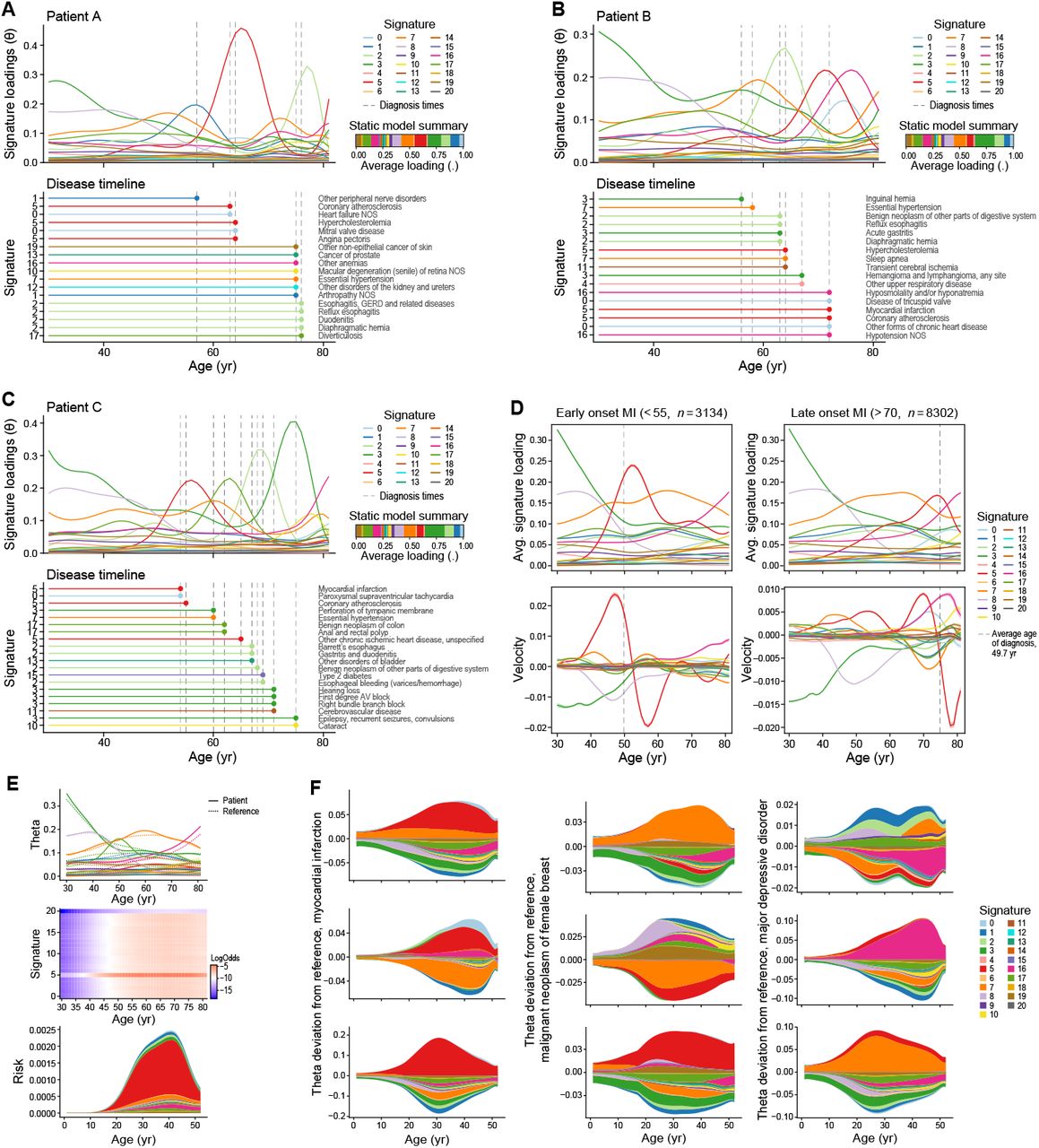
Patient-specific signature loadings over time, disease timelines, and decomposition of disease risk into signature contributions, for representative individuals. From Urbut et al., medRxiv 2024.09.29.24314557, Figure 3.
Decision Support for Genetic Testing and Early Detection
Following a rapid drop in the cost of DNA sequencing, multi-gene panel testing for inherited genetic susceptibility has become widely used, and multi-cancer early detection (MCED) assays are quickly emerging. With co-leader Danielle Braun and other members of the BayesMendel lab we are developing machine learning applications for risk stratification and clinical decision support systems to increase the efficiency of panel testing and MCED testing. The cornerstone is a comprehensive pre- and post-testing risk stratification tool called Fam3PRO. Ongoing project range from innovative statistical and computational approaches, to clinical implementation trials.
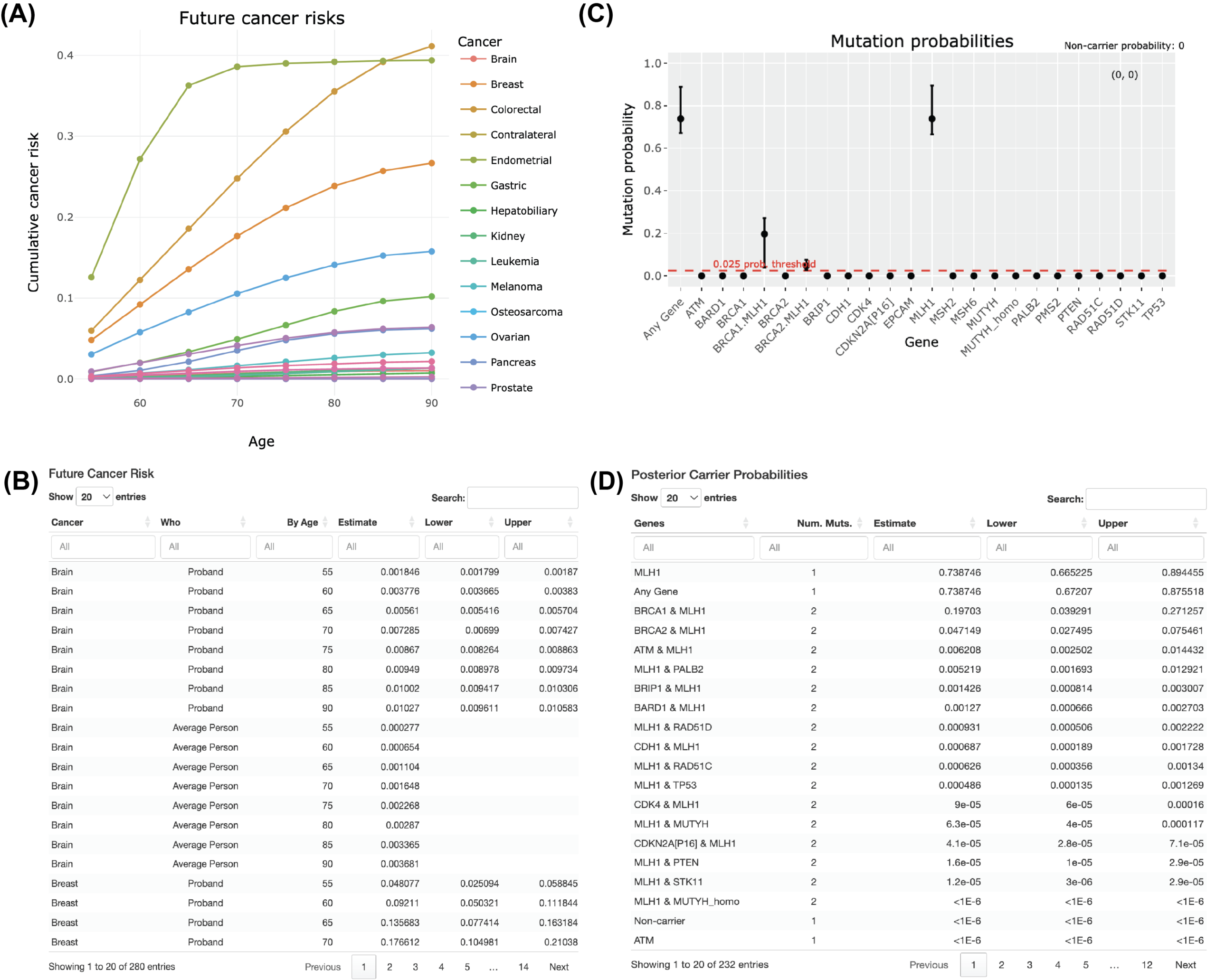
Example Fam3PRO outputs for a proband: future cancer risks across cancer types (A, B) and posterior carrier probabilities across hereditary cancer genes (C, D), in interactive figure and tabular formats. From arXiv:2510.23805, Figure 6.