What would Alice Hamilton do? Panel explores public health justice then and now
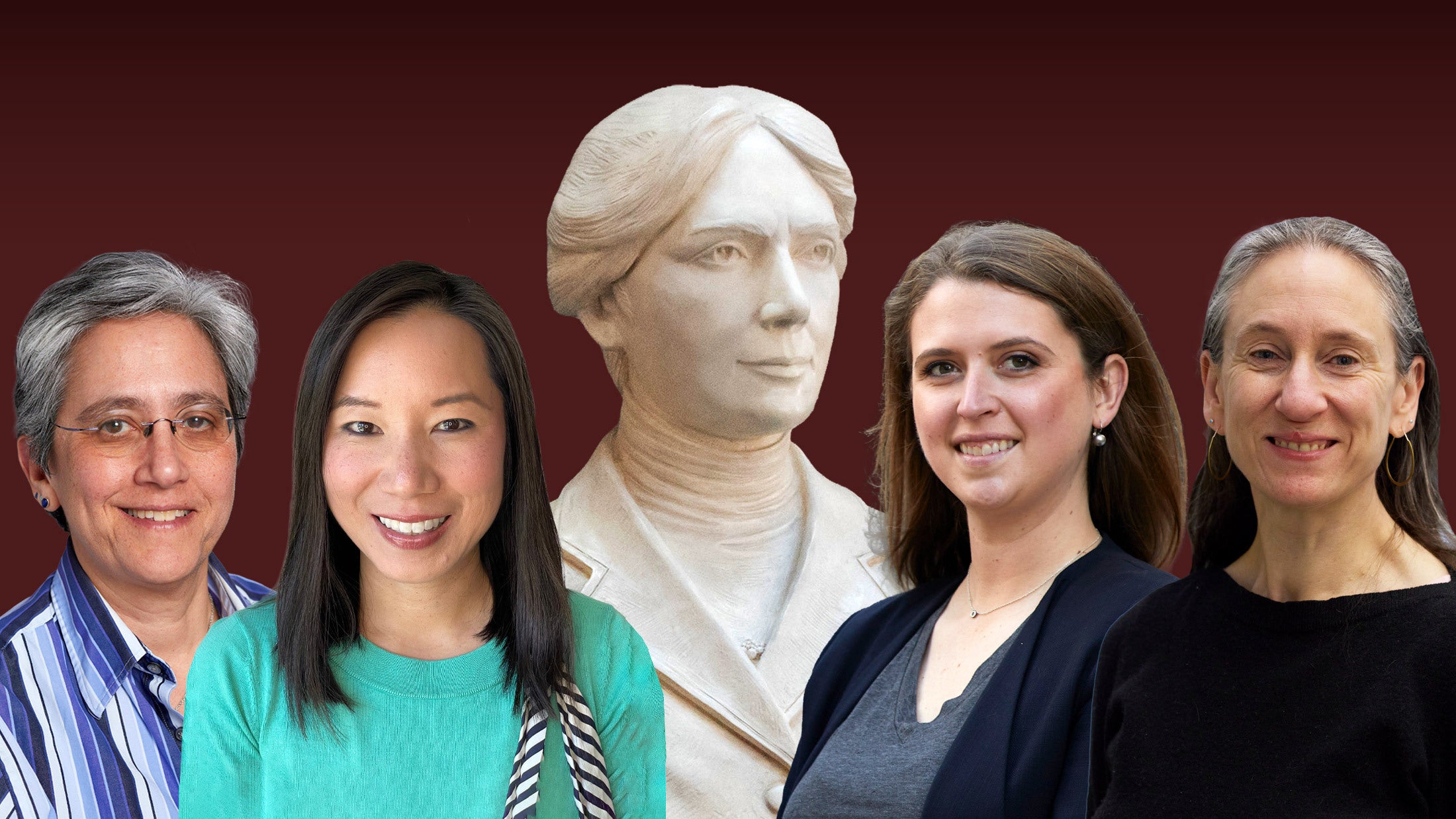
Public health pioneer Alice Hamilton was the first woman appointed to Harvard University’s faculty. An Oct. 20 panel discussion sponsored by Harvard T.H. Chan School of Public Health’s Committee on the Advancement of Women Faculty—which honors a female faculty member each year with the annual Alice Hamilton Award—explored Hamilton’s legacy and the lessons it holds for researchers today.
In the early 20th century, Hamilton helped establish the fields of occupational health and industrial toxicology in the United States through her investigations of hazardous conditions faced by workers in a range of trades from munitions to watch dial painting.
During the panel discussion, held in Kresge 200, faculty members Nancy Krieger, Cindy Leung, Maggie Sullivan, and Kathryn Tomsho explored how Hamilton might approach occupational health in the current landscape of gig workers and warehouse laborers, in addition to discussing her solutions-oriented research and commitment to the communities she served. Hiwot Zewdie, a Yerby fellow in the Department of Environmental Health, moderated.
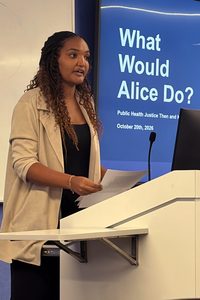
“Hamilton’s work anticipated several principles that are now associated with the fundamentals of environmental justice and social epidemiology,” Zewdie said. “That risk is unequally distributed. That prevention must address systems and not just individuals. That workers and other exposed individuals possess essential knowledge. That evidence must be connected to accountability, and that public health should examine power,” she said.
The panelists emphasized that Hamilton’s work was inextricably linked to her passion for social justice. She wanted her research to bring about practical changes that improved people’s lives, and she also frequently spoke out about causes, including support for pacifism (in relation to World War I and the subsequent League of Nations, but not the fight against Nazi Germany), women’s, workers’, and immigrants’ rights, and opposition to eugenics and to fascism.
In 1897, Hamilton became a resident at social reformer Jane Addams’s Hull House, in Chicago, where she lived side by side with low-income and immigrant members of the community. There, she gained insights that informed her work on the health impacts of environmental and social conditions and grounded her research in lived experiences.
Hamilton was appointed assistant professor of industrial medicine at Harvard Medical School in 1919, and her division joined the School of Public Health three years later. Throughout her time at Harvard, she lived half the year in Boston and the other half at Hull House.
A body of evidence where none existed
Krieger, professor of social epidemiology, recalled being influenced by Hamilton’s autobiography Exploring the Dangerous Trades early in her academic career. During the panel, she discussed Hamilton’s efforts to help build public health institutions around workplace health issues by forging collaborations with both civil servants in the federal government and unions and advocacy groups campaigning for better living and working conditions and voting rights.
A Hamilton of today would be pushing for more regulations to protect workers not just inside the workplace, but in the communities where they live—for example, around the potential impacts of data center expansion, Krieger said. She added that Hamilton would be alarmed by changes to the way the federal government is collecting data, such as proposed changes to the census. “She was clear that evidence was necessary. And if you want to link evidence [to outcomes], you have to have it,” Krieger said.
Hamilton took the initiative to create a body of evidence in an area where it didn’t exist, noted Sullivan, an instructor in the FXB Center for Health & Human Rights. “There wasn’t anybody clamoring at her door saying, ‘All the factory workers at this one site have a problem. What should we do, Dr. Hamilton?’,” she said.
Sullivan added that the challenge for researchers now is watching bodies of evidence be dismantled, for example, health data disappearing from government websites. “Patterns in health disparity that are well-documented aren’t going to magically go away when data aren’t counted,” Sullivan said.
Tomsho, an instructor in the Department of Environmental Health, and director of the Environmental Justice and Health Program, said that she finds inspiration in Hamilton’s approach to public health research. Tomsho noted that early in her own career, she was a community organizer in Pennsylvania working on issues related to water contamination and natural gas drilling. The experience taught her valuable lessons around bringing community voices to the table and prioritizing communication that now inform how she structures her research, she said.
Now that data on social determinants of health such as food insecurity and housing stability are included in electronic health records, physicians are becoming better trained in how to speak with their patients about the types of concerns Hamilton raised, said Leung, associate professor of public health nutrition. But she noted that there needs to be a next step, such as connecting a patient to a social worker or patient navigator. “We’re moving in the right direction, although there’s still a lot more work that needs to be done to make sure that we’re adequately treating these social conditions like we would any kind of medical condition,” she said.