What to know about Ebola and the latest major outbreak
On May 17, the World Health Organization declared the current Ebola epidemic in Central Africa a public health emergency of international concern, and days later warned it could be months before the outbreak is contained. One case of the extremely contagious, often deadly virus appeared in the Democratic Republic of the Congo (DRC) in late April, and within nearly a month has spread within the DRC and Uganda, infecting more than 600 people and killing more than 130—though these are estimates that many experts believe are on the lower side.
Below, Yonatan Grad, professor of immunology and infectious diseases at Harvard T.H. Chan School of Public Health, provides a primer on Ebola and offers insights on the ongoing outbreak.
Q: What is Ebola and where does it originate?
A: Ebola is a zoonotic disease—one that originates in animals and can then, in what’s called a spillover, be transmitted to humans. Ebola is carried by fruit bats, and people get infected either through contact with fruit bats or through contact with nonhuman primates that were themselves infected through contact with fruit bats. Once spillover occurs, human-to-human transmission can begin.
There are four types of Ebola virus (within the genus Orthoebolavirus) that cause human disease: Zaire, Sudan, Bundibugyo, and Taï Forest. The Zaire virus is the cause of most human outbreaks, including the historic 2014-16 outbreak in West Africa and other smaller outbreaks in countries including the DRC and Gabon. The Sudan virus has caused several outbreaks around South Sudan, Uganda, and the DRC. The Taï Forest virus is very rare—there’s only one report of a single infection in Côte d’Ivoire in 1994.
The Bundibugyo virus—the cause of the ongoing outbreak—has been reported as the cause of two prior outbreaks, with this current outbreak now the third. All have been around the DRC and Uganda border.
Q: How is Ebola transmitted between humans?
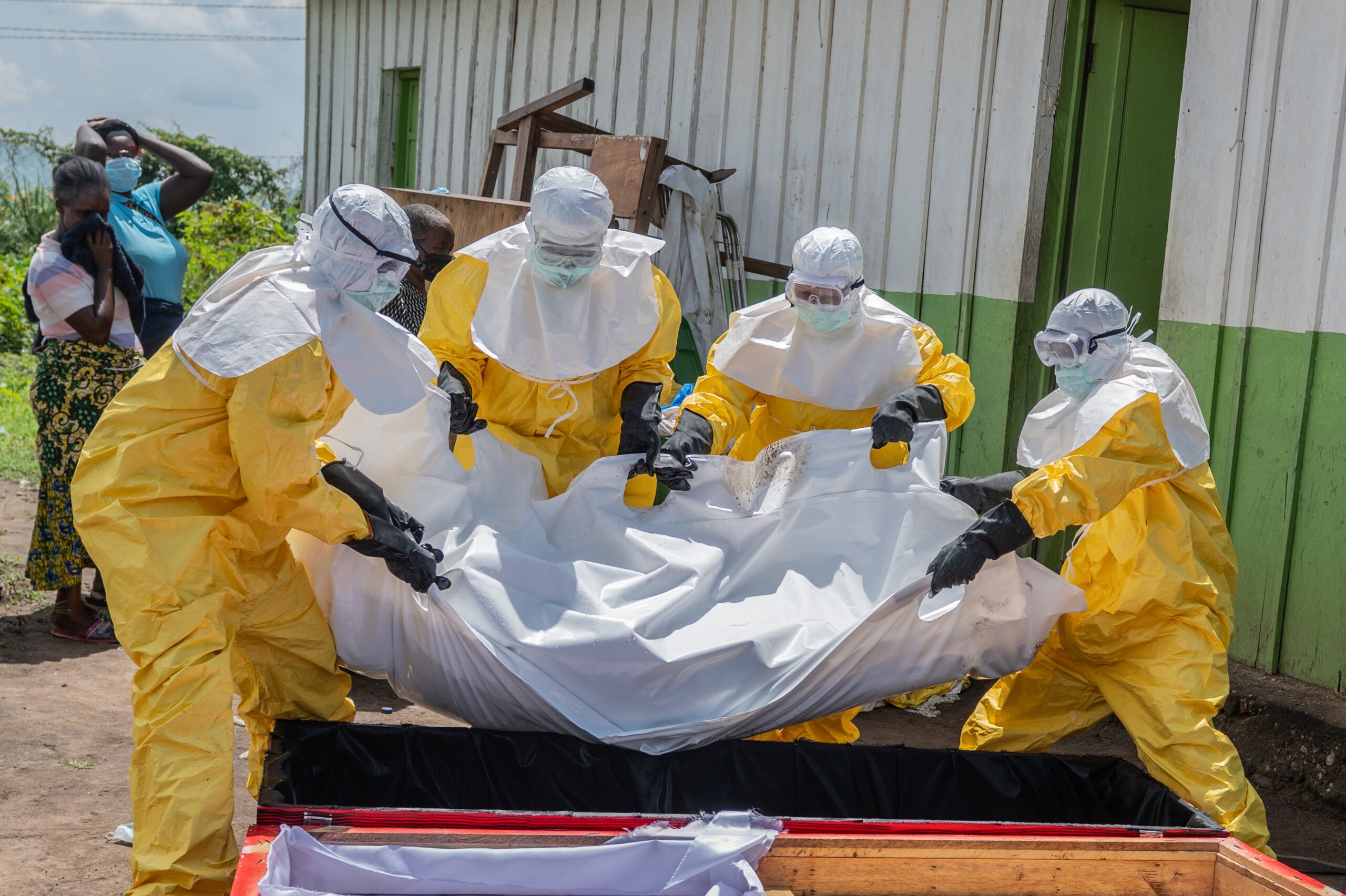
A: The virus can be transmitted from an infected person—or someone who recently died from the virus—when their bodily fluids, such as urine, saliva, feces, vomit, breast milk, and sweat, come into direct contact with another person’s mucus membranes or a break in their skin. People caring for those sick with Ebola, whether clinicians or family members, are at serious risk of infection. We have also seen transmission associated with funeral rites that involve washing and preparing for burial the bodies of those who died from Ebola.
Some survivors of Ebola can continue to carry the virus for some time—particularly in areas of the body with less immune activity, such as the eye, brain, and testes. How often this happens and in which people is not clear. But there have been cases of people transmitting Ebola virus through semen a year or so after they’d recovered from symptoms.
Q: What are the symptoms of Ebola? How is it treated, and how deadly can it be?
A: Ebola belongs to a group of viral hemorrhagic fever diseases that also includes hantavirus (which has been in the news after an outbreak on a cruise ship). Hemorrhagic fever combines bleeding (hemorrhaging) and fever and represents very serious infections that impact multiple body systems. The fatality rates vary by the four Ebola viruses. In the absence of any treatment, the fatality rates are up to 90% for the Zaire Ebola virus, 50% for the Sudan virus, and 30% for the Bundibugyo virus.
After exposure to Ebola, it can take a couple of days to a few weeks to develop symptoms. The first symptoms are nonspecific and can be associated with a wide variety of infections: fever, muscle and joint aches, severe headache, weakness, and fatigue. As the illness progresses, other symptoms may appear, including vomiting, diarrhea, and the bleeding that puts this in the viral hemorrhagic fever category.
For treatment, the mainstay is supportive care, keeping patients hydrated, and managing their symptoms while their immune systems hopefully fight the virus successfully. There are drugs available to treat the Zaire Ebola virus. That’s not the case for the Bundibugyo virus that’s circulating now.
Q: How can transmission be prevented?
A: Prevention is through avoiding contact with the bodily fluids of those who are infected or who recently died from the virus. It’s incredibly important that caregivers have access to personal protective equipment—masks, gowns, gloves.
There is a vaccine for the Zaire Ebola virus, which is a powerful tool to prevent future outbreaks of this most deadly strain. There’s no vaccine for the Bundibugyo virus yet. There’s a bit of evidence that vaccination for the Zaire Ebola virus might give a small amount of protection against Bundibugyo. But this work is preliminary, hasn’t been thoroughly tested in people, and there’s reason to be skeptical that it will show a benefit. It’s a big question whether the Zaire vaccine will be deployed in the hopes of helping quell the current outbreak.
At this point, identifying cases is critical, as is contact tracing, quarantines, and communicating with local communities about how the virus transmits, the possible delay between when one is infected and when one develops symptoms, and the precautions that are needed to prevent transmission. As trials to test new interventions get underway, clear communication about the trials and careful interpretation of their results will also be critical.
Q: What worries you about the current outbreak?
A: There’s a lot to worry about, unfortunately. This is already the third largest Ebola outbreak on record, and I suspect it’s likely to grow substantially before it’s controlled. A mathematical modeling study estimated that, as of May 17, there were between 400 and 800 cases as a best guess—but possibly over 1,000. The outbreak has certainly grown since then.
This outbreak was detected late due to a lack of Bundibugyo virus diagnostics and due to the outbreak emerging in a remote region of the DRC, where there’s ongoing armed conflict, where health care capacity is limited, and where there’s a lot of population movement. These issues continue to pose big challenges. The appearance of cases in dense urban and semi-urban areas, including reports of two confirmed cases in Kampala, Uganda, increase concern for spread locally and regionally.
I worry that all of these issues are exacerbated by reductions in foreign aid. These cuts have led to limited availability of proven countermeasures—a problem amplified by the fact that the vaccines and therapies on hand were developed for the Zaire strain, not the one that’s circulating. Efforts to rapidly test new vaccines and therapeutics for Bundibugyo will be important, but we don’t yet know how well they’ll perform. In the meantime, there’s critical need for support in implementing a response centered around case identification, daily monitoring of contacts, quarantines, and strict infection prevention and control protocols—all of which requires ongoing engagement with and buy-in from local communities.