The state of biomedical science—the past, present, and path forward
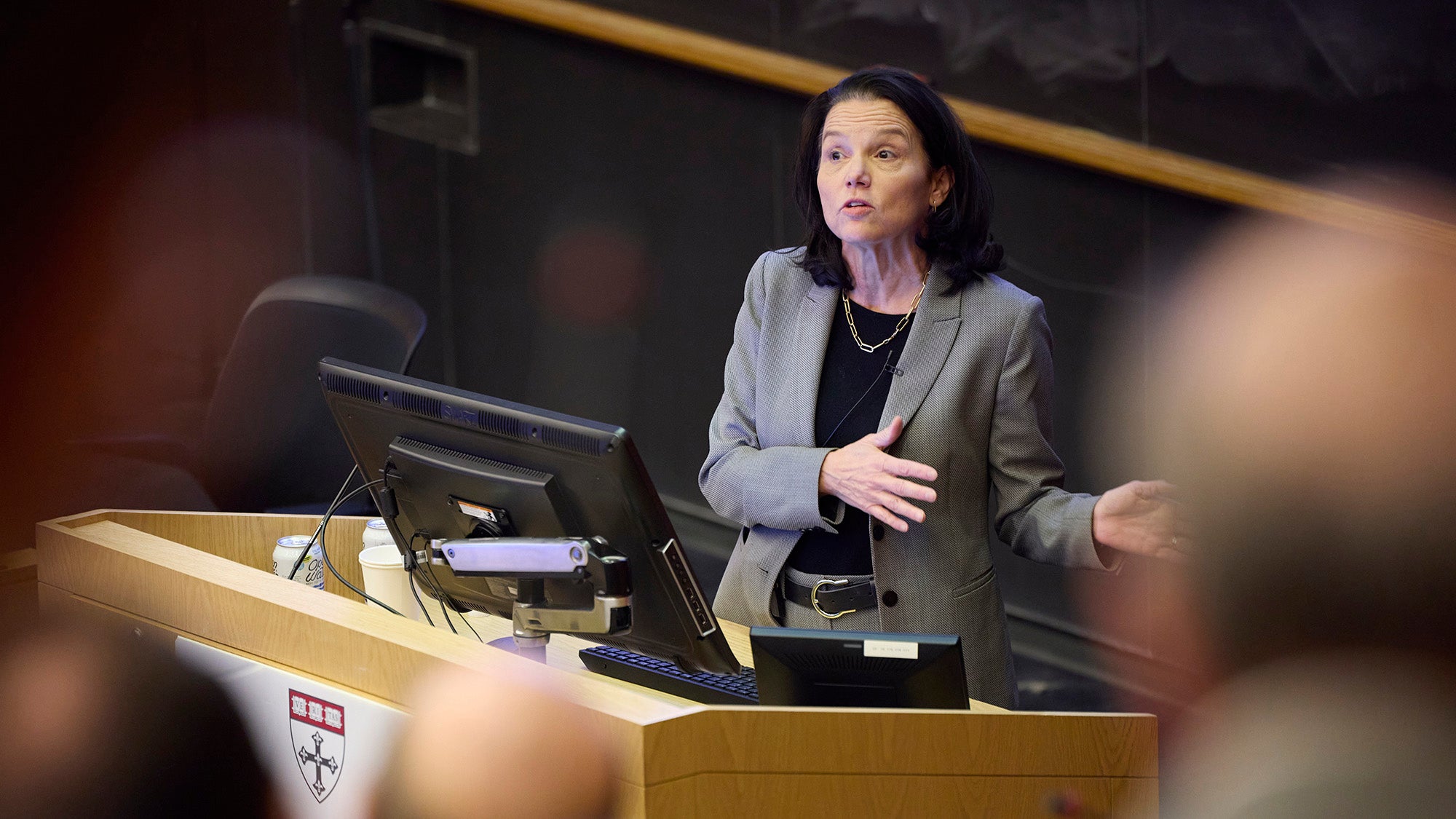
Physician, scientist, and academic leader Katrina Armstrong explored the factors that led to extraordinary growth in biomedical science in the U.S. over the past 60 years—and offered thoughts on how to move the field forward in spite of current headwinds—at a Dec. 8 talk at Harvard T.H. Chan School of Public Health.
Armstrong spoke at the 177th Cutter Lecture on Preventive Medicine, addressing an audience of about 100 people in Kresge Auditorium, as well as online viewers. She leads Columbia University’s health and biomedical sciences campus, serving as chief executive officer of the Irving Medical Center as well as executive vice president for health and biomedical sciences. Previously she led Massachusetts General Hospital’s Department of Medicine, and was a professor of clinical medicine at Harvard Medical School and a professor of epidemiology at Harvard Chan School.
The Cutter Lecture is supported by a bequest from John Clarence Cutter, a graduate of Harvard Medical School. It has been held since 1912 under the auspices of Harvard Chan School’s Department of Epidemiology. Albert Hofman, chair of the department, introduced Armstrong and later presented her with a plaque commemorating her lecture.
A changing partnership
Armstrong said that the decades-long partnership between the federal government and research universities grew out of scientists’ important contributions during World War II, such as the development of radar and antibiotics. Government officials continued funding university research after the war to spur further advances to benefit society.
By 2023, federal research funding had leapt to about $60 billion per year—more than 30 times higher than what it was in 1953, said Armstrong, citing a New York Times graphic. This huge investment fueled major advances, such as heart disease treatments like statins and beta blockers that led to major reductions in early deaths, she said. It was a time of big discoveries, of translating those discoveries into clinical practice, and making progress on health disparities, she said.
Interest has grown in research with real-world impact, both in the government and in academia, Armstrong said. She noted that the percentage of funding from the National Institutes of Health for clinical research grew dramatically for two decades beginning in the mid-1960s. In addition, a 2014 Pew Research Center survey found that most scientists at that time thought they should be actively involved in public policy debates about science and technology.
Growing pains
The expanding scientific revolution over the past several decades led to dramatic changes in the health care field, Armstrong said. For instance, new treatments and technologies required new health care infrastructure, such as machines and buildings.
“Health care has always been a capital-heavy enterprise, but it became extraordinarily capital hungry,” she said. “The amount of money that was required to deliver cutting-edge health care just went really through the roof.” As a result, hospital systems affiliated with universities became increasingly focused on bringing in more dollars from medical services—and those dollars provided support that the universities came to depend on.
The focus on generating income, which ramped up significantly starting about 25 years ago, also led health care systems to more closely monitor providers’ work volume, for instance by requiring doctors to document their work on electronic medical records systems. Doctors were also pushed to increase their patient volume. The result has been higher levels of physician burnout, as well as fewer patients reporting an ongoing relationship with a personal physician—and more turning to the internet instead of their doctors for medical advice.
Armstrong described other major changes in the biomedical research landscape. For instance, an increased emphasis on gathering data on the U.S. population exposed the nation’s serious health disparities related to geography, income, race, and ethnicity. There was also an explosion of scientific information, increasingly available on the internet—setting the stage for problems when the pandemic hit.
Pandemic upheaval
When the COVID-19 pandemic arrived, health care providers hit the ground running to figure out how to best care for patients, to protect people from the virus, and to gather evidence on best practices, said Armstrong. Scientists set a new standard for collaborating, sharing data, and working quickly—“the greatest example being Operation Warp Speed and the creation of the mRNA vaccines, which brought us all back together so much faster,” she said.
While trust in science had been declining in the decade or so before 2020, it briefly rose in the early months of the pandemic. But that trend didn’t last. As the number of COVID variants grew, public confidence in scientists dropped, according to a 2021 Pew survey. Other factors contributing to growing levels of distrust included the sometimes-chaotic rollout of COVID vaccines, disparities in how people experienced the pandemic, and vaccine mandates, Armstrong said.
Building public trust in science
In addition to declining trust in scientists, Armstrong listed other challenges ahead for biomedical science—including hefty cuts in federal research funding, an overall lack of trust in the federal government, and falling numbers of people seeing value in a college education.
First and foremost, she advised scientists to focus on building trust. “Any time we portray false certainty, we risk destroying that trust,” she said. “We should trust the people we serve more to understand the complexity and the uncertainty that we’re facing. … We need to tell people what we don’t know. And we need to be honest and authentic in how we do that.”
Further—given the fraying relationship between the federal government and universities—Armstrong recommended that scientists build a broader vision for advancing science, working more closely with communities, hospitals, agencies such as the National Academies of Sciences, Engineering, and Medicine, insurers, and the private sector.
In spite of the current challenges, Armstrong said, “I personally believe that we’re at an incredible time.” She added, “I’ve decided that the motto of all good biomedical researchers … is ‘never waste a good crisis.’”