At JBL Symposium, a focus on making radiation therapy safer
Radiation therapy can be part of lifesaving cancer treatment by killing or slowing the growth of cancer cells. But it can also damage healthy cells, leading to side effects ranging from fatigue to nausea to cognition problems and, in some cases, to the formation of secondary cancers.
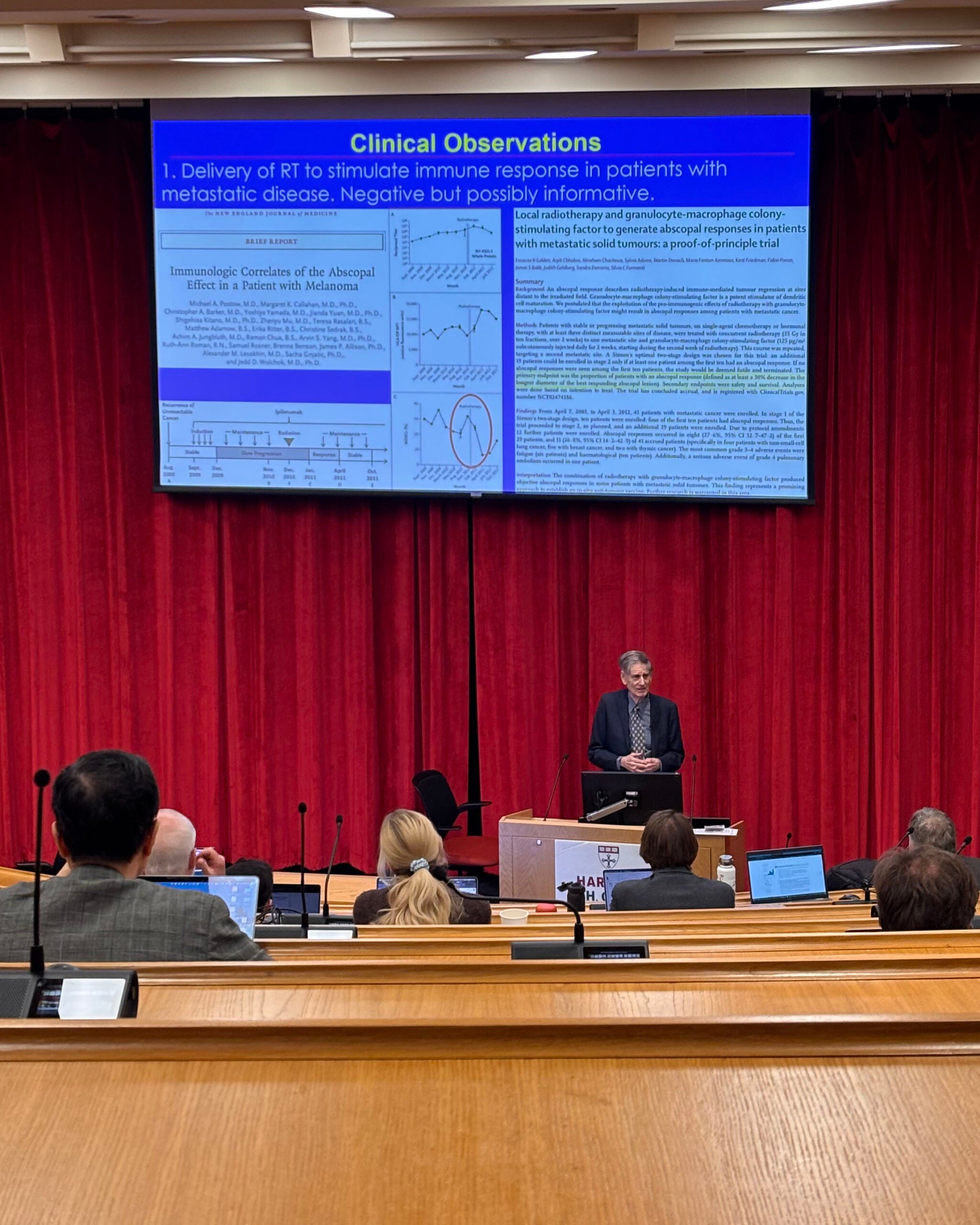
Experts at the 29th annual John B. Little Symposium, held Oct. 30 at Harvard T.H. Chan School of Public Health, talked about ways to make radiation therapy less toxic.
The symposium honors the legacy of the late John B. Little, the former James Stevens Simmons Professor of Radiobiology, Emeritus. Little, who died in 2020, ran the John B. Little (JBL) Center for Radiation Sciences at Harvard Chan School for many years and initiated the symposium, which seeks to foster the dissemination of information and interactions among scientists in the field.
This year’s event drew roughly 150 attendees to Kresge Auditorium to hear from three guest speakers. Co-hosts of the event were acting co-directors of the JBL Center Zachary Nagel, associate professor of genomics and cancer biology, and Kristopher Sarosiek, associate professor of radiation biology and cell death.
One of the speakers was Deborah Citrin, scientific director for clinical research at the National Cancer Institute Center for Cancer Research and senior investigator, radiation oncology branch. Citrin talked about how radiation can cause some healthy cells to become “senescent”—meaning that they acquire new features that lead to chronic inflammation, which can cause problems such as less efficient blood flow and nutrient utilization, as well as tissue and organ dysfunction. Citrin’s research focuses on learning more about these cells: figuring out why they become senescent, what sort of signals they send to the immune system, and how to potentially block those signals to minimize tissue injury.
Another speaker was Ralph Weichselbaum, Ludwig Distinguished Service Professor of Radiation and Cellular Oncology and chair of the Department of Radiation and Cellular Oncology at the University of Chicago / UChicago Medicine, who trained under Little. He discussed how radiation therapy—instead of attacking tumor cells directly—can also be used to prompt the immune system to do so.
Diani Shi, assistant professor of radiation oncology at the Mass General Brigham Cancer Institute, spoke about how to understand and exploit DNA repair mechanisms in a type of brain tumor called IDH-mutant glioma—the most common type of malignant brain tumor in adults under age 50.
Offering introductory remarks for each of the featured speakers were JBL Center affiliate faculty, including Jan Scheumann of Massachusetts General Hospital’s Department of Radiation Oncology; David Kozono and Henning Willers of the Mass General Brigham Cancer Institute; and Helen Shi of Mass General Brigham.
Kozono, who introduced Citrin, shared information about research conducted with colleagues at Brigham and Women’s Hospital aimed at understanding why some patients are more at risk from DNA damage from radiation therapy than others. Said Nagel in an interview, “Some people have major side effects, and other people have no problems. We really don’t understand why, so it’s an active area of research.”
The symposium also featured remarks from a patient who offered his perspective on what it’s like to go through radiation treatment. Noted Sarosiek, “It was inspirational and informative to hear a story from a patient directly because a lot of cancer biologists, who primarily work in a laboratory, don’t truly understand what it’s like to get radiation therapy.” Nagel added that having the patient perspective “just makes it so real for those of us who are studying it. It’s motivating.”
Wrapping up the symposium was a poster session featuring research from trainees in radiation science. “That part of the symposium really shone a light on the trainees who are actually performing experiments to make these incredibly important advances,” said Sarosiek. Noting that Little was dedicated to mentorship, he added that featuring these young scientists “is how we try to carry on Little’s legacy.”