AI’s role in learning, research, and career exploration—using tools thoughtfully, ethically
Harvard Chan School’s four-part pilot series explored how to use artificial intelligence ethically while keeping critical thinking and mastery of knowledge front and center.
More than 100 members of the Harvard T.H. Chan School of Public Health community came together this fall to explore how artificial intelligence (AI) can complement people’s work without taking over their thinking or responsibilities.
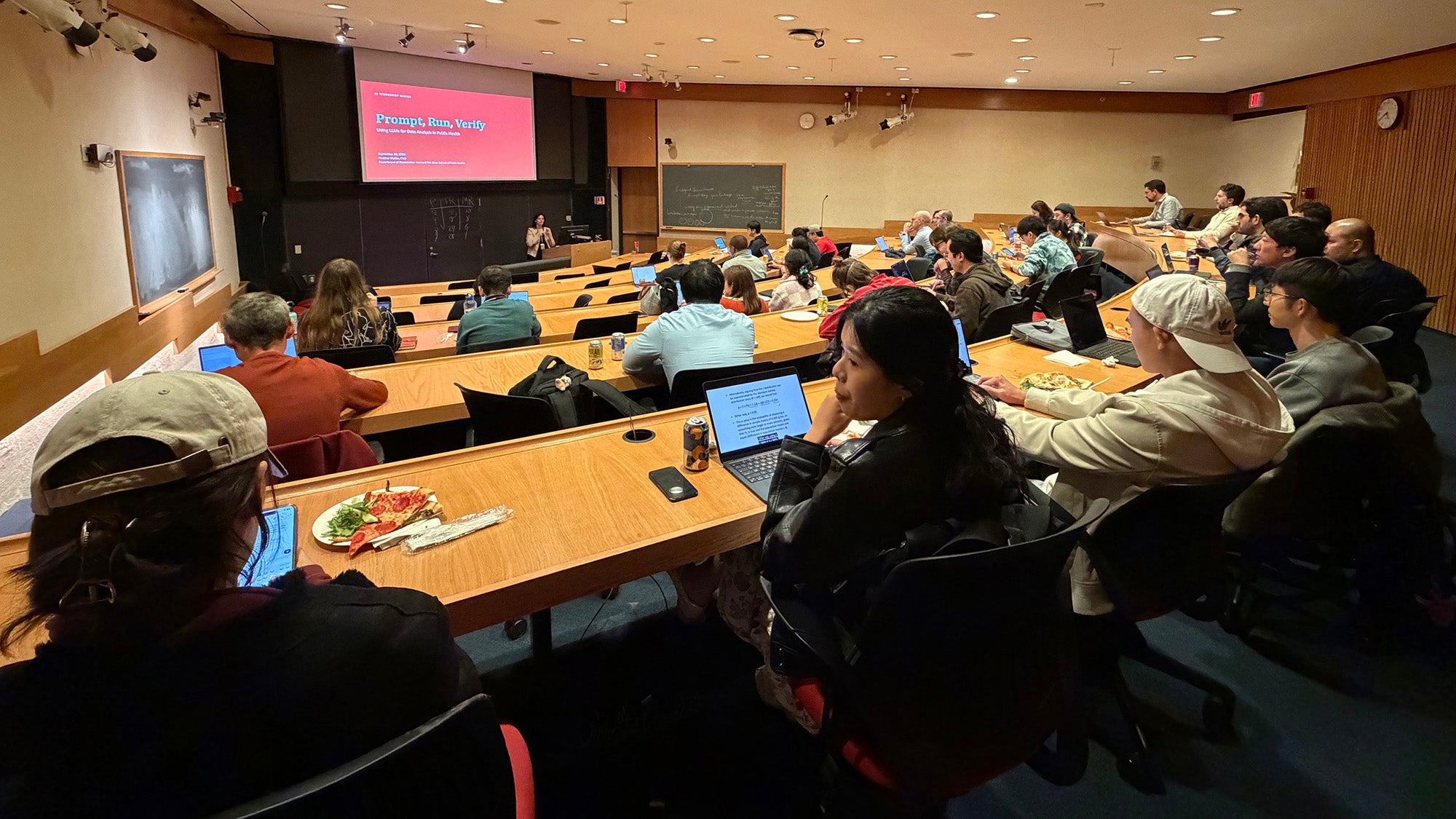
The series, held from mid-September to early October, included sessions on generative AI; AI tools for scholarly literature research; using large language models (LLMs) for data analysis in public health; and what employers want graduates to know about AI.
“The aim of the series was to build awareness, knowledge and judgment about how to use these tools thoughtfully and ethically,” said Jennifer Betancourt, director of educational policy, who helped organize the series.
In the opening session, Carrie Wade, a research and instruction librarian at Countway Library, gave an overview about generative AI, a machine learning model that can generate content such as text, images, or computer code in response to human prompts. She also discussed LLMs, a type of generative AI that generates content based on the probability of what the next word might be. Claude and ChatGPT are examples of LLMs.
LLMs are good at things such as generating emails, creating image captions, summarizing class notes, and answering common questions, she said. On the other hand, while they are designed to produce human-sounding text, they may not always produce true text. They also don’t communicate uncertainty. “LLMs are not designed to say ‘I don’t know,’” she said.
Wade sought to demystify LLMs and invited participants to discuss their uses and ethical questions. The conversation moved beyond what the tools can do to how people might use them while staying actively engaged in their own work.
Wade described ways that LLMs can support research but emphasized its limitations. For example, when it comes to literature searches, she said, “AI can provide a good snapshot and some highly relevant information, but it’s not going to be deep or broad.” She noted that LLMs can’t search research databases because proprietary subscription models limit access.
Wade recommended paying close attention to any data that gets input into an AI search—such as unpublished research findings—noting that all such data becomes part of the AI model’s training.
‘Verify everything’
Alex Cronin, Wade’s colleague and also a research and instruction librarian, led a session on AI and scholarly research. She showed participants how to use reputable sources such as PubMed, alongside AI tools, and how to check for “hallucinated” citations—when AI generates false citations but presents them as if they were fact.
In a session on using LLMs for data analysis in public health, lecturer on biostatistics Heather Mattie demonstrated the importance of checking AI output. She gave a dataset to an LLM and analyzed its output with participants, showing in real time where the tool helped and where it misinterpreted the data.
She acknowledged that AI tools can be incredibly helpful with the everyday work of analyzing health data, such as summarizing a dataset, making charts and graphs, building tables that can be used in research papers, and running statistical tests. She also cautioned participants that if they use an LLM to generate software code, they should make sure that it “makes sense and that they have a pretty good understanding of what the code is doing. They should make sure they’re using LLMs responsibly, safely, and ethically. And then always, always verify everything.”
AI in the job search and in the workplace
The final session of the series featured a panel of employers who discussed the role of AI in the hiring process and in the workplace. It was moderated by Sheila Krishnan, director of career and professional development. Panelists emphasized that organizations value open-mindedness and critical thinking alongside skills in using AI.
Use of AI is common in workplaces, according to the panelists. Sonali Verma, MPH ’26, senior manager of AI diagnostics at the Clinton Health Access Initiative (CHAI), said that AI provides critical support at her organization—but it should not be doing all the heavy lifting. “You need to be able to stand behind your work regardless of whether you use AI tools or not,” she said. “We’re looking for how you can use AI to amplify your own thinking and whether you can interrogate the AI output to make sure it’s accurate. You still want to show your critical thinking.”
“Our philosophy is, [you need to] know how to use AI effectively as a thought partner and a critiquing partner to advance robust and rigorous health research,” said Kalé Kponee, SM ’18, ScD ’19, vice president at the Analysis Group and an adjunct senior lecturer on epidemiology at Harvard Chan School.
Kponee advised students to think carefully about how they use AI to facilitate learning as they pursue their degrees. “I think there’s a real danger that we are outsourcing a lot of that struggle that makes humanity so brilliant to artificial intelligence,” she said.
“When you think about epidemiology or statistics or math—you must struggle,” she added. “A lot of these AI tools can answer questions [in these areas] so quickly. But I would say to students: I think you’re doing yourself a grand disservice if you’re leaning so heavily on AI. If that’s happening, I beg you to rethink that, because you’re outsourcing a lot of your learning, and when you get into the workplace, I think there are real consequences for that.”