Health journalism case study series with Gabriella Stern
Join us for part one of an engaging case study series led by Gabriella Stern, journalist and former Director of Communications at the World Health Organization. In this session, we’ll dig into a compelling piece of health journalism—how complex health topics are communicated to the public, what we can learn from journalistic choices, framing, and impact, and actionable-takeaways for your own health communication.
Lunch will be served.
Speakers will share their own perspectives; they do not speak for Harvard.
Speaker Information
Gabriella Stern
Organizers
Occupational and Environmental Medicine Grand Rounds
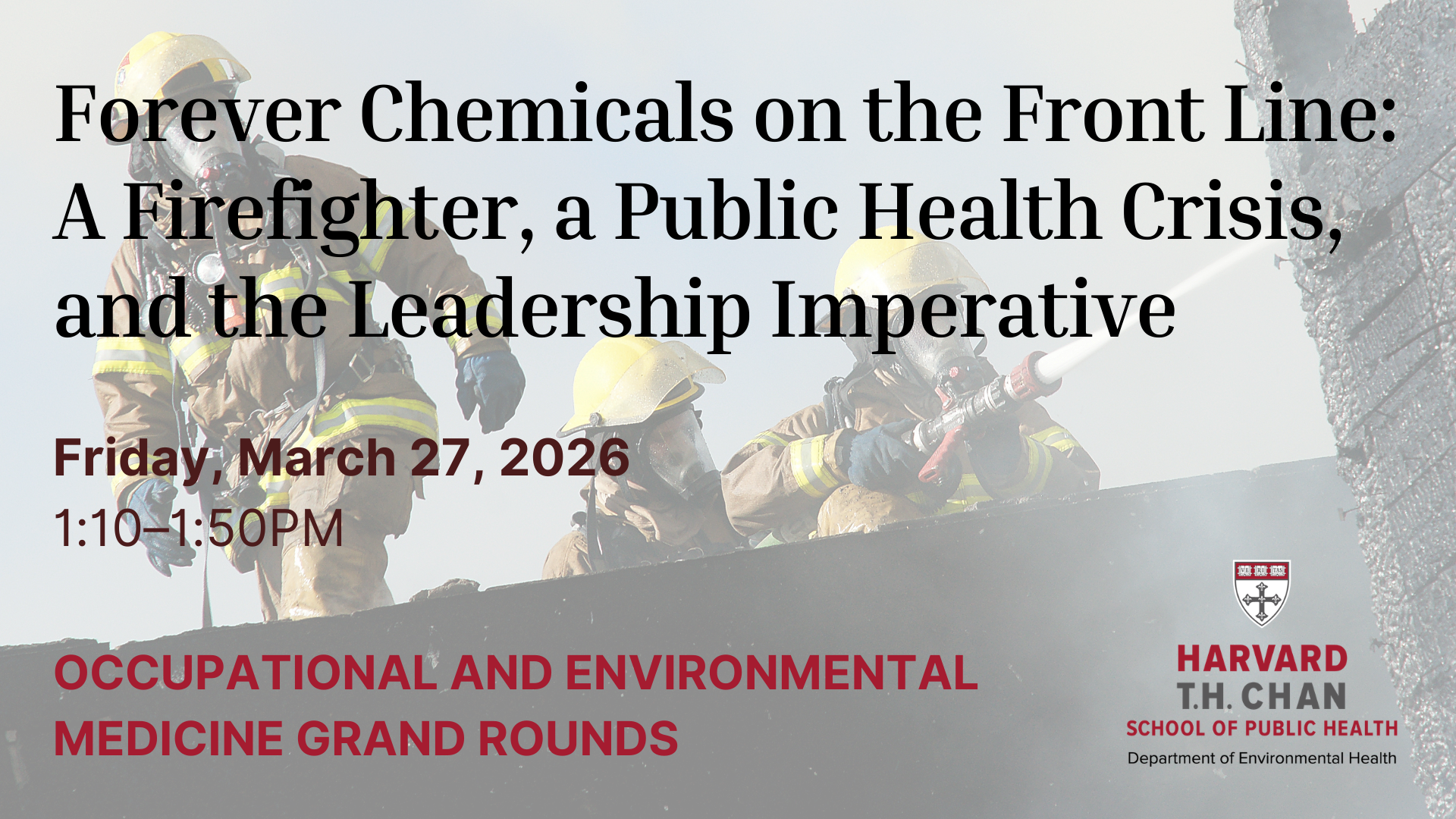
The Department of Environmental Health and the Occupational and Environmental Medicine Residency Program invite you to the Occupational and Environmental Medicine Grand Rounds.
Title: “Forever Chemicals on the Front Line: A Firefighter, a Public Health Crisis, and the Leadership Imperative”
Learning Objectives:
- Describe the toxicology, exposure pathways, and clinical health effects of PFAS, particularly in high-risk occupational groups such as firefighters.
- Apply an occupational and environmental medicine framework to the evaluation, testing interpretation, and longitudinal monitoring of PFAS-exposed patients.
- Integrate clinical science with public health leadership principles to inform decision-making during environmental contamination events, including regulatory navigation and crisis communication.
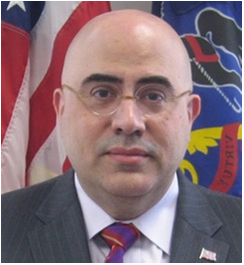
Presenter: Gabriel Carrillo, MD, JD, 1st Yr. OEM Resident
Discussant: Eli Avila, MD, JD, MPH, FCLM, Chief Federal Medical Officer, U.S. Department of Defense/DHA/Watervliet Arsenal;
Distinguished Visiting Professor, School of Health Sciences and Practice – Department of Public Health, New York Medical College, Valhalla, NY; Fellow, New York Academy of Medicine
Location: Building 1, Room 1302 and Zoom
RSVP: Please click here to register.
CMEs for US licensed physicians
This activity has been planned and implemented in accordance with the accreditation requirements and policies of the Accreditation Council for Continuing Medical Education (ACCME) through the joint providership of The Harvard T.H. Chan School of Public Health and the Harvard Chan Education and Research Center. The Harvard T.H. Chan School of Public Health is accredited by the ACCME to provide continuing medical education for physicians. The Harvard T.H. Chan School of Public Health designates this live activity for 1.5 AMA PRA Category 1 Credits™. Physicians should claim only the credit commensurate with the extent of their participation in the activity.
Speaker Information
Organizers
Related Events
Occupational and Environmental Medicine Grand Rounds
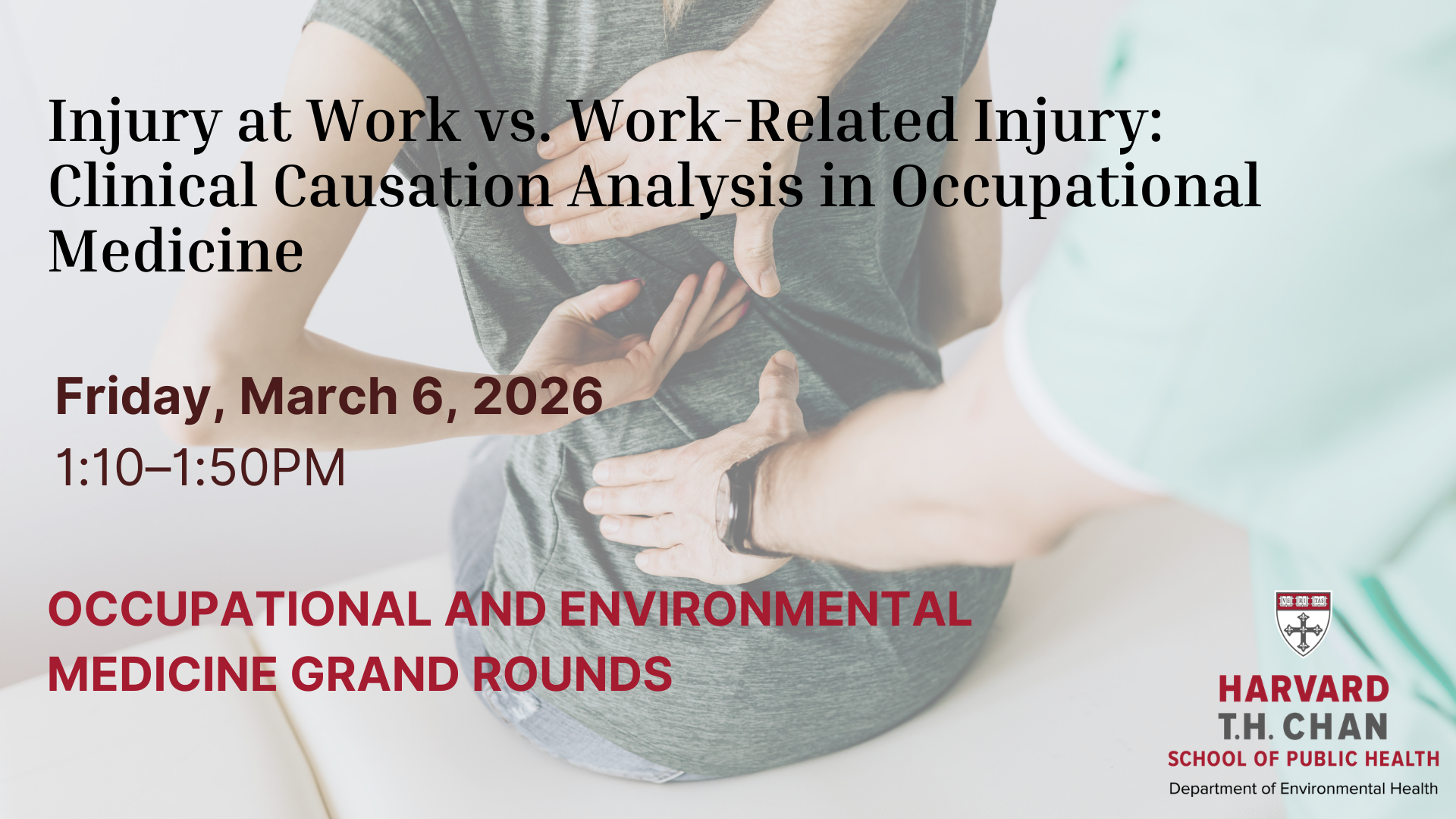
The Department of Environmental Health and the Occupational and Environmental Medicine Residency Program invite you to the Occupational and Environmental Medicine Grand Rounds.
Title: “Injury at Work vs. Work-Related Injury: Clinical Causation Analysis in Occupational Medicine”
Learning Objectives:
Attendees will be able to…
- Differentiate workplace injury events from medically work-related causation using a structured clinical framework.
- Analyze musculoskeletal and neurologic presentations to determine whether job activities plausibly explain pathology.
- Identify clinical red flags suggesting systemic, degenerative, or non-occupational contributors to injury.
Presenter: Hariprasad Korsapati, MD, OEM Complementary Pathway Resident
Discussant: Russell Tontz, MD, Occupational & Environmental Medicine Provider, Cambridge Health Alliance
Location: Building 1, Room 1302 and Zoom
RSVP: Please click here to register.
CMEs for US licensed physicians
This activity has been planned and implemented in accordance with the accreditation requirements and policies of the Accreditation Council for Continuing Medical Education (ACCME) through the joint providership of The Harvard T.H. Chan School of Public Health and the Harvard Chan Education and Research Center. The Harvard T.H. Chan School of Public Health is accredited by the ACCME to provide continuing medical education for physicians. The Harvard T.H. Chan School of Public Health designates this live activity for 1.5 AMA PRA Category 1 Credits™. Physicians should claim only the credit commensurate with the extent of their participation in the activity.
Speaker Information
Hariprasad Korsapati
Russell Tontz
Organizers
Related Events
Occupational and Environmental Medicine Grand Rounds
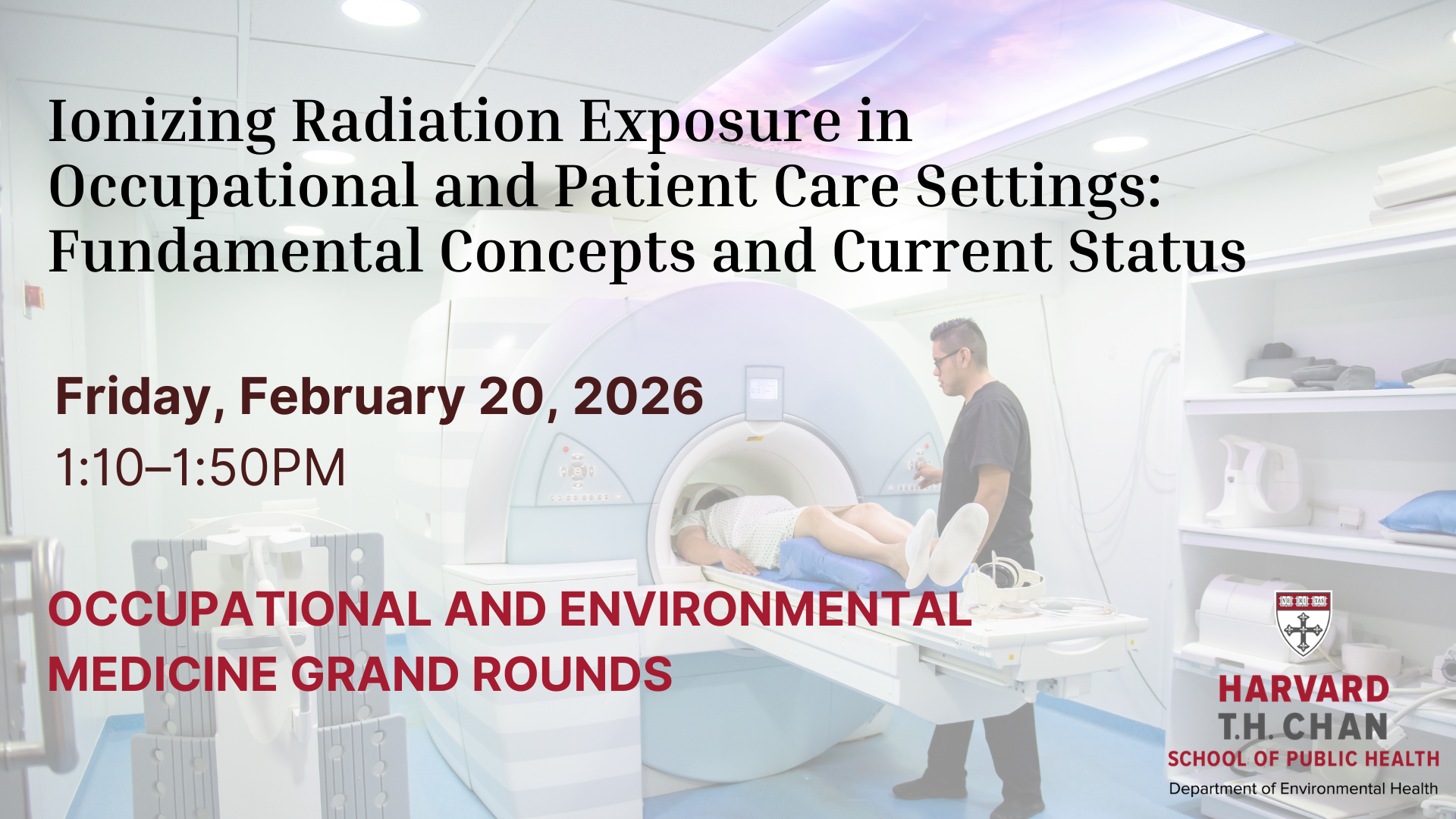
The Department of Environmental Health and the Occupational and Environmental Medicine Residency Program invite you to the Occupational and Environmental Medicine Grand Rounds.
Ionizing Radiation Exposure in Occupational and Patient Care Settings: Fundamental Concepts and Current Status
Presenter: Keith Williams, MD, FACP, 1st Yr. Resident, Occupational & Environmental Medicine, Harvard TH Chan School of Public Health
Discussant: Rajiv Gupta, PhD, MD, MGB Radiology AMC Vice Chair of Clinical Operations, Mass General Brigham; Associate Professor of Radiology, Harvard Medical School; Director, Advanced X-ray Imaging Science (AXIS) Center; Lecturer, Nuclear Science and Engineering, MIT
Learning Objectives: Participants will be able to…
- List the types of ionizing radiation
- Describe the deterministic and stochastic effects of ionizing radiation
- Discuss common methods of radiological protection
- Contrast the level of exposure to ionizing radiation in occupational vs. medical settings
RSVP: Please click here to register.
CMEs for US licensed physicians
This activity has been planned and implemented in accordance with the accreditation requirements and policies of the Accreditation Council for Continuing Medical Education (ACCME) through the joint providership of The Harvard T.H. Chan School of Public Health and the Harvard Chan Education and Research Center. The Harvard T.H. Chan School of Public Health is accredited by the ACCME to provide continuing medical education for physicians.
The Harvard T.H. Chan School of Public Health designates this live activity for 1.5 AMA PRA Category 1 Credits™. Physicians should claim only the credit commensurate with the extent of their participation in the activity.
Speaker Information
Rajiv Gupta
Organizers
Related Events
Occupational and Environmental Medicine Grand Rounds
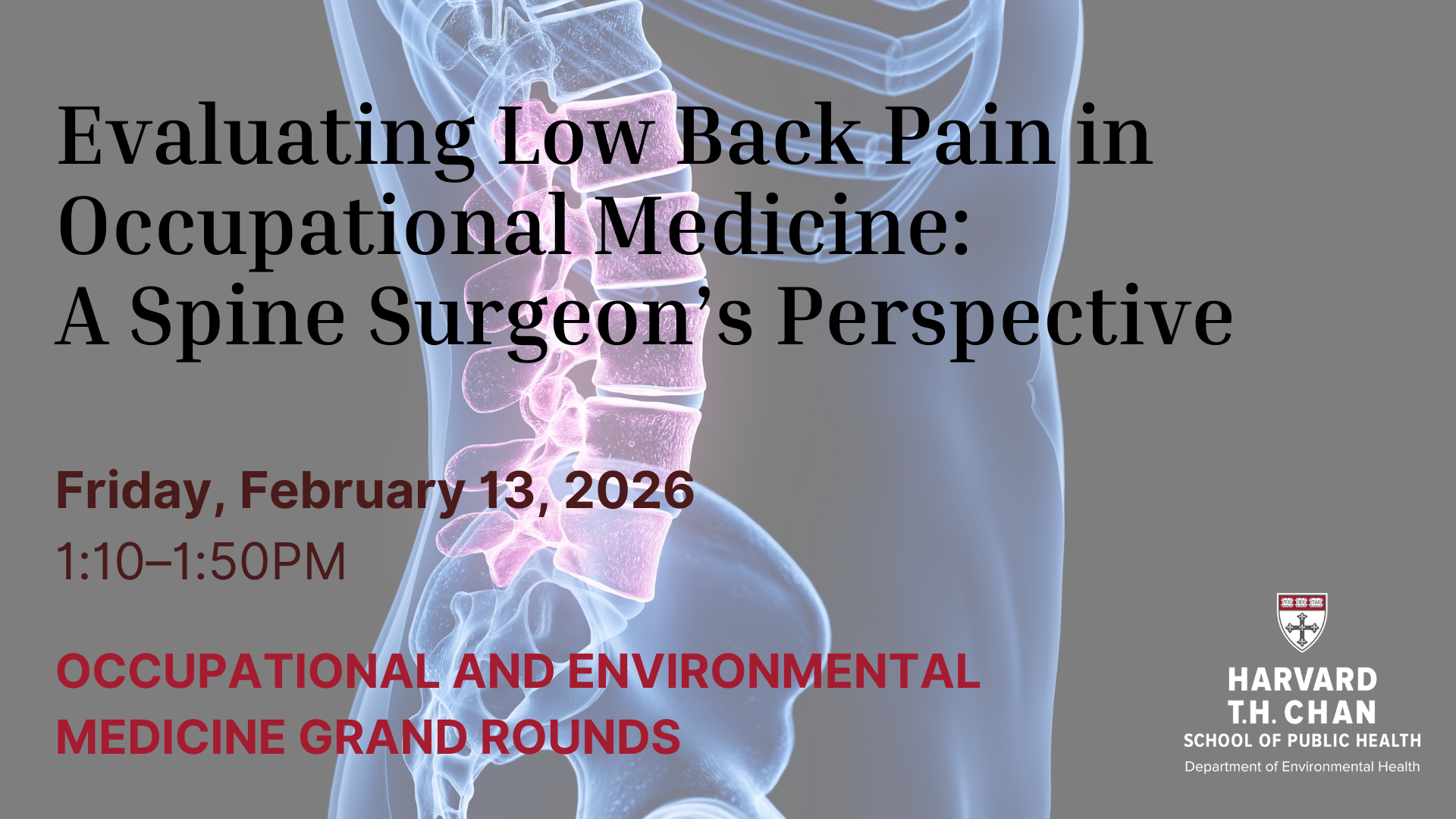
The Department of Environmental Health and the Occupational and Environmental Medicine Residency Program invite you to the next Occupational and Environmental Medicine Grand Rounds.
Evaluating Low Back Pain in Occupational Medicine: A Spine Surgeon’s Perspective
Presenter: Talon Miner, DO, 1st year OEM Resident
Discussant: Chima Ohaegbulam, MD, Board-certified neurosurgeon, Boston Bone & Joint Institute
Learning Objectives:
- Differentiate common mechanical and degenerative causes of low back pain based on clinical presentation and timelines relevant to working populations.
- Apply current evidence-based guidelines and recent spine literature to evaluate low back pain in the occupational medicine clinic.
- Assess clinical features and response to conservative treatment that predict poor outcomes or progression and determine clear, practical referral thresholds for spinal surgery.
RSVP: Please click here to register.
CMEs for US licensed physicians
This activity has been planned and implemented in accordance with the accreditation requirements and policies of the Accreditation Council for Continuing Medical Education (ACCME) through the joint providership of The Harvard T.H. Chan School of Public Health and the Harvard Chan Education and Research Center. The Harvard T.H. Chan School of Public Health is accredited by the ACCME to provide continuing medical education for physicians.
The Harvard T.H. Chan School of Public Health designates this live activity for 1.5 AMA PRA Category 1 Credits™. Physicians should claim only the credit commensurate with the extent of their participation in the activity.
Speaker Information
Chima Ohaegbulam
Organizers
Related Events
(NEW DATE) Pressure points: Balancing clinical and financial priorities in health care

Due to inclement weather, this event will not take place in person or live stream on February 24. Instead, we will record the discussion and post on Harvard Chan YouTube on March 4, 1pm ET.
Pressure Points is a webinar series co-hosted by The Studio and Executive and Continuing Education at Harvard T.H. Chan School of Public Health bringing you inside the business of health care.
As financial pressures intensify across health care, leaders face difficult choices that test their ability to protect clinical excellence while sustaining their organizations. Join leading experts for a candid conversation about navigating the tensions between clinical and financial priorities—and the skills, strategies, and innovations needed to lead effectively through these competing demands.
Register for free to submit your questions.
An on-demand video will be posted after the event.
Speakers
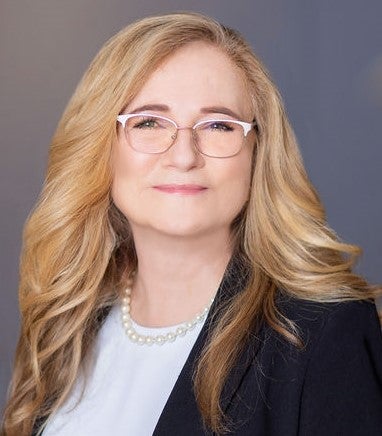
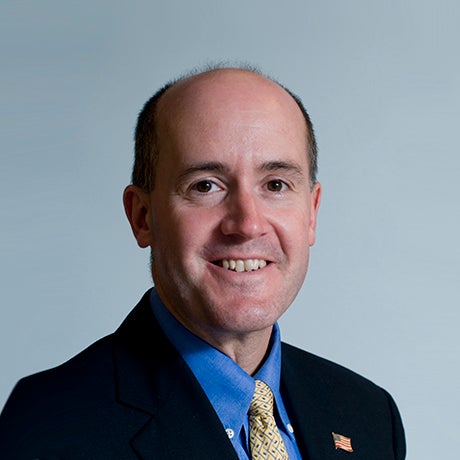
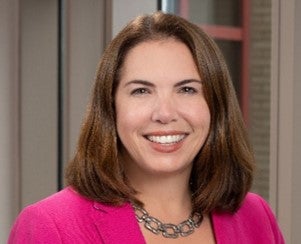
Moderator
About The Organizers
The Harvard Chan Studio is the hub for the School’s premier in-person and live-streamed events. We convene global leaders in health policy, advocacy, industry, and research for insightful conversations about public health’s most pressing challenges and most promising solutions.
Executive and Continuing Education
Strengthen your expertise and build new capabilities to address pressing healthcare and public health challenges. Learn from industry experts and esteemed Harvard faculty and join a global community of peers driven to creating a healthier world.
Monday Nutrition Seminar | Integrating Multi-Omics and Blood-Based ATX(N) Biomarkers to Identify Precision Dietary Paths for Alzheimer’s Prevention in Harvard Cohorts
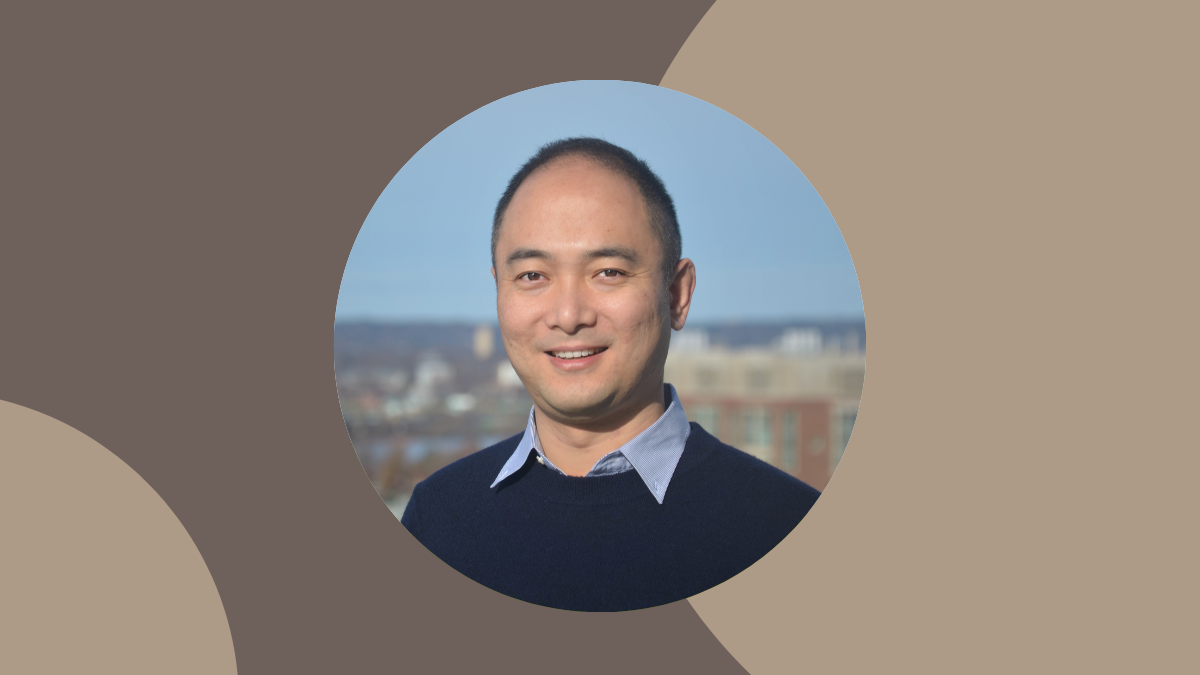
Please join the Department of Nutrition for the Monday Nutrition Seminar featuring Daniel Wang, MD, ScD, Assistant Professor of Medicine at HMS and Assistant Professor in the Department of Nutrition at Harvard Chan School.
Dr. Wang’s talk—”Integrating Multi-Omics and Blood-Based ATX(N) Biomarkers to Identify Precision Dietary Paths for Alzheimer’s Prevention in Harvard Cohorts”.
Registration is required in advance. Healthy snacks will be provided, thanks to the generous support of the Office of the Associate Provost for Student Affairs’ Wellbeing Project Fund.
The Monday Nutrition Seminar Series is free and open to the public. If you plan to attend this event and do not have an active HUID, please fill out the registration form by 3:00 p.m. ET on the Friday before the seminar to request a visitor pass to access the building.
Seminar speakers share their perspectives, they do not speak for Harvard.
Speaker Information
Organizers
Harvard Pop Center Social Demography Seminar: “Credibility laundering as a vector: The afterlives of reactionary knowledge in population studies.”

Brian Keegan, PhD, associate professor of information science, University of Colorado-Boulder, and visiting scientist, Harvard Center for Population and Development Studies, presents “Credibility laundering as a vector: Change-point detection and socio-technical afterlives of reactionary demographic knowledge.”
With the aim of disseminating scholarly research, The Harvard Center for Population and Development Studies hosts a diverse array of speakers. They do not represent or speak for the Center, the School or the University, and hosting them does not imply endorsement of their views, organizations, or employers.
Speaker Information
Organizers
Social Demography Seminar with Jessica Finlay

VIRTUAL
Jessica Finlay, PhD, Assistant Professor of Geography, University of Colorado-Boulder, presents ‘Cognability: A mixed-methods approach to neighborhoods and cognitive health across the life course.’
The Social Demography Seminar (SDS) series at the Harvard Center for Population and Development Studies provides a lively forum for scholars from across the University to discuss in-progress social scientific and population research. Social demography includes work that uses demographic methods to describe and explain the distribution of social goods across populations. The hybrid series offers presentations on a wide variety of topics such as family, gender, race/ethnicity, population health—including mortality, morbidity, and functional health—inequality, immigration, fertility, and the institutional arrangements that shape and respond to population processes.
With the aim of disseminating scholarly research, The Harvard Center for Population and Development Studies hosts a diverse array of speakers. They do not represent or speak for the Center, the School or the University, and hosting them does not imply endorsement of their views, organizations, or employers.
Speaker Information
Organizers
Harvard Pop Center Social Demography Seminar: Navigating—and leveraging—existing data sources to guide sound public health programming to address social determinants of health

Sabrina Hermosilla, PhD, MPH, assistant professor of population and family health, Mailman School of Public Health, Columbia University, presents “Navigating—and leveraging—existing data sources to guide sound public health programming to address social determinants of health.”
The Social Demography Seminar (SDS) series at the Harvard Center for Population and Development Studies provides a lively forum for scholars from across the university to discuss in-progress social scientific and population research. Social demography includes work that uses demographic methods to describe and explain the distribution of social goods across populations. The hybrid series offers presentations on a wide variety of topics such as family, gender, race/ethnicity, population health—including mortality, morbidity, and functional health—inequality, immigration, fertility, and the institutional arrangements that shape and respond to population processes.