Student Government General Body Meeting
Student Government General Body Meeting
Join the Harvard Chan Student Government Association (HCSGA) on Tuesday, April 27, 2027, from 1:00–2:00 p.m. EDT for our next General Body Meeting! All students are welcome to attend in person in Kresge G2 or on Zoom. Food will be provided for in-person attendees.
General Body Meetings are an opportunity to connect with student government, share your experiences on and off campus, and help HCSGA better support, represent, and serve our student community.
Meeting highlights
- Announcements: Hear updates from student government.
- Open mic: Share a concern, comment, idea, or highlight.
- Swap Meet: Offer or request an item, service, skill, or other support.
There will also be a prize incentive for attending every General Body Meeting!
Date: Tuesday, April 27, 2027
Time: 1:00–2:00 p.m. EDT
Location: Kresge G2
Zoom: Join the meeting
Your voice matters. Join us and help shape our community!
Organizers
Health resilience in polycrisis: Reinforcing a health systems approach
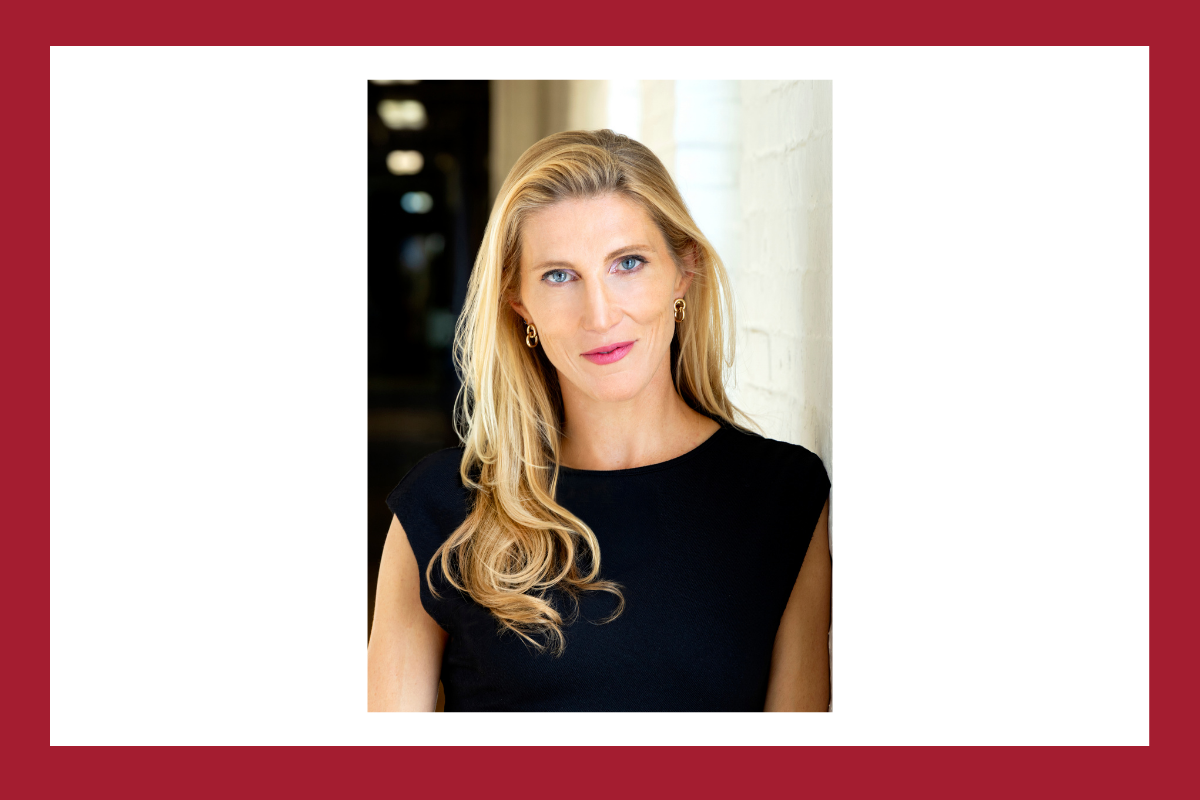
Join the Department of Global Health and Population for this Brown Bag Seminar featuring Vanessa Kerry, co-founder and CEO of Seed Global Health and WHO Special Envoy for Health Resilience. Please note that an HUID is required to attend this in-person seminar.
Speaker bio
Vanessa Kerry, MD, MSc, is the co-founder and CEO of Seed Global Health, where she leads efforts to strengthen health systems by investing in the health workforce. Under her leadership, Seed has trained more than 47,000 health workers who are in service to over 108 million people across Africa. A physician and global health leader, she serves as WHO Special Envoy for Health Resilience and director of Global and Climate Health Policy at Harvard T.H. Chan School of Public Health.
Speaker Information
Organizers
Student Government General Body Meeting
Student Government General Body Meeting
Join the Harvard Chan Student Government Association (HCSGA) on Tuesday, February 23, 2027, from 1:00–2:00 p.m. for our next General Body Meeting! All students are welcome to attend in person in Kresge G2 or on Zoom. Food will be provided for in-person attendees.
General Body Meetings are an opportunity to connect with student government, share your experiences on and off campus, and help HCSGA better support, represent, and serve our student community.
Meeting highlights
- Announcements: Hear updates from student government.
- Open mic: Share a concern, comment, idea, or highlight.
- Swap Meet: Offer or request an item, service, skill, or other support.
There will also be a prize incentive for attending every General Body Meeting!
Date: Tuesday, February 23, 2027
Time: 1:00–2:00 p.m.
Location: Kresge G2
Zoom: Join the meeting
Your voice matters. Join us and help shape our community!
Organizers
Student Government General Body Meeting
Student Government General Body Meeting
Join the Harvard Chan Student Government Association (HCSGA) on Tuesday, November 17, 2026, from 1:00–2:00 p.m. for our next General Body Meeting! All students are welcome to attend in person in FXB G10 or on Zoom. Food will be provided for in-person attendees.
General Body Meetings are an opportunity to connect with student government, share your experiences on and off campus, and help HCSGA better support, represent, and serve our student community.
Meeting highlights
- Announcements: Hear updates from student government.
- Open mic: Share a concern, comment, idea, or highlight.
- Swap Meet: Offer or request an item, service, skill, or other support.
There will also be a prize incentive for attending every General Body Meeting!
Date: Tuesday, November 17, 2026
Time: 1:00–2:00 p.m.
Location: FXB G10
Zoom: Join the meeting
Your voice matters. Join us and help shape our community!
Organizers
Student Government General Body Meeting
Student Government General Body Meeting
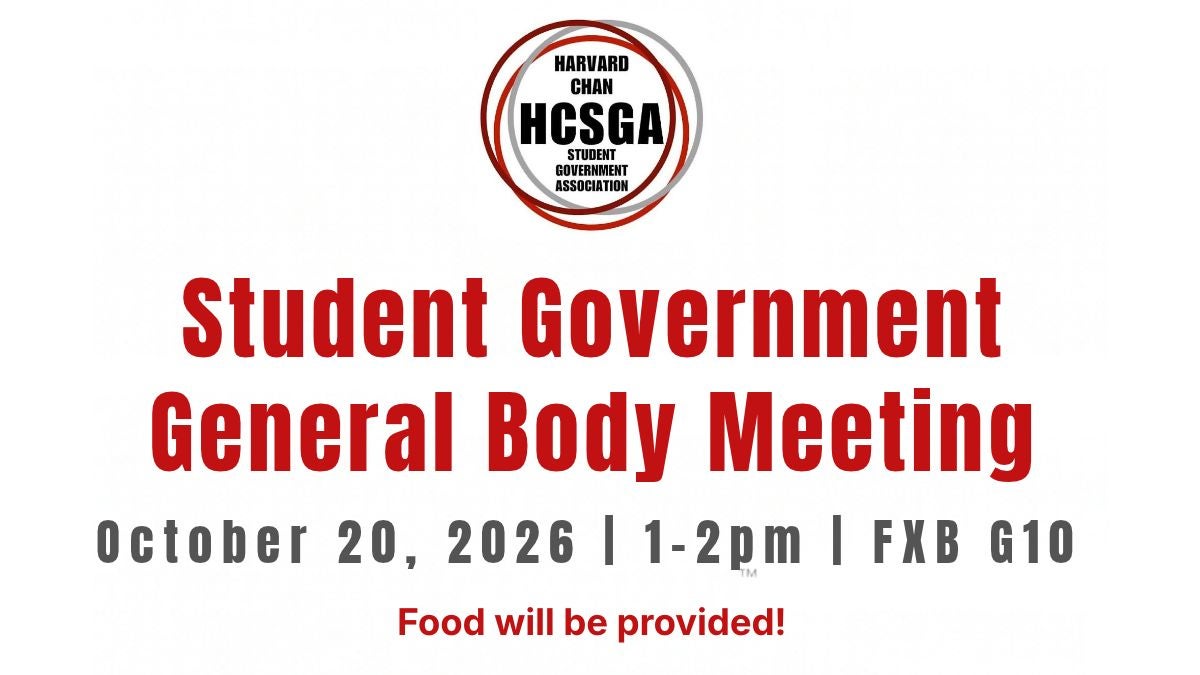
Join the Harvard Chan Student Government Association (HCSGA) on Tuesday, October 20, 2026, from 1:00–2:00 p.m. for our next General Body Meeting! All students are welcome to attend in person in FXB G10 or on Zoom. Food will be provided for in-person attendees.
General Body Meetings are an opportunity to connect with student government, share your experiences on and off campus, and help HCSGA better support, represent, and serve our student community.
Meeting highlights
- Announcements: Hear updates from student government.
- Open mic: Share a concern, comment, idea, or highlight.
- Swap Meet: Offer or request an item, service, skill, or other support.
There will also be a prize incentive for attending every General Body Meeting!
Date: Tuesday, October 20, 2026
Time: 1:00–2:00 p.m.
Location: FXB G10
Zoom: Join the meeting
Your voice matters. Join us and help shape our community!
Organizers
Where Climate Change and Child Protection Meet
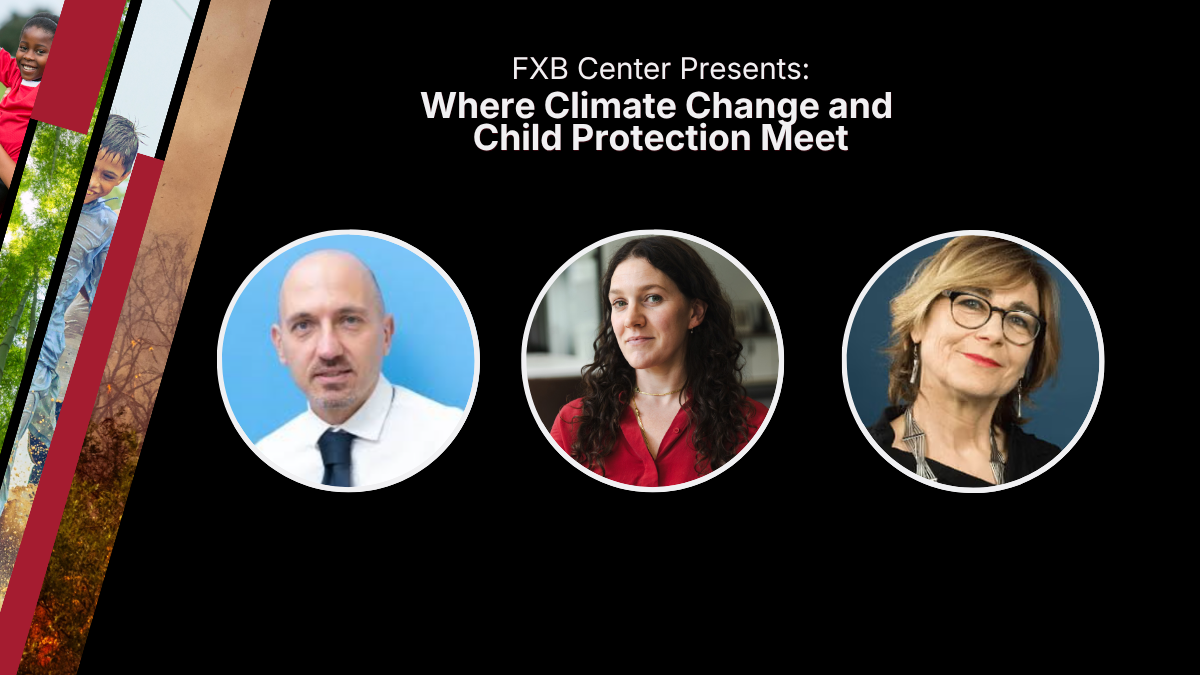
Join the FXB Center for Health and Human Rights on Zoom for a timely discussion on the intersection between climate action and child protection. FXB Research Director Professor Jacqueline Bhabha will be joined by practitioners working directly in this space.
Speaker Information
Organizers
Cascading and emergent water risks at the margins with Marccus Hendricks, PhD, MPH
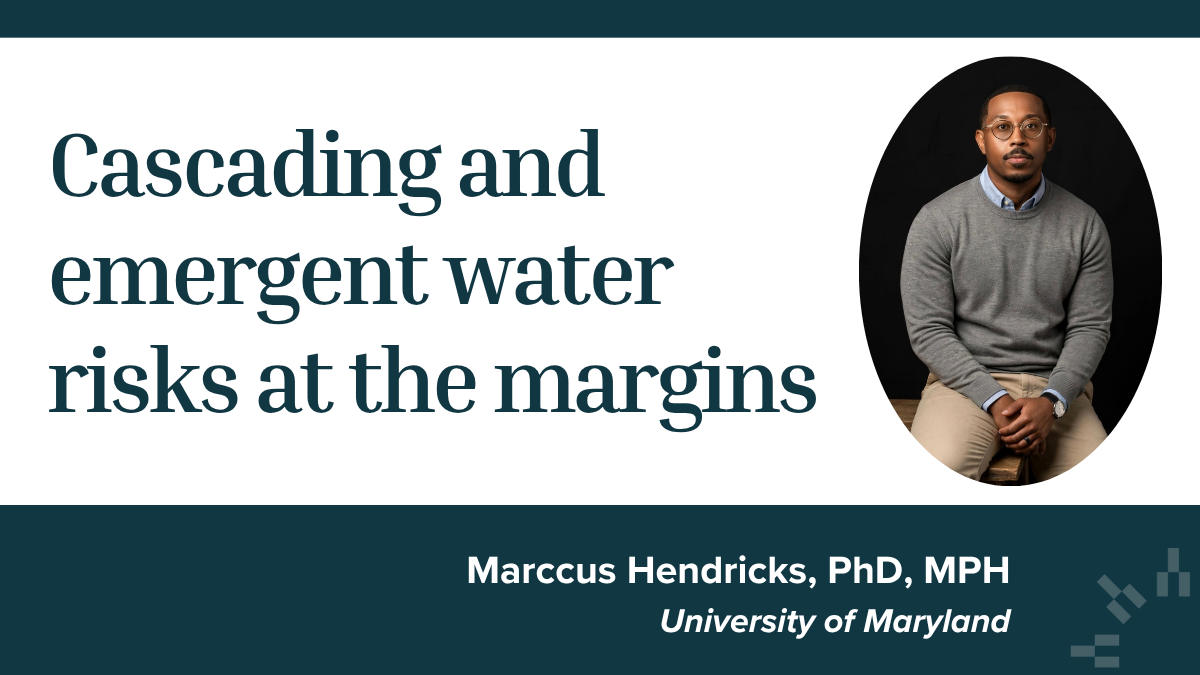
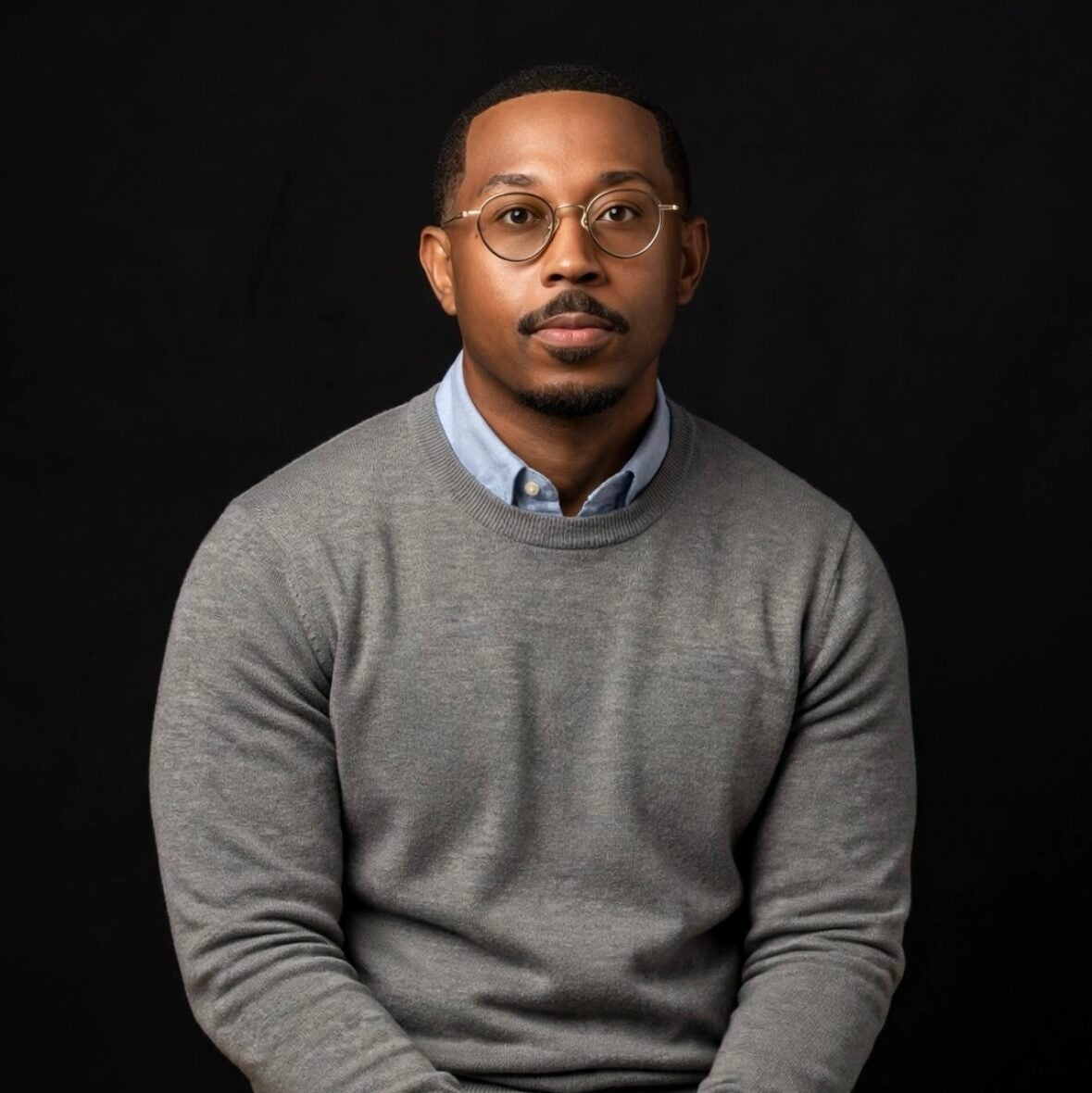
Please join the Harvard Chan NIEHS Center for Environmental Health and the Department of Environmental Health for a talk by Marccus Hendricks, PhD, MPH, Associate Professor of Urban Studies and (Environmental) Planning at the University of Maryland. Dr. Hendricks will discuss “Cascading and emergent water risks at the margins: Insights from the Stormwater Infrastructure Resilience and Justice (SIRJ) Lab.”
This event will be held in person (HSPH Bldg. 1, 1302) and via Zoom. Register here
Trainee meeting for students and postdocs immediately following the seminar, 2-2:30 pm, in 1306A! Come in-person to discuss research interests, career plans, and funding opportunities. RSVP here!
Abstract
Stormwater hazards are unevenly distributed across urban landscapes, with working-class communities of color disproportionately exposed to a variety of water risks; conditions intensified by extreme weather. This talk examines how “cascading and emergent water risks” arise at the intersection of aging infrastructure, environmental variability, and social inequality.
Drawing on research from the SIRJ (pronounced surge) Lab, Dr. Marccus Hendricks introduces conceptual frameworks that situate stormwater systems within broader social, political, and environmental contexts, emphasizing how infrastructure access and performance are shaped by inequitable planning and governance. He demonstrates how cascading risks, such as stormwater runoff, sewer overflows, and basement backups, create emergent hazards that extend beyond traditional flooding to impact health, housing, and well-being.
The talk additionally highlights sensing technologies and advanced GIS modeling to track water and infrastructure, monitor performance, and assess real-time conditions. A Baltimore case study illustrates a multi-method approach to evaluate interconnected risks and inform more equitable infrastructure planning and management.
About the speaker
Marccus D. Hendricks is an Associate Professor of Urban Studies and (Environmental) Planning at the University of Maryland (UMD), where he directs the Stormwater Infrastructure Resilience and Justice (SIRJ) Lab and holds affiliations in engineering and public health. In 2023, he served as Senior Advisor for Climate and Community Resilience in the inaugural Office of Environmental Justice at the White House Council on Environmental Quality.
A leading scholar of environmental justice, infrastructure resilience, and water risks, Dr. Hendricks examines how social processes and development patterns shape hazardous environments that disproportionately affect marginalized communities. His work has been featured by the Associated Press, Washington Post, CNN, NPR, Bloomberg, and Scientific American, among others.
Dr. Hendricks is a 2026–2027 Harvard Radcliffe-Salata Climate Justice Fellow, former U.S. EPA Science Advisory Board member, author on the U.S. Fifth National Climate Assessment, and a 2021 Grist 50 “Fixer.” He holds a PhD in Urban and Regional Sciences and MPH from Texas A&M University.
Speaker Information
Organizers
CultureFest 2026
Join the Office for Student Affairs for our annual CultureFest on Wednesday, October 14, from 5:30–7:00 p.m. in the Kresge Cafeteria.
Hosted by Harvard Chan student organizations, CultureFest celebrates the cultures and experiences that make up our community. Stop by to enjoy cultural snacks, try interactive activities, and connect with students and colleagues. Everyone is welcome—we hope to see you there!
Organizers
Poster Design Essentials and Presentation Delivery – Countway @ Kresge Brown Bag Series
Join Countway and HSPH for a new lunchtime brown bag series focused on common topics that come up in research and scholarly communication!
Posters are a great, concise method to present your research as it forces you to focus on the highlights and share the most captivating bits. And just like your poster, your presentation needs to be brief and to-the-point.
In this one-hour session, we will explore guidelines and considerations for creating physical and digital research posters and maintaining an impactful professional presentation. Along with poster essentials we will review some of the important techniques that will help you prepare for, and execute, a public speech for any occasion.
Organizers
Publish Your Research: Journal Selection, Manuscript Preparation, and Author Rights – Countway @ Kresge Brown Bag Series
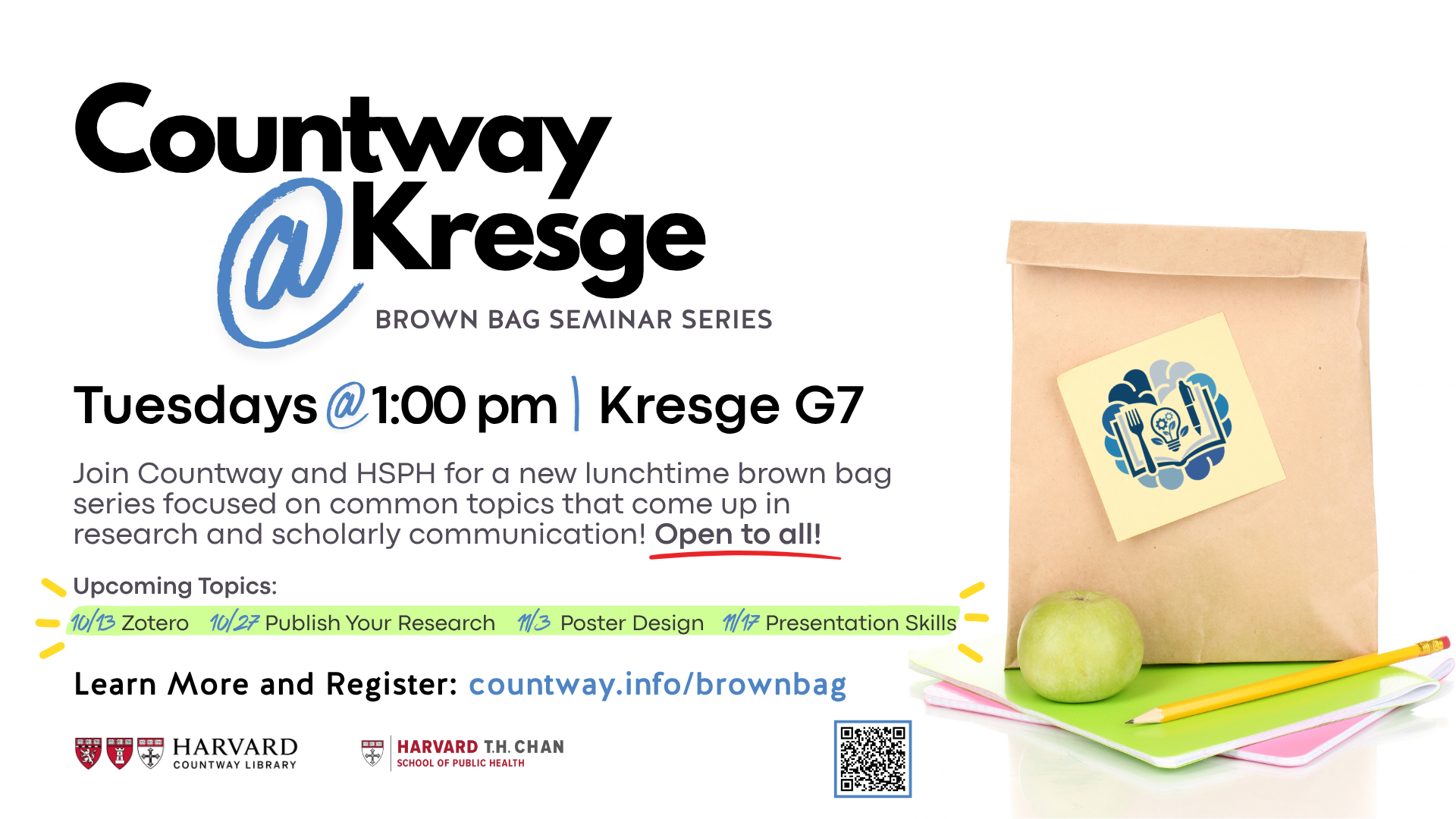
Join Countway and HSPH for a new lunchtime brown bag series focused on common topics that come up in research and scholarly communication!
We’ll provide guidance in selecting the best scholarly journal to reach your intended audience and ensure that your published research generates high impact. Learn how to ensure you retain important rights to your scholarship, and how this may impact your ability to share your article more broadly in the future. Most importantly, we will look at ways to avoid falling victim to predatory publishers and be able to identify trusted publishers/journals.