The lens we carry
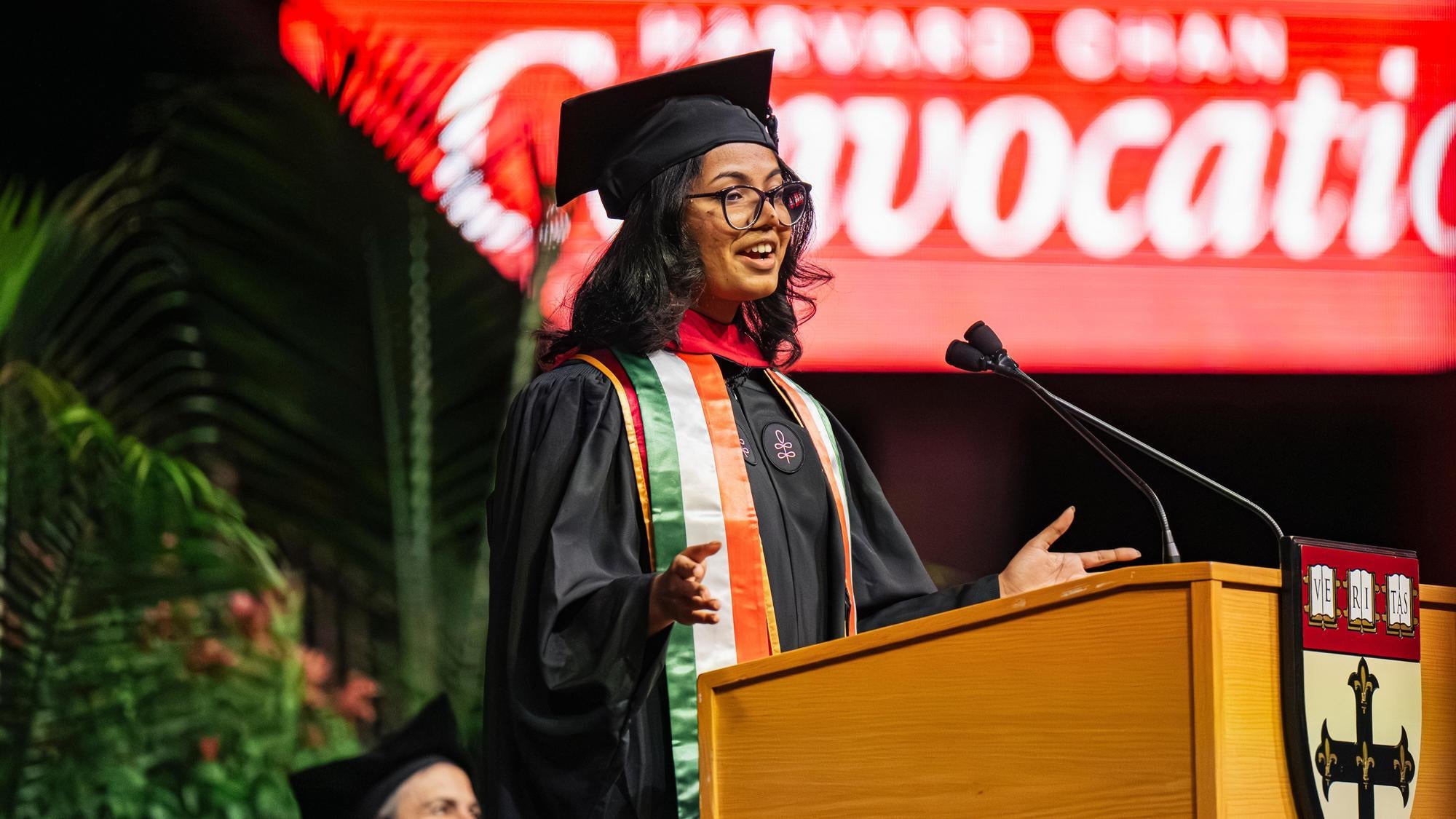
Class of 2026 Convocation student speaker speech by Rajeshwari Subramanian, MPH ’26
Good afternoon and namaste, Dean Baccarelli, esteemed faculty, fellow graduates, family and friends
I want to start with a simple question: What do you notice when you enter a room?
Some people notice who’s there. Others notice the food, or where their friends are sitting.
I notice the stairs.
I notice if there’s a ramp, how wide the elevators are,
if a wheelchair could fit between the tables.
Because before I ever learned the words public health, I learned what it meant to live in a world that wasn’t built for someone I love.
When I was young, my family was in a road accident that left my father with quadriplegia, or paralysis from the neck down. Overnight, our lives changed.
Our home in Mumbai went from a home to a system, of caregiving and improvisation. An old microphone stand attached to a flat wooden board became a table so my father could read again.
I grew up watching my mother become a full-time caregiver and my father navigate a world that told him, time and again: you were not considered when this was built.
I noticed the buildings without entry points, the stares that lingered a second too long. The small frictions that led to a life made harder than it needed to be.
That was my FIRST LENS. A lens shaped by access. dignity and the invisible barriers most people never have to see.
And then… I came to Harvard….And I realized that everyone here carries a lens. Some of us see the world through the lens of the climate, or nutrition or housing disparities. But what struck me most was this:
Public health is where people care. Truly, deeply care.
Not just in a well-intentioned way. In a specific way. We care about the air in a neighbourhood, whether a child is raised with love, or whether someone can afford healthy food.
In this space, I didn’t just refine my lens. I gained yours.
A classmate made me see that a doctor’s waiting room is often the last line of defence and for too many patients… already too far away.
A friend who spent years in gender equity ensuring young people have a language for their bodies made me question what our curriculums exclude.
And another working to upskill youth in the Global South made me realise that potential doesn’t disappear, it just goes unmet.
All this feels personal now. Because once we began to see through each other’s lenses, distance disappears. That is what Harvard has given us. Not just knowledge. But new ways of seeing.
And here’s the thing about seeing: Once you see something, you can’t unsee it.
You cannot unsee who was left out of the design, you cannot unsee where the system fails
And that is not just our burden to carry, its our superpower. Because the world does not just change through big, dramatic revolutions. It changes because people like us will walk into rooms : and notice things others don’t. And decide: This shouldn’t be this way.
So, as we leave, we don’t just carry our diplomas. We carry these lenses shaped by our stories, refined by this education and expanded by each other.
The question now is not just what we see. It is what do we refuse to ignore?
For me, it started with a ramp. For you, it may be something else.
But whatever it is; hold onto it.
Because that lens, is not just how you see the world. It is how you will change it.
Congratulations, Class of 2026!