Conflict, Feedback, and Negotiation in Health Care

Program Overview
Date: February 22–25, 2027
Modality: Online Live
Certificate of Specialization eligibility:
Build Essential Negotiation and Conflict Management Skills
The stakes are high in healthcare. The ability to negotiate and manage conflict is crucial to guiding your organization. As the healthcare landscape continues to change, the need for effective leadership and communication skills for managerial stakeholders continues to be pivotal.
This online program is designed to build on your leadership and management skills. This course will empower you with cutting-edge skills and confidence to tackle the challenging situations you face as a leader. These techniques can be used by any stakeholders; be you a physician leader, practicing physician, residency director, or nurse manager.
Harvard faculty will enhance your ability to face the most complex situations and conversations with greater confidence. Instructors use a combination of learning approaches such as teaching mini case studies, interactive classroom discussions, and helping you apply newly learned skills to real work situations.
By the end of the program, you will have built the confidence and developed the skills necessary to be more effective at managing conflict, having difficult conversations, and negotiating with others.
Program Details
Leaders spend considerable time managing interpersonal conflict. The substantive issues being negotiated in healthcare often require a difficult decision between two equally good or bad alternatives—with the care of a patient in the mix. The need to effectively and quickly negotiate through informal, unarticulated channels makes strong relationships critical.
One way to effectively manage conflict and ultimately build strong relationships as a leader is through frame-based feedback, which is founded on the concept that people’s actions are driven by their “frames,” or their point of view regarding the situation at hand. Without discussing a feedback receiver’s frames, changes to his or her learning and behavior is unlikely.
Within a learning environment that will facilitate career growth, this program will develop your expertise in the following critical areas:
Through this program, you will learn how to:
- Develop strategies for overcoming the barriers and challenges to conflict management
- Apply the skills of using frame-based feedback to conflict management and relationship building
- Identify the key components of organizational accountability for supporting a culture of trust and psychological safety
Through this program, you will learn how to:
- Explore the dynamics of influence in the context of healthcare leadership
- Develop strategies for overcoming the most difficult challenges of negotiation
- Apply the skill of interest-based negotiations to real situations
- Develop effective methods for driving decisions
From Our Alumni
“The content is excellent and there are frequent breakout sessions to practice the new frameworks and tools. I left feeling much more confident and competent in these skills. I know there will be many chances to continue practicing these approaches to disruptive behavior, negotiation, and decision-making structure outside the course.”
—Karina Stone, MD, Unity Hospital Adult Inpatient Med Director
Program Logistics
All Times are Eastern Time (ET).
| Monday, February 22, 2027 | ||
|---|---|---|
| 4:00–5:00 pm | Program Introduction | Tuesday, February 23, 2027 |
| 8:00–9:00 am | Psychological Safety: Why it’s important and how to overcome barriers to supporting this culture | |
| 9:00–9:10 am | Break | |
| 9:10–10:10 am | Psychological Safety: Why it’s important and how to overcome barriers to supporting this culture | |
| 10:10–10:20 am | Break | |
| 10:20–11:20 am | Skills for Conflict Management: Using frame-based feedback | |
| 11:20–11:30 am | Break | |
| 11:30 am–12:30 pm | Skills for Conflict Management: Using frame-based feedback | Wednesday, February 24, 2027 |
| 8:00–9:00 am | Building an Organizational Program to Support a Culture of Trust | |
| 9:00–9:10 am | Break | |
| 9:10–10:10 am | Building an Organizational Program to Support a Culture of Trust | |
| 10:10–10:20 am | Break | |
| 10:20–11:20 am | The Challenges of Influence in Healthcare | |
| 11:20–11:30 am | Break | |
| 11:30 am–12:30 pm | The Challenges of Influence in Healthcare | Thursday, February 25, 2027 |
| 8:00–9:00 am | Negotiating for Outcomes Without Damaging Relationships | |
| 9:00–9:10 am | Break | |
| 9:10–10:10 am | Negotiating for Outcomes Without Damaging Relationships | |
| 10:10–10:20 am | Break | |
| 10:20–11:20 am | Negotiating to a Decision | |
| 11:20–11:30 am | Break | |
| 11:30 am–12:30 pm | Negotiating to a Decision |
This agenda is subject to change.
This program is specifically designed for physician leaders. Clinicians with the titles below are strongly encouraged to apply:
- Assistant VP
- Assistant Medical Director
- Chair
- Chief Medical Officer
- Chief Operating Officer
- Director
- Division Chief
- Executive Director
- Executive Administrator
- Medical Director
- Non-Physician Dyad Partner
- Nurse Manager
- Program Director
- Professor
- Residency Director
- Service Line Leader
- VP
- Vice Chair
Current faculty, subject to change
Jo Shapiro
Associate Professor of Otolaryngology – Head & Neck Surgery
Harvard Medical School
Theodore J. Witherell
Primary Faculty
Harvard T.H. Chan School of Public Health
The Harvard T.H. Chan School of Public Health is accredited by the Accreditation Council for Continuing Medical Education (ACCME) to provide continuing medical education for physicians.
The Harvard T.H. Chan School of Public Health designates this live activity for a maximum of 12 AMA PRA Category 1 Credits™. Physicians should claim only the credit commensurate with the extent of their participation in the activity.
The American Medical Association (AMA) has an agreement of mutual recognition of continuing medical education (CME) credit with the European Union of Medical Specialties (UEMS). Additional information regarding this agreement may be found on the American Medical Association (AMA) website.
Harvard T.H. Chan School of Public Health will grant 1.2 Continuing Education Units (CEUs) for this program, equivalent to 12 contact hours of education. Participants can apply these contact hours toward other professional education accrediting organizations.
All credits subject to final agenda.
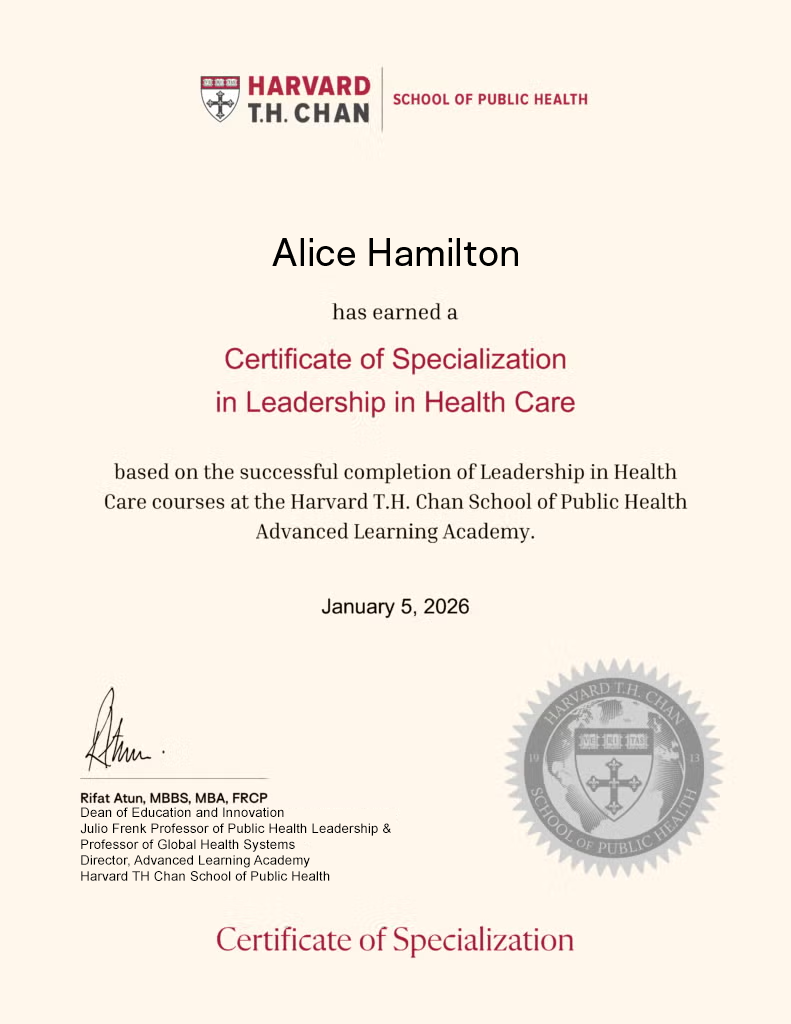
This program also contributes to the Leadership in Health Care Certificate of Specialization, among others. While each program can be taken independently, completing multiple courses in our portfolio earns the Certificate of Specialization.
Certificate of Specialization
Earn a Leadership in Health Care Certificate of Specialization
Take this program to earn a Certificate of Completion, or take 3 to earn a Certificate of Specialization. Learn more here.