Exploring links between viruses and neurological disorders

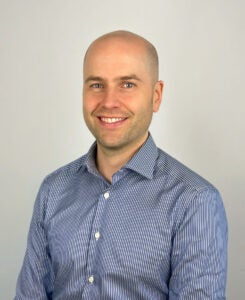
Kjetil Bjornevik first came to Harvard Chan School as a visiting researcher in 2014 while he was earning his PhD at the University of Bergen, Norway. He later served as a postdoctoral research fellow and research scientist, before joining the faculty as an assistant professor of epidemiology and nutrition in 2023. He also co-directs the School’s neuroepidemiology program, which provides training for students and fellows in how to investigate the roles of exposures and lifestyle factors in neurological diseases.
Bjornevik was first author of the landmark 2022 study that confirmed Epstein-Barr virus (EBV) as the leading cause of multiple sclerosis, and in a study published earlier this year, he found that healthy diets in midlife may benefit long-term cognitive health. He recently spoke about his research and what’s next for his work.
Q: What’s your overall goal for your research?
A: My motivation is always to find something that can help patients and people at risk of disease. Toward that end, the big goal is to identify targets for intervention that could reduce the risk or slow the progression of neurodegenerative diseases. Targets could be existing drugs that can be repurposed—for example, research has come out in the last few years that the shingles vaccine seems to lower the risk of dementia. Or they could be lifestyle factors, or something entirely novel that can be used to develop new drugs or vaccines.
Q: What’s next for your team’s research on EBV?
A: We’re part of a consortium that’s funded by the European Union, specifically on trying to proceed on the findings from the 2022 paper. Part of the goal is to do clinical trials. We’re testing whether antiviral therapies can have an effect against EBV in patients and in healthy adults. One trial recently finished, and the results should be published by the fall. The second one is starting this spring.
Q: You helped develop a screening strategy for identifying individuals at high risk of Parkinson’s disease. Would you explain that research?
A: A major focus in Parkinson’s disease research is to try to identify individuals earlier in the disease course. Currently, most people have had the disease for 15 or 20 years by the time they are diagnosed. That’s probably why many clinical trials with Parkinson’s patients fail—the disease has progressed so far that it’s less likely for the drugs to work.
We published a paper in 2025 focusing on three symptoms that could identify people at high risk of developing clinical Parkinson’s later: a reduced sense of smell, likely REM sleep behavior disorder [which causes people to act out behaviors in dreams such as running], and constipation. We found that individuals who had all three symptoms had a much higher risk of developing Parkinson’s. Ifwe can further validate these findings, they could be used as a screening tool.
Q: You also have been studying Alzheimer’s disease and infections. What’s the status of that work?
A: We’re just getting started on a project to investigate the role of infections in Alzheimer’s disease and have been sending samples out for laboratory analysis. The goal of the study is to try to clarify the role of a specific family of viruses called herpes viruses. In addition, we’re going to look more comprehensively at past infections from other viruses that have not previously been linked to Alzheimer’s disease.
Because it can be tricky to distinguish Alzheimer’s disease from other types of dementia based on clinical symptoms, we’re using a very specific blood test for Alzheimer’s disease pathology.