Applied Health Care Quality Improvement Through Simulation

Program Overview
Date: April 12-June 7, 2027
Modality: Online Blended (self-paced content & live sessions)
Certificate of Specialization eligibility:
Lead healthcare improvement with a real-world simulation
Understanding improvement science is the starting point. Being able to lead an improvement initiative, step by step, under real conditions, with real data, is the goal. This course takes participants through the complete improvement journey in a structured, instructor-led environment designed to build practical capability and the confidence to act.
The core of the course is a synchronous group simulation exercise built around a real-world case study. Working with peers and guided by the instructor, participants move through each stage of the Model for Improvement: defining an aim, assembling a team, mapping the current system, designing indicators, testing changes, plotting time-series data, and making data-driven decisions to iteratively improve results. Methods and tools are introduced just-in-time as they arise within the simulation, ensuring that learning is always grounded in application rather than abstraction.
Running in parallel with the simulation, participants use the provided template to design their own healthcare improvement project. At each stage of the simulation, they apply the same methods and tools in the simulation exercise to a priority relevant to their own setting. By the end of the course, each participant will have produced a complete improvement project design ready for implementation.
Advanced topics, including collaborative improvement, leading improvement, scaling up improvement, learning about improvement, and the relationship between quality assurance and quality improvement, extend the curriculum to prepare participants for the broader landscape of improvement work.
Program Details
In this course, learners will be able to:
- Articulate the key challenges in healthcare quality and explain the rationale for a science-based approach to improvement
- Describe the dimensions of quality care and apply them to their own professional context
- Explain the frameworks that guide organized improvement efforts, including the distinction between discovery and delivery
- Identify the core principles of improvement science and describe how each shapes the design of effective improvement initiatives
- Explain why standards, training, or measurement alone are insufficient drivers of sustained improvement
- Draw on real-world improvement examples to recognize how improvement methods are applied across diverse healthcare settings
- Draft the building blocks of an improvement project for their own setting: an aim statement, a team map, a process analysis, a measurement plan, and a time-series display
This course is intended for healthcare leaders and professionals who are ready to lead an improvement initiative, such as:
- Mid-level health care leaders who want a practical approach and means to contextualize their learnings for current or future health care improvement projects
- Senior leaders who have had previous training in health care improvement and want more practical application in their learning for a current or future projects
- Various health care personnel with titles that may include: Health Care Project Managers; Director of Quality Improvement; Director of Patient Experience; Director of Hospital Operations; Director of Patient Safety; Physician and Nurse Leaders; Director of Engagement; Service Line Leaders; Executive Directors; Ministry of Health Team Leaders; Directors of Programs; and more
This is an online blended course, consisting of both self-paced (asynchronous) and live (synchronous) sessions.
The core of this course is a live online simulation of a healthcare improvement project. It starts with setting the aim for improvement and goes through achieving the desired results. Course participants are divided up into small groups to work on this simulation of seven 1.5-hour sessions. Each session consists of a 10-minute introduction, group exercises, guided work in small groups, and a discussion.
Leading up to the simulation are self-paced modules which introduce healthcare quality improvement concepts, principles, methods, and examples.
Following the simulation exercise, advanced concepts are introduced using a combination of self-paced content and live sessions.
Modules
- Quality of Healthcare (Self-paced/Asynchronous)
- Overview of Improving Healthcare (Self-paced/Asynchronous)
- Examples of Improving Healthcare (Self-paced/Asynchronous)
- Defining Improvement Aim(s) (Live/Synchronous)
- Forming the Improvement Team (Live/Synchronous)
- Understanding the Current Process (Live/Synchronous)
- Developing Indicators I & II (Live/Synchronous)
- Developing, Testing, and Implementing Changes (Live/Synchronous)
- Setting Up and Plotting a Time Series Chart (Live/Synchronous)
- Additional Concepts and Approaches in Improving Health Care (Self-paced/Asynchronous)
- Additional Concepts and Approaches in Improving Health Care (Self-paced/Asynchronous)
- Additional Concepts and Approaches in Improving Health Care (Self-paced/Asynchronous)
- Leading Improvement (Live/Synchronous)
- Final Discussion, incl. Pseudoinnovation & the Question of Improvement (Live/Synchronous)
Program Logistics
| Week | Module | Format | Live Session Date & Time |
|---|---|---|---|
| Week 1 – Begins Mon, April 12 | Module 1: Quality of Healthcare | Self-paced | — |
| Week 2 – Begins Mon, April 19 | Module 2: Overview of Improving Healthcare | Self-paced | — |
| Week 3 – Begins Mon, April 26 | Module 3: Examples of Improving Healthcare | Self-paced | — |
| Modules 1–3 Synthesis + Q&A | Live | Thu, April 29, 9:00–10:00am ET | |
| Week 4 – Begins Mon, May 3 | Module 4: Defining Improvement Aim(s) | Live | Mon, May 3, 9:00–10:30am ET |
| Module 5: Forming the Improvement Team | Live | Tue, May 4, 9:00–10:30am ET | |
| Module 6: Understanding the Current Process | Live | Wed, May 5, 9:00–10:30am ET | |
| Week 5 – Begins Mon, May 10 | Module 7: Developing Indicators I | Live | Mon, May 10, 9:00–10:30am ET |
| Module 7: Developing Indicators II | Live | Tue, May 11, 9:00–10:30am ET | |
| Module 8: Developing, Testing, and Implementing Changes | Live | Wed, May 12, 9:00–10:30am ET | |
| Module 9: Setting Up and Plotting a Time Series Chart | Live | Thu, May 13, 9:00–10:30am ET | |
| Week 6 – Begins Mon, May 17 | Module 10: Additional Concepts and Approaches in Improving Health Care | Self-paced | — |
| Week 7 – Begins Mon, May 24 | Module 11: Additional Concepts and Approaches in Improving Health Care | Self-paced | — |
| Week 8 – Begins Mon, May 31 | Module 12: Additional Concepts and Approaches in Improving Health Care | Self-paced | — |
| Module 13: Leading Improvement | Live | Wed, June 2, 9:00–10:00am ET | |
| Week 9 – Begins Mon, June 7 | Module 14: Final Discussion – Pseudoinnovation, The Question of Improvement & Final Q&A | Live | Wed, June 9, 9:00–10:00am ET |
Current faculty, subject to change
M. Rashad Massoud
Healthcare Improvement Instructor
Harvard T.H. Chan School of Public Health
Head, Global Health
USA
IQVIA

Please return to our website at a later date for credit information.
Certificate of Specialization
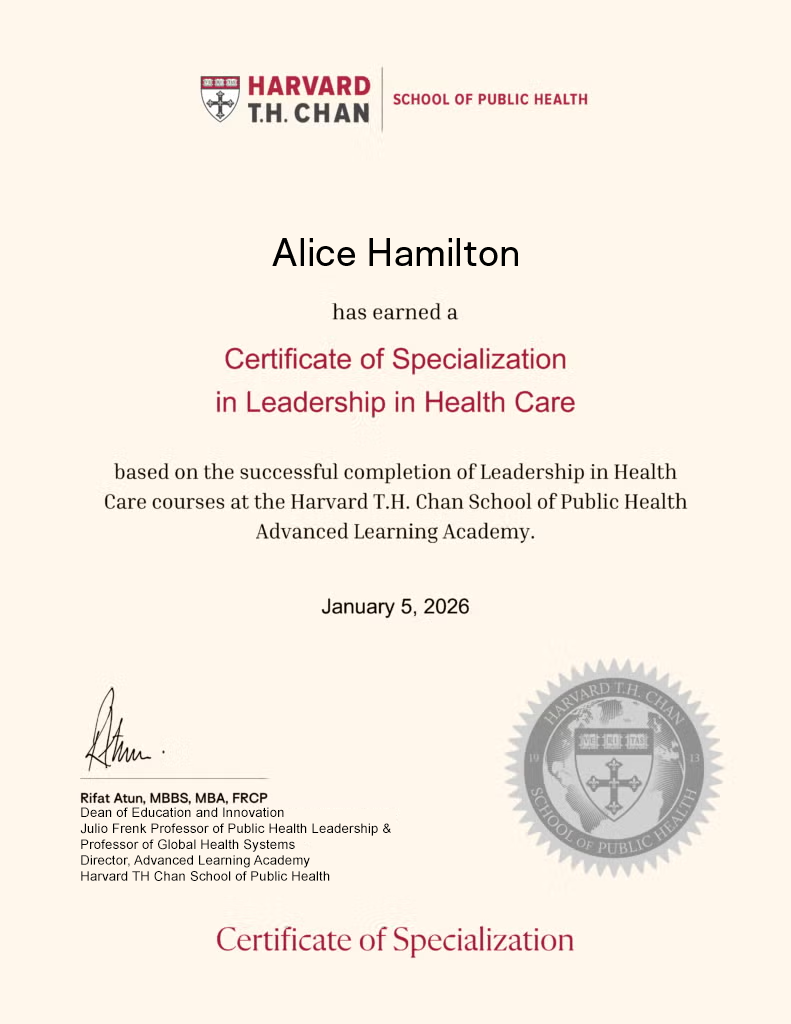
Earn a Leadership in Health Care Certificate of Specialization
Take this program to earn a Certificate of Completion, or take 3 to earn a Certificate of Specialization. Learn more here.