Graduate Profile: Q&A with Emnet Sisay
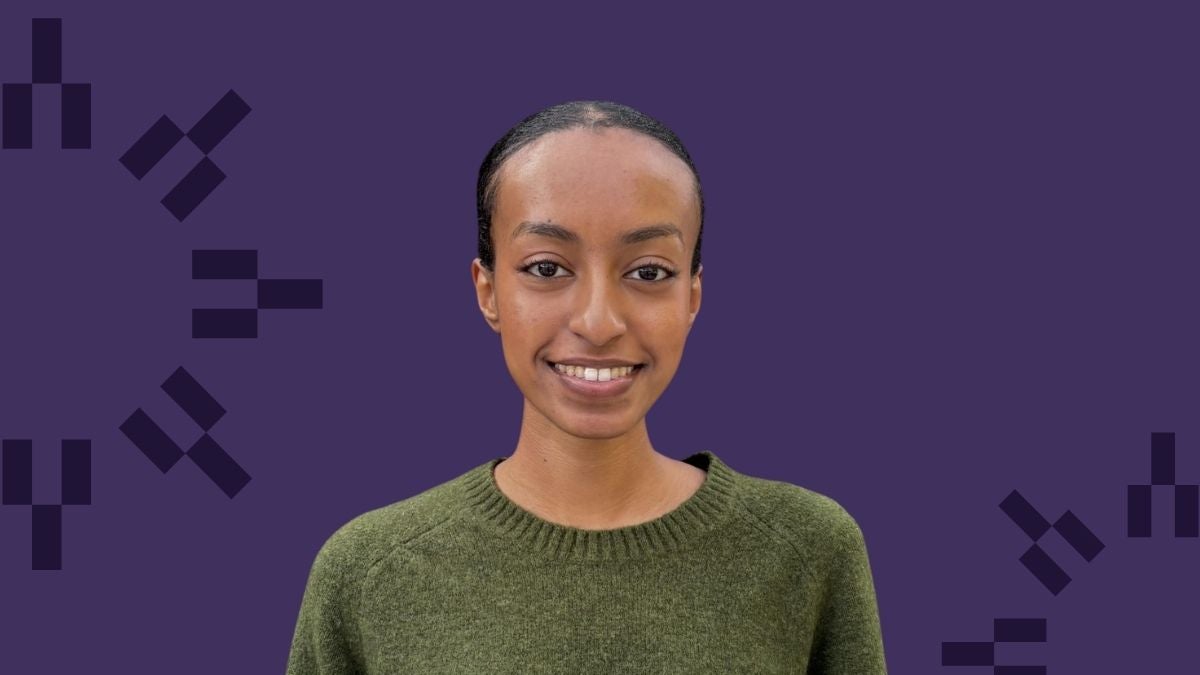
Name: Emnet Sisay
Area of Research: Infectious Disease Epidemiology “ID Epi”
Degree: Masters of Science (SM2)
Year of Gradation: 2024
Current Role: Researcher, Princeton Precision Health
- What did you do before pursuing your graduate degree?
I studied biology and public policy, which gave me the foundation to explore both the biology of disease and the structures around it. I wrote two theses — one on patient-provider communication with young sickle cell patients and another on hospital policies for monitoring racial bias. The summer before senior year, I did the HSPH summer program in epidemiology and worked with James Hay at the Center for Communicable Disease Dynamics (CCDD) on COVID transmission, which made me decide to apply to the Master of Science —Epidemiology. - What attracted you to the program at Harvard?
I was most attracted to the range of research possibilities and wanted to explore both modeling and policy, and HSPH had people doing both. I also wanted somewhere with strong quantitative training and being at the CCDD the summer before introduced me to epidemiological research that was actually shaping disease testing policy in real time, which mattered to me. - What surprised you the most about being a graduate student in your chosen research program?
How immediate everything was. I’d be in a class on neglected and tropical diseases learning about vaccine development, and at the same time there’d be major news about HIV vaccine trials (sometimes involving the same researchers who were teaching us). It made public health feel urgent in a way I hadn’t fully expected and furthered my passion into ID epi. - Why do you think your research area is important to public health?
Infectious disease is everywhere and questions are getting increasingly specific. It’s not just about how diseases spread but also about why the same disease affects people differently. Especially with major developments in precision medicine now you can look at genetics to understand someone’s biological susceptibility alongside socio-environmental factors. ID epi is often where all of this can come together, which I think makes it an exciting area to be in public health. - What suggestions would you have for someone interested in applying for this research area?
I would suggest being curious about the mechanisms behind why things work, not just whether they work. Also, don’t feel like you need a traditional epidemiology background. I came in from bench science and policy and that ended up being incredibly useful. I think that the field benefits from people with diverse perspectives. - How has your time in the program influenced your career path?
I came in thinking at the population level, but through my coursework and thesis I realized I wanted to go deeper to the genetic level. This led me to the precision health research I’m doing now at Princeton. The training in causal inference and coding are tools I use every day. Additionally, the program showed me what it looks like when research actually informs policy. For example, my thesis work utilized HIV intervention strategies from the Ministry of Health, which is the type of work I wanted to keep doing. - Is there anything else that you would like to share about your experience at the Harvard Chan School?
The opportunity to travel definitely shaped my experience. I participated in the Health Reform & Community Medicine in Chile program and received the Rose Traveling Fellowship which funded fieldwork in Malawi for my thesis. Talking to people on the ground there changed how I interpreted the data and thought about my research.