Michaela Greenlee, Master of Science
Michaela Greenlee, Master of Science
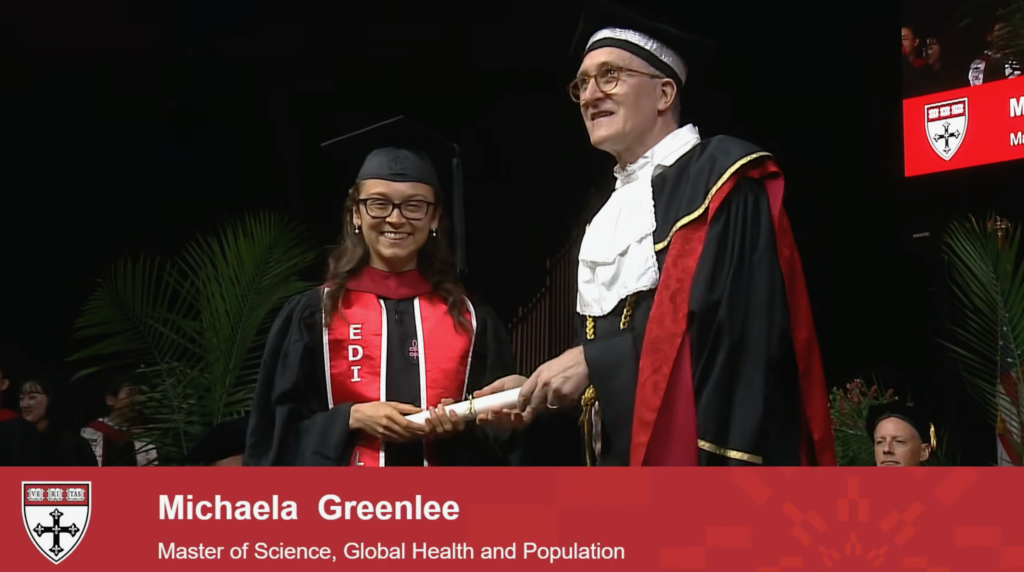
This spring, we celebrated several graduates at the Chan School, including Michaela Greenlee, who received a Master of Science in Global Health and Population. Michaela supported our PRC work with local health agencies, developing resources and evidence of the cost-effectiveness of different strategies to foster healthy eating and active living.
What drew you to participate in the PRC program?
I was drawn to work at the PRC because it offered an opportunity to apply the skills I was developing in my health economics and decision science coursework at the Harvard T.H. Chan School of Public Health to a real-world project focused on preventing non-communicable diseases. During my undergraduate studies, I developed a strong interest in cost-effectiveness analysis and the role it can play in informing public health decision-making. Joining the PRC allowed me to build on that interest through hands-on research experience, while gaining more advanced training and expertise in health economic evaluation methods.
What was your PRC project about?
For the first year working on the CalFresh Healthy Living-CHOICES project, in close collaboration with the California Department of Public Health, I worked on evaluating the cost-effectiveness of an Active Physical Education program for public school K-8 children in San Diego, California. In my second year, I worked on assessing the cost-effectiveness of a Healthy Beverage Initiative to eliminate sales of sugar-sweetened beverages from all state-sponsored beverage procurement outlets in California. In both of these projects, the team and I were interested in examining how cardiometabolic outcomes, such as BMI, are impacted by the implementation of such strategies.
What was your favorite part of participating in PRC?
My favorite part of being a Research Assistant at the PRC was the opportunity to work alongside a multidisciplinary team of dedicated and talented researchers, decision science modelers, health communication specialists, and partners at the California Department of Public Health. It was incredibly rewarding to learn from experts across different disciplines and gain insight into the many components of public health research. I was especially inspired by seeing how a cost-effectiveness analysis evolves from its earliest stages—such as conducting systematic literature reviews and examining key data assumptions—to the final stages of dissemination and communication. Watching research translate into evidence that can inform policy and support healthy eating, physical activity, and health equity initiatives made the work especially meaningful.
What are you up to now? Any plans for the future?
Now that I’ve graduated from HSPH with my MS in Global Health and Population, I’m excited to begin a new role as a Program Evaluation Research Consultant at the National University of Singapore’s Health Intervention Program Evaluation Research (HIPER) Centre. In this position, I will work closely with Singapore’s Ministry of Health to conduct formative and evaluation-focused research that informs health policy and program decision-making. I’m especially looking forward to applying the health economic evaluation skills I developed at the PRC to health services research, while collaborating with policymakers and stakeholders to design, implement, and evaluate initiatives that improve population health outcomes.
What advice would you share to those who might be interested in applying for a future research position working with the PRC?
I would encourage students to be proactive in communicating both the skills they hope to develop and the ways they can contribute to ongoing projects. The CHOICES team is incredibly supportive and provides outstanding mentorship, creating an environment where students can learn health economic evaluation methods step-by-step. Students who are eager to learn, ask questions, and take initiative—whether conducting systematic literature reviews, analyzing data, or contributing to microsimulation modeling—will find many opportunities to grow and make meaningful contributions to the team’s research.