India Health Systems Reform Project
The India Health Systems Reform Project is dedicated to strengthening health systems in India, working collaboratively to enhance the health and well-being of communities across the nation.
665 Huntington Ave
Building 1
12th Floor
Boston MA, 02115
Case Study Writing Seminar
India’s progress towards Universal Health Coverage depends on re-design of health system’s architecture & function based on systems assessment, policy relevant research/evidence synthesis and conducting experiments that focus on health outcomes to re-engineer health interventions.
HSTP’s objectives are:
- Develop and articulate medium & long term health systems strategies for India and states, learning from Indian and global experiences, best practices & innovations
- Nurture talent and enhance capability in India on health systems research, leadership, policy & strategy formulation
- Collaborate with governments, research/ academic institutions, experts and practitioners to create a platform for health systems thinking and attempt to solve health systems challenges
- Foster a safe space for health systems stakeholders for policy dialogue, knowledge sharing & learning.
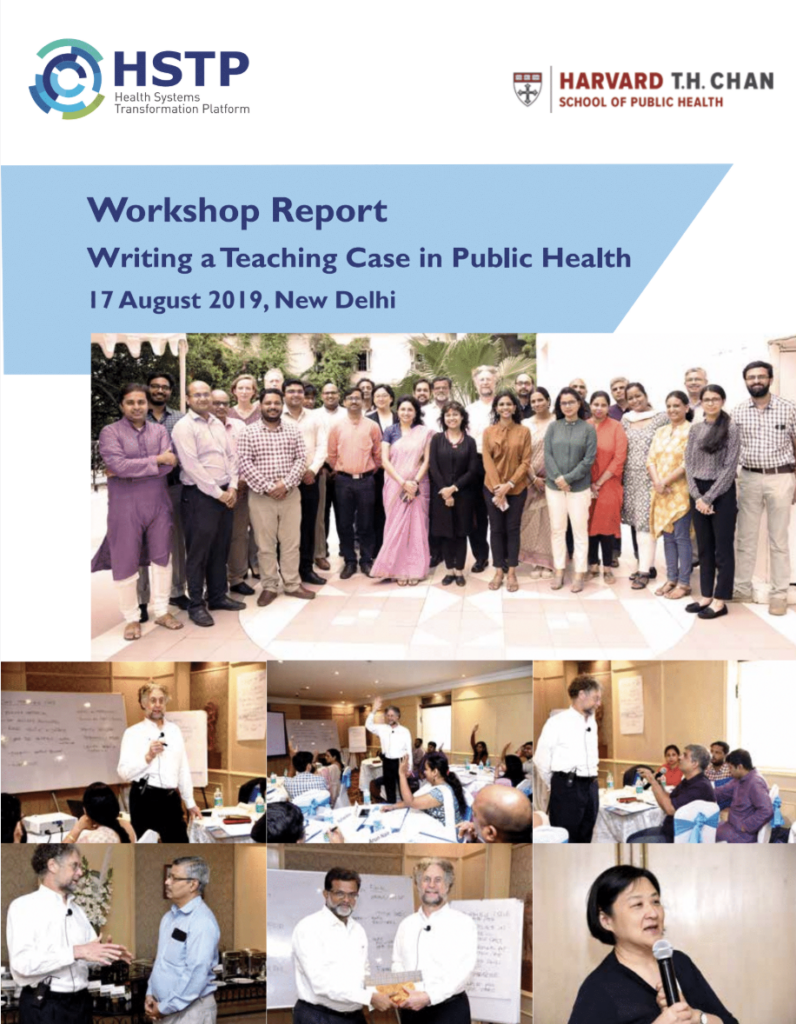
This workshop on Teaching Case Writing in Public Health is part of HSTP’s program for enhancing capacities of Indian researchers and is executed in collaboration with Harvard School of Public Health. The workshop provided a learning opportunity to twenty-two (22) Indian researchers across India working in universities/school of public health/public policy/technical support organizations.The objective of the workshop was to train researchers and academicians involved in teaching or development of case studies in public health on approach to write a teaching case with a focus on public health. It is widely recognized that case studies are effective learning tools. They act as problem based exercises and help simulate public health challenges and functions in practice. To be effective in driving home the message, case studies have to be rooted in local context and culture but should be lucid, engaging and underpin issues that are globally relevant for learning.
The Workshop was developed and taught by Prof. Michael Reich, Taro Takemi Research Professor of International Health in the Department of Global Health and Population at Harvard T.H. Chan School of Public Health and Director of the Takemi Program in International Health. He has a Ph.D. in Political Science, Yale University; M.A. in East Asian Studies(Japan), Yale University; and B.A. in Molecular Biophysics & Biochemistry, Yale University. Dr. Reich’s research program addresses the political dimensions of public health policy. His research interests include health system strengthening and reform, access to medicines and pharmaceutical policy, and the political economy of policy-making processes. He has worked on health systems issues with colleagues at Harvard for over three decades and is faculty director of the WorldBank Flagship Course on Health Sector Reform and Sustainable Financing.We duly acknowledge the guidance and contribution of the HSTP Board, Rajeev Sadanandan CEO-HSTP, Winnie Yip & Anuska Kalita (Harvard), Rahul Reddy, Bhupendra Prabhakar & Peter Parekattil (HSTP)
The material presented below is adapted from Prof. Michael Reich’s presentations and discussions during the session –which were [adapted from materials by Susan L Madden, SM Assoc. Director, Case-Based Teaching and Learning Initiative, Harvard T.H. Chan School of Public Health].
- A teaching case is a vehicle for applying skills with a specific teaching purpose. It is a narrative of something specific and real – a challenge or a decision that needs to be made – something that a public health professional might encounter in his/her career. The situation presented in the case is complex, where different viewpoints/approaches can be applied. This creates an opportunity to apply skills/judgment and analysis, allowing students learn how to approach these kinds of challenges.
- Constructing a good teaching case is an art. The components of a good teaching case are –the opening (set the scene), the narrative (what has happened so far?), the case question (what is the challenge facing the protagonist?) Shorter cases are better if structured well. Exhibits in a case should be limited and focused.
- The opening should introduce the reader to the story, to the issue facing them – so they have an overview and can read the rest of the case critically – looking for information that is relevant to understanding the problem and coming up with ideas for how to approach it, and possibly solve it. It should cover Who is the protagonist, what is his/her role? What is the timing – when is this taking place? What is the situation facing the protagonist, briefly? Why is this important/relevant to public health? What is the controversy that makes a decision or intervention challenging?
- The narrative is where the reader is presented with what has happened so far that has led to this moment. It should cover – Key facts/occurrences that have happened, why is this issue important? What role has the protagonist played? What are the key points in the story that give context to the decision/issue/challenge? What do you leave out in the story?
- The case questionis the ending and often restates what the case’s central question or challenge: What must the protagonist do now? What is the task/decision/issue? What makes it complex/challenging?
- While writing a case – structure the case to tell a good story, avoid jargon and technical terms, if possible, use anexcellent editor to assure writing quality, use the past tense, length? 4 – 6 pages plus a few exhibits, write in a neutralvoice and avoid judgments, use quotes from interviews for judgments or opinions.
- A teaching note is prepared for every case so that other instructors can teach the case. It should provide a case synopsis, clear learning objectives, background readings, assignment questions, road map of class discussion and a board teaching plan.
- For more resources for writing and teaching case studies visit the Harvard T.H. Chan School Case Resources Websitewhich hosts a case library of 81 cases and other materialwww.caseresources.hsph.harvard.edu2
Robust scientific research and evidence synthesis is fundamental to evidence based policy making in India. At the core of this are the Indian researchers. We value their contribution to current understanding of the Indian health systems. To enable transformation and lead the system on the path towards universal health coverage and achieving Sustainable Development Goals India needs enhanced research capacities especially in health systems diagnostics, design, policy, strategy and measuring performance. HSTP’s program on enhancing capacities of Indian researchers is committed to continue conducting activities in this direction.This workshop provided the participants an approach to writing a teaching case in public health.
From the participant feedback received, we envisage to engage with Indian researchers and academicians to curate a one or two-day case writing workshop and develop a continuous mentoring program involving experts from our partner institutions who would guide interested researchers/academicians and explore the possibility of discussing/ initiating writing case studies relevant to Indian health systems and public health issues