Operations Office
Operations works to provide a healthy, safe, and productive work environment by striving to set standards for operational excellence.
Kresge Building, Room LL15
677 Huntington Avenue
Boston, Massachusetts 02115
EcoOpportunity
EcoOpportunity, Harvard Longwood Campus Green Team, is a group dedicated to advancing sustainability on campus.
Join EcoOp and get involved!
Email ecoop@hsph.harvard.edu to learn more about the team and to be added to the mailing list.
Join the EcoOpportunity team for meetings to discuss sustainability project ideas, brainstorm new campaigns, and get to know people from across the Harvard Longwood Campus.
About
Harvard T.H. Chan School of Public Health is at the forefront of research addressing the most pressing global health and environmental issues facing us today. As members of this community, it is important that we recognize the findings of this research and strive toward minimizing our environmental impact through the adoption of sustainable business practices.
A truly sustainable campus requires the cooperation and inclusion of everyone in the community, and in this spirit the community formed The EcoOpportunity Team, Harvard Longwood Campus Green Team. This collaborative forum for knowledge creation and transfer, fosters an environment where sustainable initiatives are developed and executed.
The EcoOpportunity team works hard to brainstorm new ideas or campaigns to educate and inspire individual behavior change among the Harvard Longwood Community.
Our Mission
Our mission is to institutionalize sustainability practices on campus. This group will:
- Serve as the primary point of communication for sustainability efforts on campus.
- Work with the Facilities and Operations Group to establish best practices, policies, and/or standards for sustainable design and operations on campus, where appropriate.
- Identify and prioritize resource conservation opportunities in offices, labs, and residential buildings.
- Inspire the Harvard Longwood Community to reduce environmental and health impacts and become a leader in campus sustainability efforts
Upcoming Meetings and Announcements
Upcoming Events
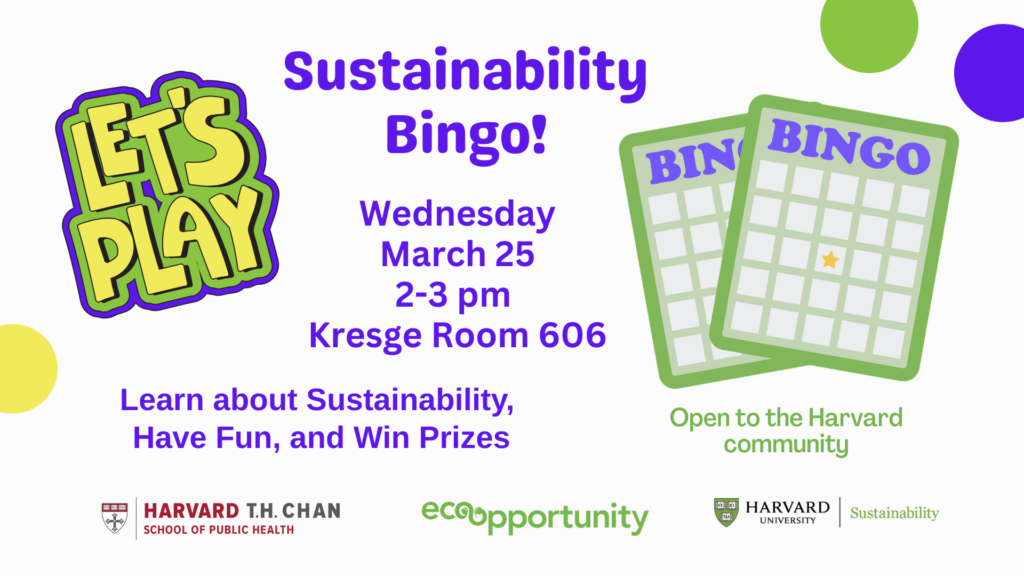
Join us on Wednesday, March 25, 2026 from 2-3 pm for Sustainability Bingo in HSPH Kresge 606. It’s going to be fun!
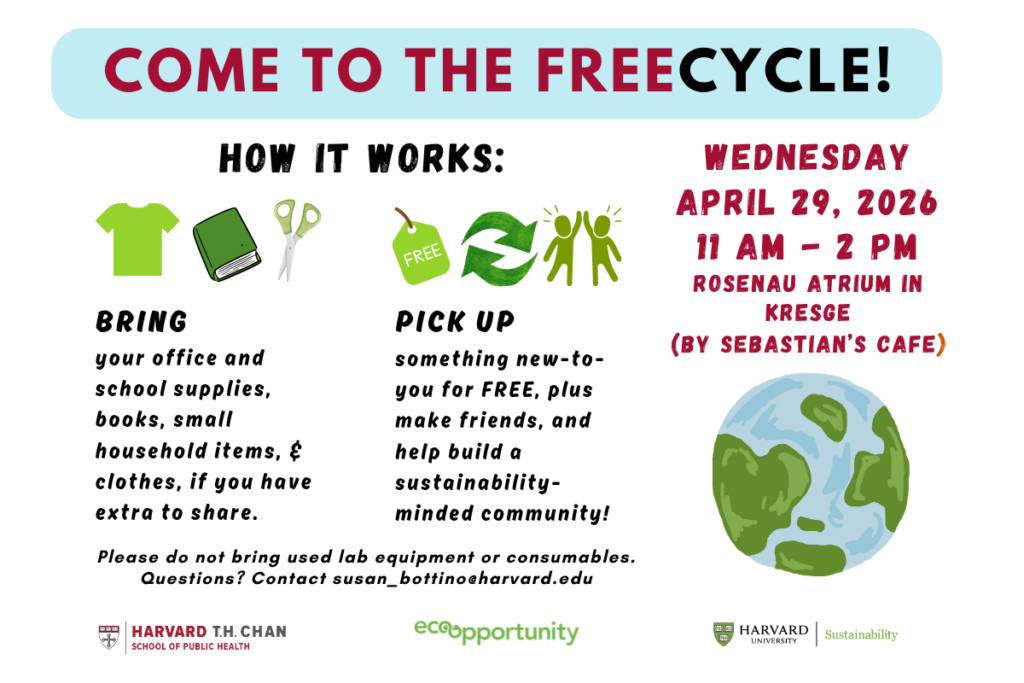
Don’t miss our spring Freecycle! Back by popular demand and in celebration of Earth Month, this event helps build community as well as save items that might otherwise end up in the trash. Last fall, over 300 people attended and swapped hundreds of items including: clothes, socks, shoes, and accessories; books and magazines; notebooks, paper tablets, clipboards, post-its, pens, pencils, and markers; white boards and dry erase supplies; staplers, tape, and clips; labels and envelopes; vases, mugs, dishes, and utensils; monitor stands and computer peripherals; and more! Do some spring cleaning and bring your surplus items to the swap. (Please note, it is not necessary to bring anything to be able to shop!) Harvard i.d. required for building entry.
Reuse Room
The Reuse Room is located at HSPH Building 1 basement, room B-5, and is open on Wednesdays 11:30 am – 1:30 pm, unless otherwise noted below. We are closed during university holidays.
The Reuse Room will be closed on April 29 because we’ll be having the Freecycle next to Sebastian’s Cafe instead!
The Reuse Room accepts small office supplies, home goods, and lab equipment that can be reused by students, faculty, and staff. Inventory changes frequently. Bring your donations (see guidelines below) and pick up items for free. No donation is required to shop.
Current offerings include:
- Office/household supplies: 3-ring binders, hanging file folders, file folders, 3-hole punches, paper and binder clips, magazine holders, paper organizing trays and racks, envelopes in assorted sizes, labels, metal bookends, staplers, staples, staple removers, markers/pens/pencils, tape dispensers, decorative items, mugs, kids’ toys
- Lab items: freezer shelves, glass pipettes, graduated cylinders
- Directions: If you enter the Kresge Building through the revolving door or automatic door near Sebastian’s Café, go past the elevators on your left, which are currently under construction. Looking ahead of you, you will see a hallway that starts with the gender inclusive restrooms. Go down that hallway, away from the cafe, until you reach the stairs at the end. (You are now in Building 1.) You can either take those stairs down to the basement or make a right just before the stairs and go to the double elevators. Take the elevator down to B for basement. At the bottom of the stairs or when you get off the elevator, you will walk down the long hallway toward the loading dock and mail room. But do not take a left to the loading dock and mail room when you see the double glass doors on your left. Instead, continue straight and B-5 will be your first door on the left after that. There are signs to help guide you along the way.
Rules
- Please donate items during opening hours only. Do not leave items outside of door when room is not open.
- No large or heavy items (including furniture) are accepted.
- No broken or soiled items are accepted.
- Do not bring donations in biohazardous waste boxes or bags.
- Lab equipment donations:
- Must be decontaminated and have an EH&S decontamination form attached.
- Glassware must be cleaned and autoclaved before drop-off.
- No chemicals or perishables allowed.
- No needles allowed.
- Prior to donating any expensive equipment or anything with a Capital Equipment Sticker, please contact your department finance director to confirm if the equipment can be donated and next steps.
- Harvard-issued electronics must be returned to IT.
Questions? Email susan_bottino@harvard.edu.
Waste Reduction
The Harvard Chan School is working to accelerate a zero-waste future.
The EcoOpportunity Reuse Room accepts office supplies, small household goods, new lab consumables, and lab equipment that can be reused by students, faculty, and staff. Harvard affiliates can bring donations and pick up items for free. No donation is required to shop. The Reuse Room is a partnership between Harvard Chan Operations Office and the EcoOpportunity team.
In addition, Harvard’s Recycling and Surplus Center, located in Allston, makes furniture, textiles, and a wide variety of items available free to anyone on a first-come, first-served basis.
Recycling
Harvard Chan School employs single stream recycling campus-wide. All recyclable materials can go in the same bin.
Accepted in single stream recycling:
- Cardboard, paper, and magazines
- Clean and emptied glass bottles and jars
- Clean and emptied plastic bottles, jars, jugs, and tubs with lids
- Clean and emptied food and beverage cans
NOT accepted in single stream recycling:
- Plastic bags and other film
- Clothes or linen
- Tanglers – cords, wires, holiday lights
- Batteries
- Scrap metal
The school has also implemented e-waste and other special items recycling programs:
E-waste
Sustainably dispose of e-waste, including chargers and adapters, electrical cords, broken keyboards, mice, and monitors, by dropping them off in the designated large cardboard bin near the HSPH Building 1 loading dock. (Follow signs to the mailroom.)
Please note: for electronics with data (phones, laptops, USB drives), please contact HSPH IT.
Put all types of batteries into the blue battery tubes found across campus. Batteries’ terminals need to be taped/covered to prevent fire. If there is a damaged lithium battery, please contact Environmental Health & Safety.
Spent light bulbs (desk lamps/floor lamps) should be kept in a box to prevent breakage and the box labeled “Universal Waste – spent light bulbs”. The box can be placed by the blue battery tubes. If mercury-containing light bulbs are generated in a lab, they can be tagged as Universal Waste and a hazardous waste pickup request should be placed. Find the pickup request form here.
Pipette Tip Box Recycling
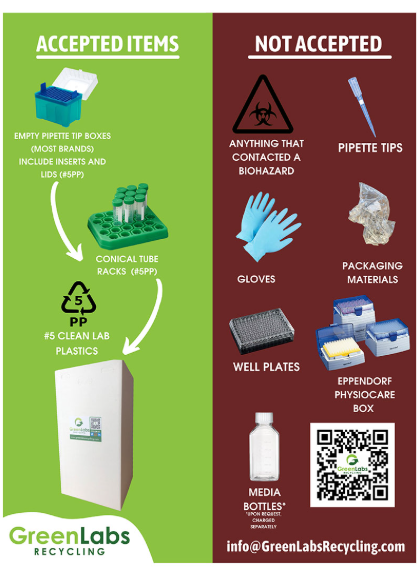
HSPH works with GreenLabs Recycling to have our pipette tip boxes collected and recycled. They can recycle tip boxes from all manufacturers EXCEPT Opentrons brand and Eppendorf’s ‘Physiocare’ box. Do not use biohazardous waste bags for these items. Please see the tip box recycling standards below. Pipette tip boxes can be dropped off in the designated cardboard bins near the HSPH Building 1 loading dock. (Follow signs to the mailroom.)
Shattuck International House residents can drop off clean textiles* in designated collection bins to be reused or recycled (when reuse is not possible), saving valuable resources and preventing unnecessary waste.
*Accepted items: clean clothes, shoes, bedding, towels, curtains, fabric, and similar items.
W.B. Mason can pick up used toner/ink cartridges from any manufacturer. Simply put a note on your next order form that you have spent cartridges for recycling and they will be picked up.
If you prefer to return Ricoh toner cartridges to that company, click here to learn more about their Consumables Take Back Program.
In 2009, Sebastian’s Café at Harvard Chan School introduced a post-consumer composting program. The Café offers compostable plates, cups, cutlery, and to-go containers. All food waste should be put in a compost bin.