Roma conference explores centuries of exclusion, paths to a better future
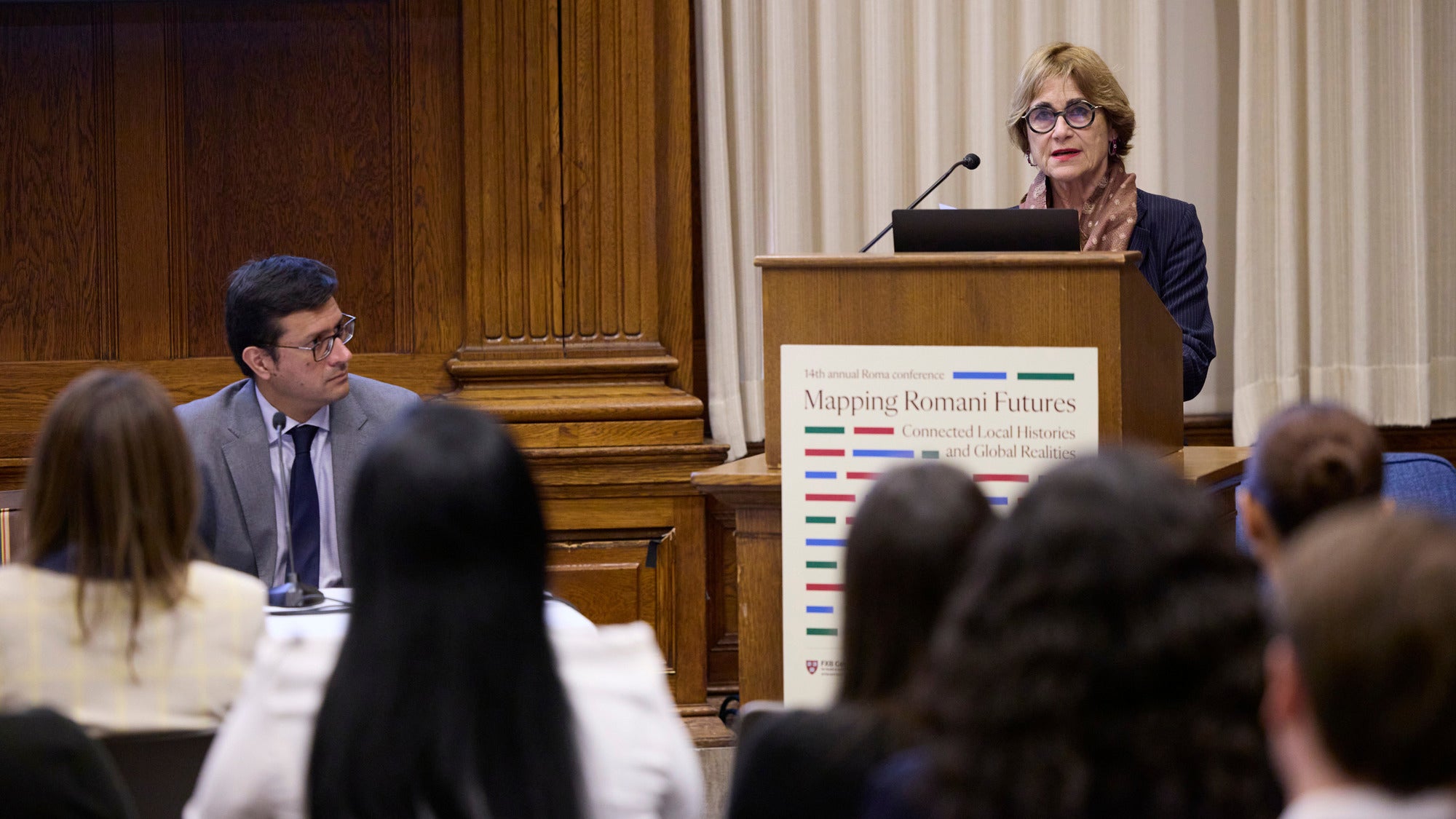
From Medieval persecution to 21st-century education discrimination, speakers at the 14th annual Roma conference dove into lessons from Romani people’s histories and current challenges—and discussed ways to achieve a more just and equitable future.
The event, held at Harvard’s Barker Center on April 10, was organized by the François-Xavier Bagnoud (FXB) Center for Health and Human Rights at Harvard University in partnership with research centers across Harvard and international Romani scholars.
In opening remarks, Jacqueline Bhabha noted that the conference is always scheduled around International Roma Day (April 8), a day when Romani people around the world celebrate their culture and resilience.
Bhabha, professor of the practice of health and human rights at Harvard Chan School and director of research at the FXB Center, also highlighted the Center’s Roma Program. Led by Margareta Matache, lecturer on social and behavioral sciences, the program has become a leading focal point for Roma scholarship in North America and beyond. A core focus of the program is advancing the rights and well-being of Romani children and youth.
Most Romani people live in Europe, and Jorge Chavarro, dean for academic affairs, noted that they face infant mortality rates three to four times higher than the general population, in addition to other significant health disparities. Convenings of experts such as the Roma conference can play an important role in addressing such a complex problem, he said. “By bringing together those who generate knowledge with those who translate it into practice, [events like this] allow us to bridge local and global perspectives and move closer to solutions that are both just and sustainable,” he said.
History of exclusion
In 2007, the European Court of Human Rights ruled in D.H. and Others v. the Czech Republic that placing Romani children in “special schools” for students with mental disabilities based on culturally biased tests constituted indirect racial discrimination. Many hoped the case would be a turning point for Romani rights, but Maleiha Malik, professor of law at King’s College London, noted in her keynote remarks that it did not spur progress.
To understand why, she looked back at how Romani people have been treated over centuries of European history. For example, in 1497, the Holy Roman Emperor undertook mass expulsions of Romani people. Malik said that the bureaucratic methods and legal patterns of exclusion and persecution he used continue to impact Romani people to this day, for example, through vagrancy laws.
Malik also explored how to create a more positive vision of the future for Romani people, both during her remarks and in the discussion that followed with Bhabha and Romani scholars Justyna Matkowska and Nidhi Trehan. Panelists discussed the importance of developing solidarity across communities and working across different areas, including political activism, the arts, and education.

The conference also included a panel focused on Romani children moderated by FXB Executive Director Jehane Sedky, and a discussion that touched on gender inequities in Romani populations. In addition, a book talk covered recently published works of Romani scholarship, and Hungarian violinist Sándor Burka performed traditional Romani music.