Federal health policy changes could upend coverage across U.S., experts warn
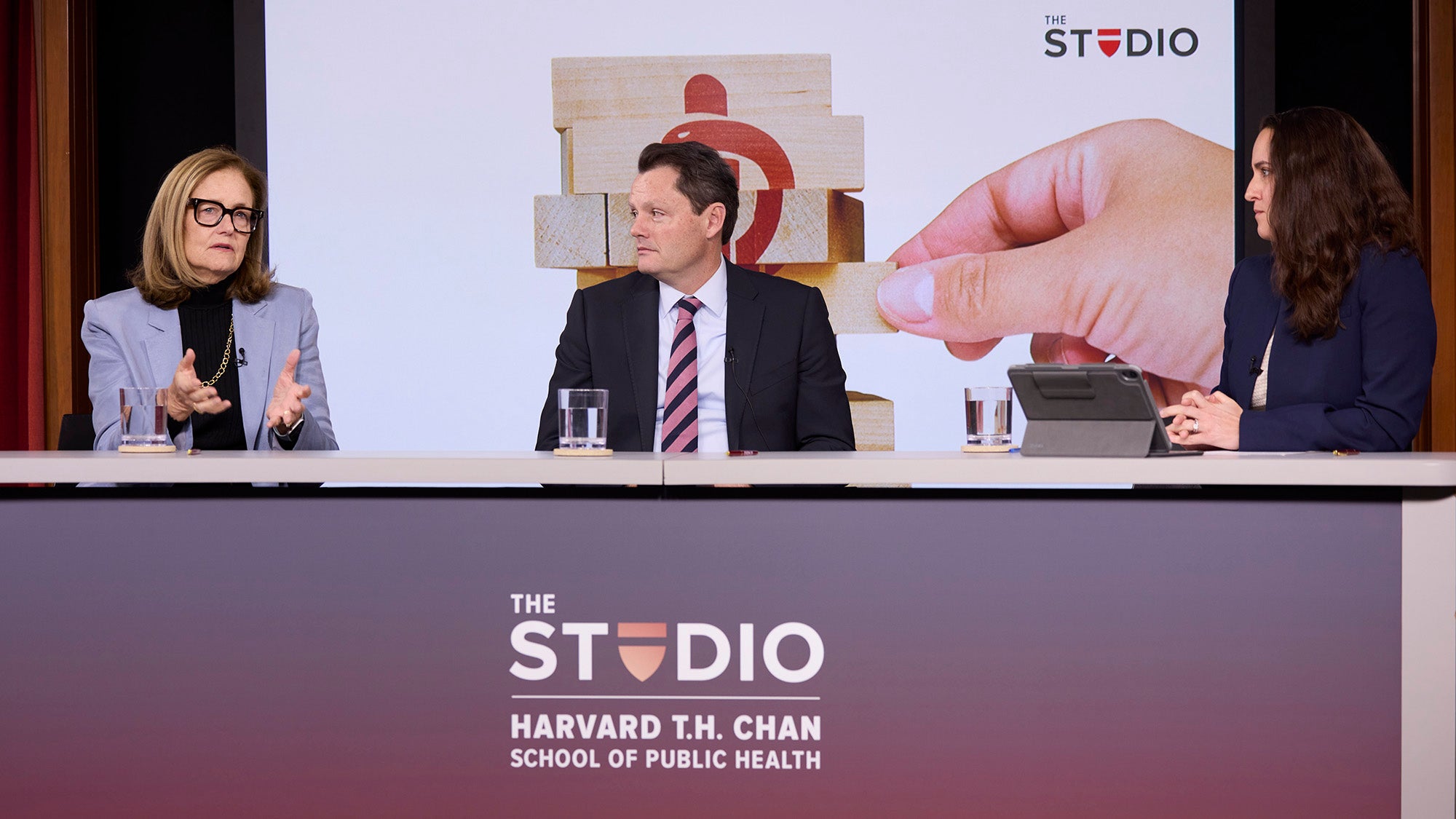
Significant changes in federal policy slated to take effect in the coming months could disrupt health care coverage, costs, and access to care for millions of people, especially lower-income Americans, according to experts who spoke at a Dec. 2 Studio event at Harvard T.H. Chan School of Public Health.
Panelists discussed how the looming expiration of enhanced Affordable Care Act (ACA) subsidies, as well as major changes to Medicaid outlined under last summer’s sweeping H.R. 1 legislation, known as the “One Big Beautiful Bill,” are likely to play out in two states with very different health care landscapes—Florida and Massachusetts.
Speakers at the event included Justin Senior, CEO of the Safety Net Hospital Alliance in Florida, who previously served as secretary of the Florida Agency for Health Care Administration and the state’s Medicaid director; and Kate Walsh, former secretary of health and human services in Massachusetts and currently a Richard L. and Ronay A. Menschel Senior Leadership Fellow at Harvard Chan School. Adrianna McIntyre, assistant professor of health policy and politics, was moderator.
ACA subsidies lapsing
Enhanced ACA marketplace subsidies—originally expanded during the COVID-19 pandemic and later extended by the Biden administration—are scheduled to expire at the end of December. The subsidies have helped millions of Americans get coverage, with marketplace enrollment more than doubling since they were introduced, according to McIntyre. Congress may still decide to extend them but may not do so in time to hold down premiums for January, she said. Enrollees could see a big spike in costs if the subsidies expire.
Losing the subsidies could have a big impact in Florida, which now has more than 4.7 million people enrolled in health coverage through the ACA marketplace—more than any other state in the U.S. Another concern in Florida is the loss of enhanced tax credits for health care, also set to expire at the end of 2025. These changes could lead many residents to drop insurance, and could also affect hospitals, which rely heavily on a stable mix of commercial, Medicare, and Medicaid payers—and as low a percentage of uninsured patients as possible, Senior said.
“A big change to that payer mix … is going to have a major impact on our members’ bottom line,” he said. “They’re all nonprofit. They have tight margins to begin with. So it could really affect the mission. That’s something everybody’s really watching closely.”
Medicaid changes: increased costs, administrative burdens
Under H.R. 1 there will be new Medicaid work requirements, stricter eligibility rules, and more frequent eligibility reviews, as well as limits on states’ use of certain financing mechanisms to boost federal dollars that support the program, according to McIntyre. “This means that states will either need to put up more funding themselves or find ways to reduce spending on Medicaid, including potentially by lowering reimbursements to health care providers,” she said, although she noted that the impacts will vary across states.
Massachusetts, which expanded Medicaid under the ACA, could face severe financial stress due to factors such as administrative burdens regarding Medicaid eligibility and greater strain on the health care system as a whole as more people become uninsured. Walsh noted that verifying compliance with work requirements will be more expensive than providing coverage itself.
“We know … that 60% of the people on Mass Health [the state’s Medicaid program] are working, and that the 40% who aren’t, can’t,” she said. “They’re either taking care of somebody disabled, they’re disabled themselves, or they have young children. The idea that there’s some large swath of people who are … staying out of the workforce because of the Medicaid benefits, I think is just flawed public policy.”
Senior pointed out that, under H.R. 1, states that expanded their Medicaid programs under the ACA will face steeper cuts than those that didn’t expand their programs. However, Florida—one of the 10 remaining non-expansion states—will still be affected. For example, over the next 10-12 years, the state will see limits in financing arrangements that enhance provider reimbursements.
At risk: hospitals, long-term care, caregivers
Walsh noted that Medicaid underpins the nation’s long-term care infrastructure, financing the majority of nursing home beds as well as home-care services. In Massachusetts, H.R. 1 funding restrictions could jeopardize a state program to raise wages and stabilize its long-term care workforce. If that effort falters, the burden of long-term care could increasingly fall on unpaid family caregivers, she said.
Senior expressed concern about the impact of “churn” in health insurance—when people move in and out of being insured due to procedural or administrative issues rather than changes in their eligibility. He noted that more frequent eligibility checks could cause eligible Floridians to lose coverage temporarily and wind up seeking care in emergency rooms. Being uninsured, even temporarily, could mean not having an ongoing relationship with a primary care provider and facing delays in addressing chronic conditions. “Instead it becomes crisis care,” he said.
On the plus side, both speakers cited rural health investments included in H.R. 1 as a promising step.
Cautious optimism
Both Senior and Walsh said they expect challenging budget debates in the future but expressed hope that federal and state leaders can reach compromises on some health-care provisions, given the shared goal of keeping people healthy.
They also urged students—in spite of the rapidly shifting policy environment—not to shy away from careers in health policy.
“You’re entering a great field,” said Senior. “There’s lots of opportunity to really help people and make a difference.” He advised students to stay focused on policies that truly support the health of individuals and families.
Walsh agreed, suggesting that the best path forward is not to bemoan budget constraints but to come up with creative ways to keep people healthy. “The person who says, ‘I have a solution that’s going to bring down your cost’—then I’m listening,” she said.