Analyzing air pollution health, economic risks from AI data centers

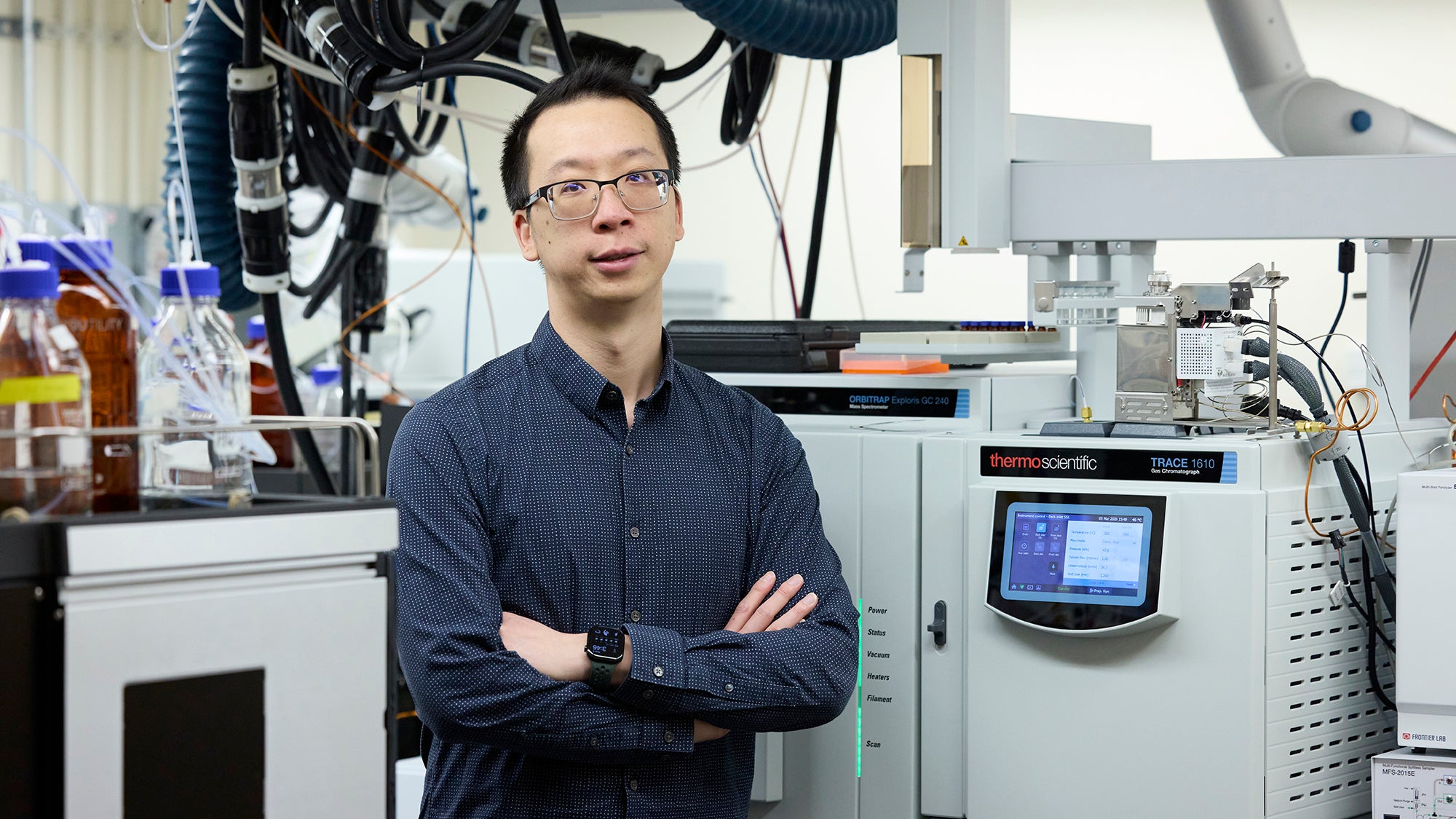
Rapid expansion of the artificial intelligence (AI) technology industry has driven a massive increase in electricity demand to power AI data centers. Many of these centers are building or planning to build on-site fossil fuel-driven power plants to alleviate strain on the local energy grid. Michael Cork—who earned a PhD in biostatistics at Harvard T.H. Chan School of Public Health in December 2025 and is now a postdoctoral researcher—has conducted analyses showing that air pollution from these new power sources could have serious health and economic impacts.
How did you get involved with looking at pollution from AI data centers?
I was doing a PhD in biostatistics under my adviser, Francesca Dominici [Clarence James Gamble Professor of Biostatistics, Population, and Data Science]. In my dissertation work I specialized in tying air pollution to health impacts using modern causal inference frameworks and large datasets such as the Medicare database, including developing new ways to estimate the causal relationship between air pollution and health impacts in the presence of complex confounding.
A couple of years ago, with so much investment happening in AI, I began to focus on how emissions from AI data centers could impact community health, building on related work from our lab. It became increasingly clear to me that powering data centers was going to be a problem—we know we have to reduce emissions to avoid climate catastrophe and protect public health, but these data centers require substantial amounts of energy to run. The two things are at odds. That’s what started me looking into this.
A lot of the conversation on the impacts of AI has centered on energy demand and the country’s grid capacity and the potential impact on electricity prices for communities. That’s certainly a real issue. Some focus has also been on the climate impact of carbon emissions and water consumption—also important issues. What I think is getting less attention right now is that this is not just an energy or climate issue, it’s also a public health issue because of the dangers of fine particulate matter. Fine particulate matter is estimated to drive nearly 90% of the health impacts from air pollution and is often not captured in traditional energy or climate assessments or incorporated into infrastructure planning decisions.
Can you describe your research?
My research focuses on developing methods to understand how air pollution from energy infrastructure, including power plants and AI data centers, impacts population health. Drawing on my PhD work in causal inference, I estimate the real-world health costs of fine particulate matter exposure by quantifying outcomes such as hospital admissions, respiratory illness, and premature mortality.
I’ve also applied my research across multiple real-world cases. I’ve produced analyses on the health and economic costs of half a dozen AI data centers and fossil fuel power plants at the request of several local communities and decision makers. These analyses have informed permitting decisions, supported environmental law organizations, and been covered by national and local media. Together with Dr. Dominici, I co-founded EmPower Analytics Group, a consulting company that provides independent, science-based health and economic analyses of AI infrastructure. These reports enable community members, regulators, and industry players to better understand the health effects of AI data centers.
What’s involved with figuring out the health and economic costs of these fossil fuel-powered data centers?
There are a few challenges. One is to try to understand how much pollution leaves a plant, which can be surprisingly hard, because often we don’t have comprehensive data on how often these plants are running.
The next challenge is understanding where the pollution might travel. Air pollution, as we know, doesn’t respect any borders and it can travel far from its source. So we need to think about the appropriate dispersion model to use to understand where pollution is going to travel to.
Translating an increase in air pollution to an increase in health risks is also challenging. With air pollution, there is continuous exposure—there’s no on-off switch—and pollution levels vary, depending on a variety of factors. We also need to consider high-risk groups, such as children, the elderly, and people with pre-existing conditions. We know that where you live, your underlying health conditions, and broader social determinants of health all shape how vulnerable you are to additional pollution exposure
What are some of the analyses you’ve conducted?
Together with the Piedmont Environmental Council, we completed an analysis of the Vantage Data Center in Loudoun County, Virginia, which uses on-site gas turbines for power in one of the densest data center corridors in the world. We estimated between $53 million and $99 million in annual health damages from associated air pollution—among the largest health-damage estimates produced for a single facility to date. One of the reasons it’s such a staggering number is because it’s built in such a populated area, in northern Virginia near the D.C. metro area. The damages we estimated are driven primarily by an estimated 3.4 to 6.5 additional premature deaths per year across the impacted region, along with increased hospital admissions, asthma-related outcomes, and lost productivity.
In another high-profile case, we looked at the proposed xAI Gas Plant in DeSoto County, Mississippi, near Memphis, which includes 41 gas turbines intended to power xAI’s Colossus 2 data center. We projected an increase in regional air pollution and tens of millions of dollars in estimated annual health damages—in an area that already carries substantial air pollution burden. We estimated that the most impacted people would be those with high social vulnerability, high levels of asthma, and lower median household income. This work led to a community town hall in Memphis hosted by Tennessee State Rep. Justin Pearson. The town hall brought the analysis directly to residents living near the proposed facility—an example of research translating into community engagement at a critical point in the permitting process.
We also analyzed the potential impacts of several other proposed projects tied to the growing energy demands of AI data centers—including a data center in Tucker County, West Virginia, as well as fossil fuel power plant expansions in Fluvanna County, Virginia, and Canadys, South Carolina. In many of these cases, our analyses have become a critical piece of the permitting process. In Fluvanna County, for example, our analysis shaped the public discussion leading up to the Planning Commission’s vote to recommend denial of the gas plant expansion—demonstrating how independent health impact analysis can inform regulatory decisions at a pivotal moment.
Do you see ways to reconcile these AI data centers’ massive need for energy with the health and economic costs you’re finding in your analyses?
The first thing I’d say is that we can’t solve a problem we haven’t measured. Right now, permitting decisions for data centers are being made without any clear accounting of their public health costs—and that gap means health damages are systematically left out of these important decisions. Independent, science-based health impact analysis is part of how we close that gap and bring these costs into decision-making.
On the technical side, there are promising approaches. Some companies are exploring ways to shift computational load across data center networks based on the local energy mix—routing more work to facilities powered by renewables like solar or wind when that capacity is available, rather than relying on on-site fossil fuel generation. That kind of demand-side flexibility could meaningfully reduce emissions without requiring every site to build its own renewable installation and is one example of how smarter system design can reduce health impacts.
None of these solutions are simple—energy reliability is a real constraint, and the scale of AI’s power demand is unlike anything we’ve had to plan for before. But the first step is illuminating these impacts so that health and environmental costs are treated as real costs, not externalities to be ignored. Once those costs are visible, it becomes much easier for policymakers, communities, and developers to align on better solutions. That’s what this work is ultimately about: making sure the full picture is on the table when these decisions are made, so that economic growth can be pursued in ways that also protect community health.