Trends in Volume and Filer Type in No Surprises Act Disputes

Written by Allison Nishi, Joshua Calianos, and Thomas Tsai*
* Faculty at Harvard T.H. Chan School of Public Health; Principal Investigator of the Healthcare Quality and Outcomes Lab
The No Surprises Act (NSA) protects insured patients from surprise medical bills by limiting what out-of-network (OON) providers may bill patients for emergency and select non-emergency services. Under the NSA, a patient’s insurer is responsible for costs beyond in-network rates. When providers and insurers disagree on payment, they can enter the NSA’s Independent Dispute Resolution (IDR) process, in which a third-party arbitrator decides between the provider and payer’s proposed prices.
Early evidence suggests that the NSA has been successful in reducing costs for patients. The arbitration process, however, has resulted in unintended consequences. Between 2022, when the NSA took effect, and 2025, IDR dispute volume has grown far quicker than expected, with providers filing nearly all disputes. The IDR process has resulted in payments well above in-network rates. There is growing concern that private equity (PE) backed physician groups or IDR filing organizations may be exploiting the NSA to extract higher payments from insurers. While this may not immediately affect patient costs, it may ultimately result in higher premiums for patients as insurers attempt to recoup these payments.
Empirical data on the trends in IDR volume, the types of filers in disputes, and the role of PE-backed entities are needed to inform potential reform of the IDR process. We therefore characterized trends in IDR volume and the makeup of IDR parties since passage of the NSA.
Methods
We used the Centers for Medicare and Medicaid Services (CMS) IDR Public Use Files (PUFs) to describe the volume and characteristics of resolved disputes from January 2023 through December 2025. Volume was measured in dispute line items (DLIs), each of which represents a single OON item or service. We identified filers from email domains reported in the PUFs, classifying each domain into one of five filer types: physician groups, intermediaries, hospitals, outpatient emergency services, and other/unknown. We included all payers in other/unknown because payers filed less than 1% of disputes. We classified the 269 most frequent domains, covering approximately 95% of DLIs in each quarter studied; the 2,497 other domains were bucketed as “other/unknown.”
We characterized the PE status as of July 2026 for each filer by referencing Pitchbook, press releases, and PE portfolio websites. Analyses were descriptive; p-values are not reported as the PUF represents the population of IDR disputes. The analysis was deemed exempt from IRB review by the Harvard Chan School of Public Health. All analysis was completed in R 4.5.1.
Results
We analyzed 8,338,286 DLIs resolved between 2023Q1 and 2025Q4. Resolved DLIs filed per quarter increased over 20-fold in that period (Figure 1).
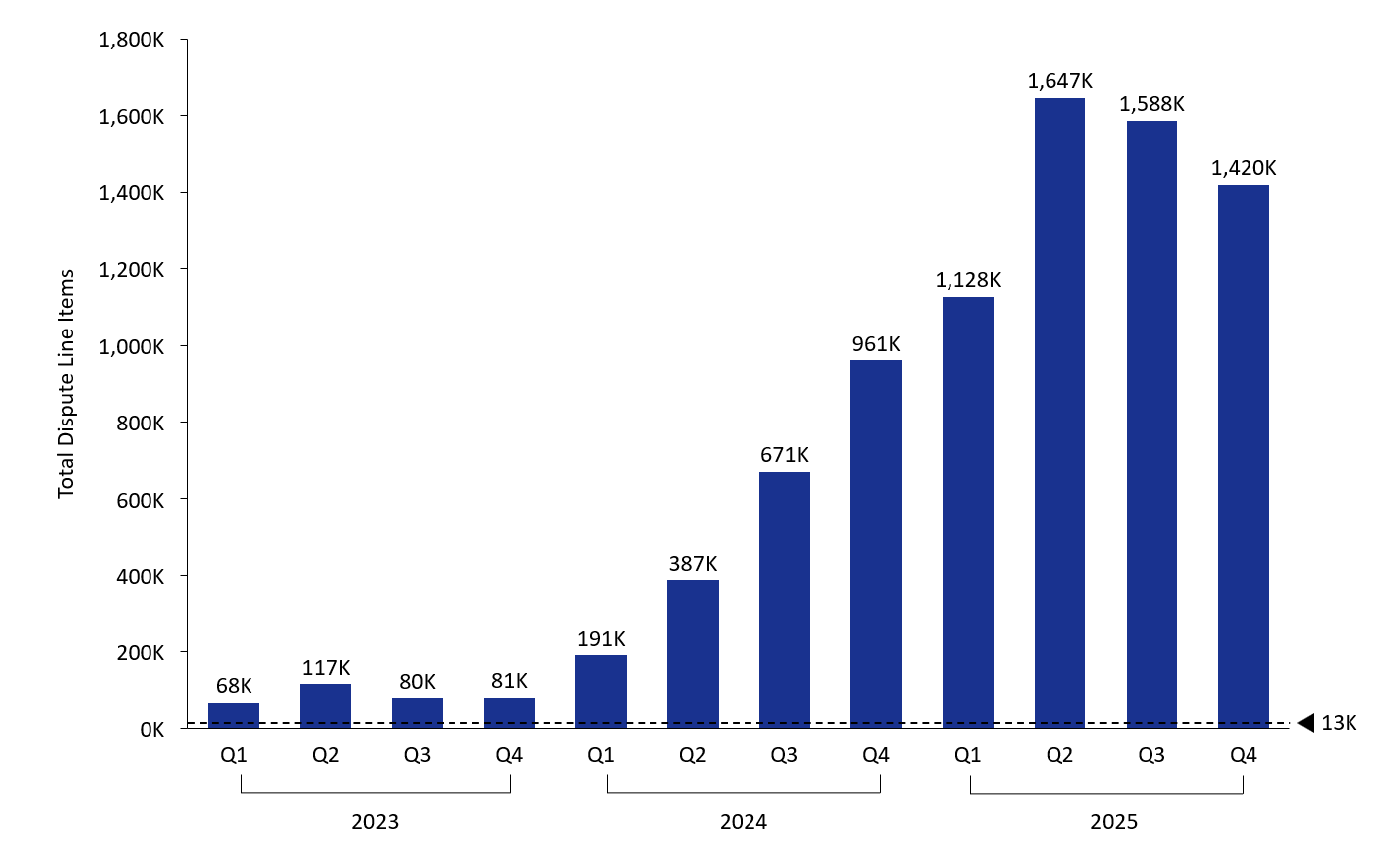
Figure 1: Resolved dispute line items by quarter. Dashed line represents an estimate of federal agencies’ predicted quarterly number of dispute line items.1
The makeup of IDR filers shifted over the same period (Figure 2). The proportion of DLIs filed by physician groups decreased from 61.2% in 2023Q1 to 23.7% in 2025Q4. The proportion filed by hospitals increased from 2.2% to 7.8%, and the proportion filed by outpatient emergency services increased from 3.0% to 6.9%. The proportion from other/unknown parties declined modestly.
The proportion of DLIs from intermediaries, including revenue cycle management, consulting, and law firms, more than doubled, comprising the majority of DLIs in 2025Q3 and 2025Q4. It increased from 22.4% in 2023Q1 to 53.9% in 2025Q4. Although the raw number of DLIs filed by PE-backed filers (across filer types) grew by nearly 10x, the proportion declined from 71.5% in 2023Q1 to 32.3% in 2025Q4.
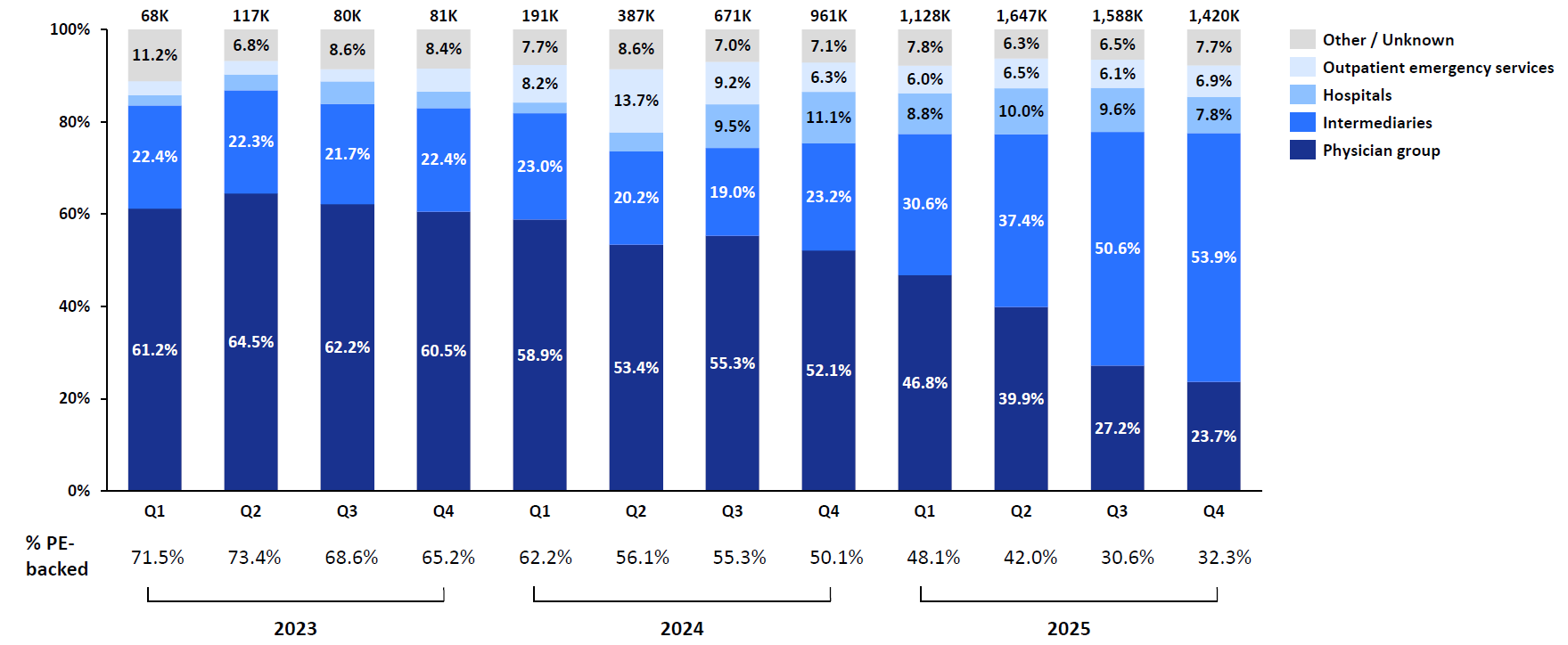
Figure 2: Resolved dispute line items per quarter by filer type and PE status.
Discussion
IDR dispute volume increased 20-fold from 2023Q1 to 2025Q4, far exceeding federal agencies’ projection of approximately 13,000 DLIs per quarter. The composition of filers has also shifted. While PE-backed providers have filed growing numbers of disputes, their share fell to 32.3% by 2025Q4 because non-PE filers grew faster. Notably, we find large growth in filings by intermediaries. Of the 23 intermediaries we classified, 8 have websites indicating exclusive specialization in NSA IDR filings as of July 2026.
IDR arbitration appears to have become a routine reimbursement strategy for a broadening share of OON providers, as opposed to its intended role as an occasional dispute-resolution mechanism, thus facilitating rapid growth in intermediaries that specialize in and profit from IDR disputes. Policymakers should monitor growth in such intermediaries and consider developing guidelines around their role in the arbitration process.
Moreover, the per-party administrative fee for filing an IDR dispute was recently lowered from $115 to $15, which could further accelerate volume growth and deepen the market for intermediaries specializing in NSA arbitration. Thus, trends in IDR dispute volume, as well as the role of intermediaries, PE firms, and various filer types, warrant continued attention as the IDR process evolves.
1 Federal agencies originally predicted 22,232 annual resolved IDR disputes (5,558 disputes per quarter). From 2023 to 2025, there were, on average, 2.4 DLIs per dispute, corresponding with an estimate of 13,339 DLIs per quarter.
For more information, contact Thomas Tsai at ttsai@hsph.harvard.edu
The Healthcare Quality and Outcomes Lab (HQO) is a state-of-the-art health services research group that produces actionable evidence to improve the quality, equity, and resilience of healthcare delivery systems.