Early results from Rural Emergency Hospital program show limited investor involvement
Written by Joshua Calianos, Tarun Ramesh, Jose Figueroa*, David Blumenthal, and Thomas Tsai*.
* Faculty at Harvard T.H. Chan School of Public Health; Principal Investigators of the Healthcare Quality and Outcomes Lab
Congress established the Rural Emergency Hospital (REH) designation to provide financial support for critical outpatient services at financially distressed hospitals, starting in 2023. REHs agree to close their inpatient services but maintain emergency room and observation care. In exchange, CMS pays the REHs 105% of the standard outpatient Medicare fee schedule as well as a direct facility payment (in 2026, roughly $295,000 per month).
This payment structure created concern that REHs could become vehicles for private investment, especially as private equity (PE) investment in emergency services and rural hospitals has grown in recent years. Additionally, acquisitions of hospital property by real estate investment trusts (REITs) have been associated with increased likelihood of hospital closures. However, 3 years into the REH experiment, REH conversion by investor-owned hospital does not appear to be occurring at elevated rates.
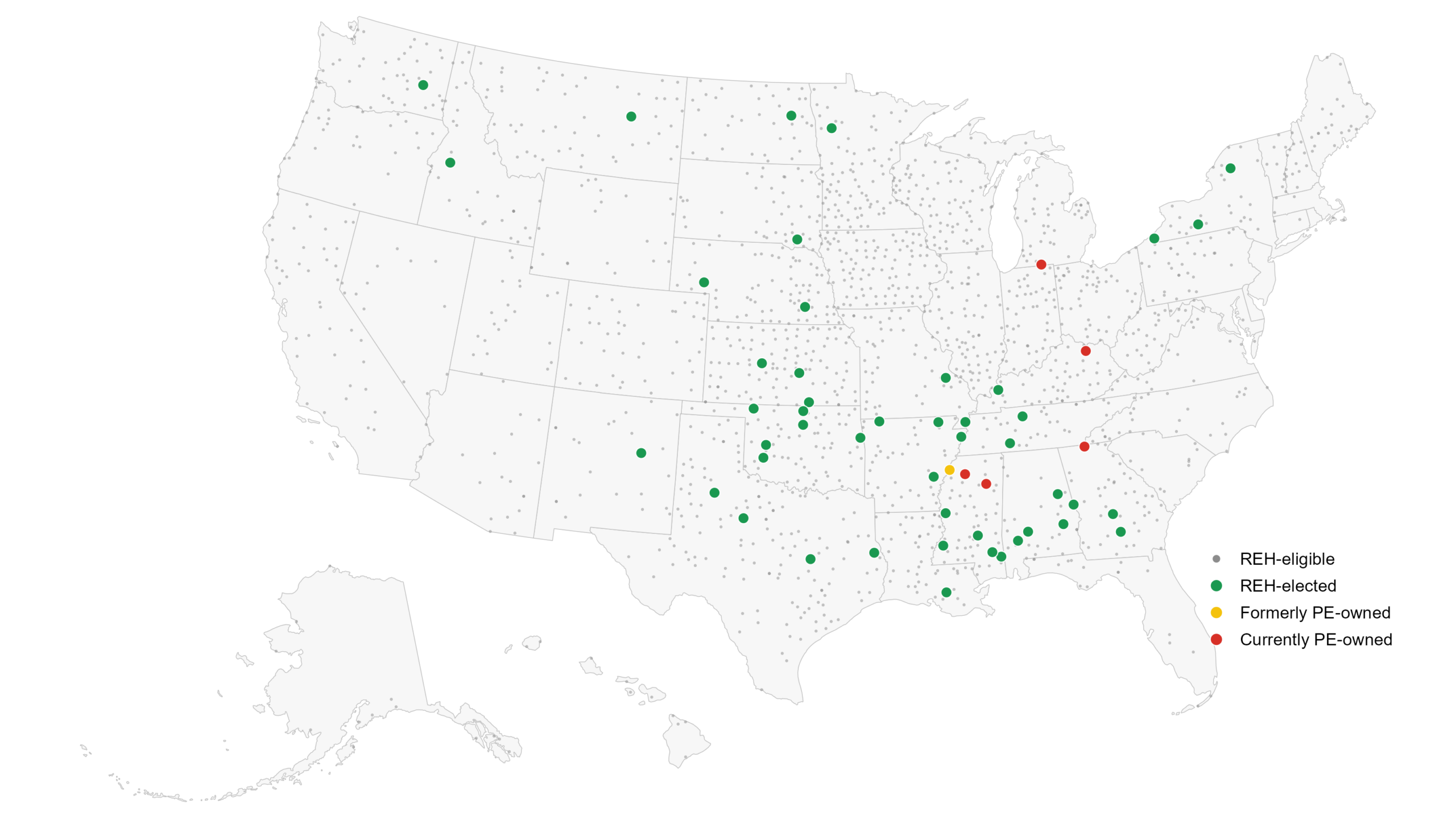
The Healthcare Quality and Outcomes Lab at Harvard’s T.H. Chan School of Public Health assessed the extent of private investment in all 53 operating REHs.1 Our research showed the following key findings, shown in Figure 1 below.
- Only 53 of the potentially eligible 1,500+ hospitals have converted to REH status.
- Of the 53 REHs, private investors held large stakes in only 6. 2 were owned by traditional PE firms before REHs existed. One converted as part of an exit; the other converted without being sold. 1 was converted by a nonprofit owner and afterward sold to a PE buyer. Finally, 3 were bought as distressed assets by Progressive Health Group and then converted.2 Progressive Health Group appears to be the primary active acquirer of rural hospitals with the intent of converting to REH status.
Figure 1: Hospitals Eligible for Rural Emergency Hospital Conversion
1,754 eligible acute care hospitals (either Critical Access Hospitals or rural with <50 beds) appear in the AHA Annual Survey between 2021-2024 and are considered eligible
REH status appears to offer a lifeline to struggling rural hospitals. Few have closed since assuming REH status, indicating that the designation may be serving its intended purpose. In the early experience of the REH program, there are signals of private involvement in REH conversions, but further monitoring and regulatory oversight are needed to assess the consequences of investor ownership for hospitals converting to REH status.
For more information, contact Thomas Tsai at ttsai@hsph.harvard.edu
1 Our work found 2 operating REHs not listed at this source, making 53 compared to the source’s 51.
2 Progressive is a small buyout firm focused on rural hospitals. They have acquired Trace Regional Hospital in Mississippi, Helena Regional Medical Center in Arkansas, and Panola Medical Center in Mississippi (Helena and Panola have since been sold to new owners).
The Healthcare Quality and Outcomes Lab (HQO) is a state-of-the-art health services research group that produces actionable evidence to improve the quality, equity, and resilience of healthcare delivery systems.