Alumni Perspective: Building an AI tool for better at-home care
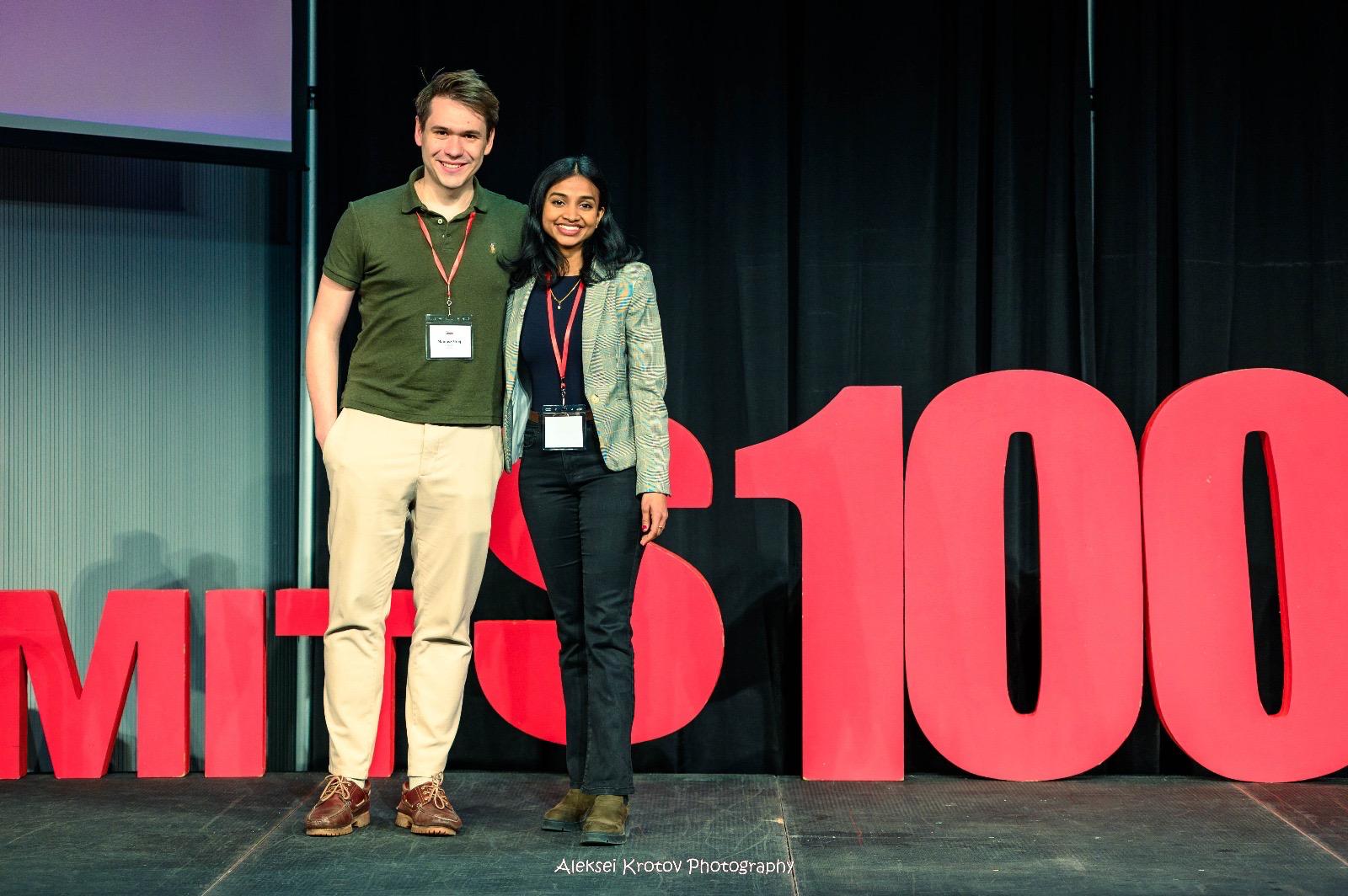
For Mateusz Firlej, MPH ’25, the story began in a small village in Poland, where he helped care for a close family member living with epilepsy. Watching how much responsibility fell on family made him realize how fragile home-based care truly is. “Caregiving isn’t just emotionally demanding, it requires near-constant vigilance, often without the right tools, access to specialists, or understanding of the health patterns,” he said. “I realized very early that reliable, easy-to-use health monitoring felt like a luxury, even though it was the foundation of good care.”
For Annanya Panagala, Ed.M. ’25, the journey started in India, where she and her family cared for her great grandmother who had dementia. Every day brought a series of feelings and emotions—confusion, overwhelm, emotional exhaustion.
Later in life, Panagala found herself in the Himalayas at the Jamyang Foundation, volunteering as a medical social work trainee with young monks and nuns living in areas with limited access to hospitals and clinics. “I noticed how widely smartphones were used, how telehealth could bring doctors to places where roads could not, and realized that the same devices could also become tools for health education and monitoring, empowering people to understand and take charge of their own wellbeing, right from where they were, with tools they already have in their hands.”
These early childhood lessons became the foundation for the duo’s shared pursuit: As telehealth and home care expands access to healthcare, how could they build solutions that make health monitoring and education possible within it.
The journey of building Valley AI as told by Mateusz Firlej, MPH ’25 and Annanya Panagala, Ed.M. ’25
Meeting at Harvard
“We met as Harvard graduate students, both cross-registered for AI Venture Studio, a course focused on teaching systematic methods for identifying high-impact real-world opportunities for AI applications and providing hands-on experience with prototyping and product development, at MIT. With the skills and resources we acquired through this class, we were able to combine our interests in innovation and social impact, as well as our academic tracks in education and public health to pursue something close to our hearts: finding an approach that addressed caregiving not just as a medical challenge, but as a human one.
We spent many hours at Harvard’s Innovation Lab (i-Lab) and MIT Media Lab, combining our expertise in public health, education, and AI to develop what became Wise AI, a camera-based health monitoring platform that later evolved into a solution capable of measuring multiple vital signs through a simple 60-second face scan. The system integrates seamlessly into existing video platforms, with no added hardware, or special training needed to use the solution.
Over the academic year, we raised a pre-seed round from VC funds and angel investors, won MIT AI Venture Demo Day & Honors Fund competition, received recognition as MIT $100K Accelerate, were $200K M2D2 Challenge finalists, and Harvard’s President’s Challenge semi-finalists.
The nature of our collaboration embodies what Harvard is: an interdisciplinary network that works tirelessly to find meaningful solutions to the world’s biggest challenges.
The problem we’re solving
During most in-person medical visits, clinicians begin by measuring basic vital signs like heart rate, blood pressure, oxygen saturation, or respiratory rate. These numbers tell doctors whether a patient is stable, anxious, or in early danger. They guide diagnosis, medication decisions, and patient education. Monitoring abnormal heart rate and breathing rate alone are key early-warning markers used to detect and risk-stratify a wide range of acute and chronic conditions.
In virtual care, this step is missing. Clinicians can talk to their patients but can’t see how their body is functioning in real time. Today, telehealth and home care relies on three unreliable options when it comes to vitals monitoring:
- Shipping monitoring devices (which is expensive and logistically complex),
- Training patients to use hardware (which many forget or misuse), or
- Relying on self-reported data and guesswork.
The Technology Behind Wise AI
Wise AI transforms this experience by turning any camera—on a smartphone, laptop, or tablet—into a contactless health and wellbeing sensor.
The system uses remote photoplethysmography (rPPG), a technique that detects subtle color changes in a person’s face caused by blood flow. Our hybrid deep-tech stack combines physics-based light modeling with AI-driven signal extraction, allowing us to measure and estimate heart rate, breathing rate, blood pressure, hemoglobin, or oxygen saturation.
This hybrid approach is key. Purely AI-based models often fail under motion or lighting changes, while physics-only models can’t generalize across populations or devices. By combining the two, we’re building an algorithm robust enough for real-world virtual care use, across different skin tones, environments, and devices. And unlike wearables or remote patient monitoring kits, Wise AI is entirely hardware-free and operates on-device, ensuring privacy and eliminating cloud dependencies.
The broader impact
At its core, Wise AI is about making health monitoring accessible to anyone with a smartphone anywhere in the world, not just to those who own the latest smartwatches or rings, or can afford personal monitoring devices. By embedding vitals directly into virtual care, the technology helps clinicians regain the missing data, while giving patients, especially in remote or low-resource settings, the power to monitor their own health.
Health education only works when people have access to basic tools that are easy to use. You can’t teach someone how to monitor their health if they don’t even have the means to measure it. Wise AI bridges that gap, making real-time insights integrated into routines and workflows, and possible through technology that billions of people already own.
Today, we’re piloting with telehealth platforms and home-care operators in the U.S., and running parallel pilots in India, adapting their models for different demographics. In early 2026, we will launch larger-scale clinical data collection, working with hospitals to validate their BP and hemoglobin models.”
A Future of Care Without Barriers
In an era where AI often sparks fear about ethics or job loss, Wise AI represents AI for good, technology that extends care rather than replaces it. It envisions a world where every virtual care visit automatically includes a vitals check, similar to an in-person visit, where caregivers have peace of mind, and where every home, whether in Boston or a Himalayan village, has access to the same standard of basic care.
Our goal is simple: to make measuring vitals as easy as turning on your camera, and to make access to essential health monitoring a universal right, not a privilege.