Q&A with Jamie Momoh

Q: Are there any fun facts about the Catteruccia Lab you’re able to share with us?
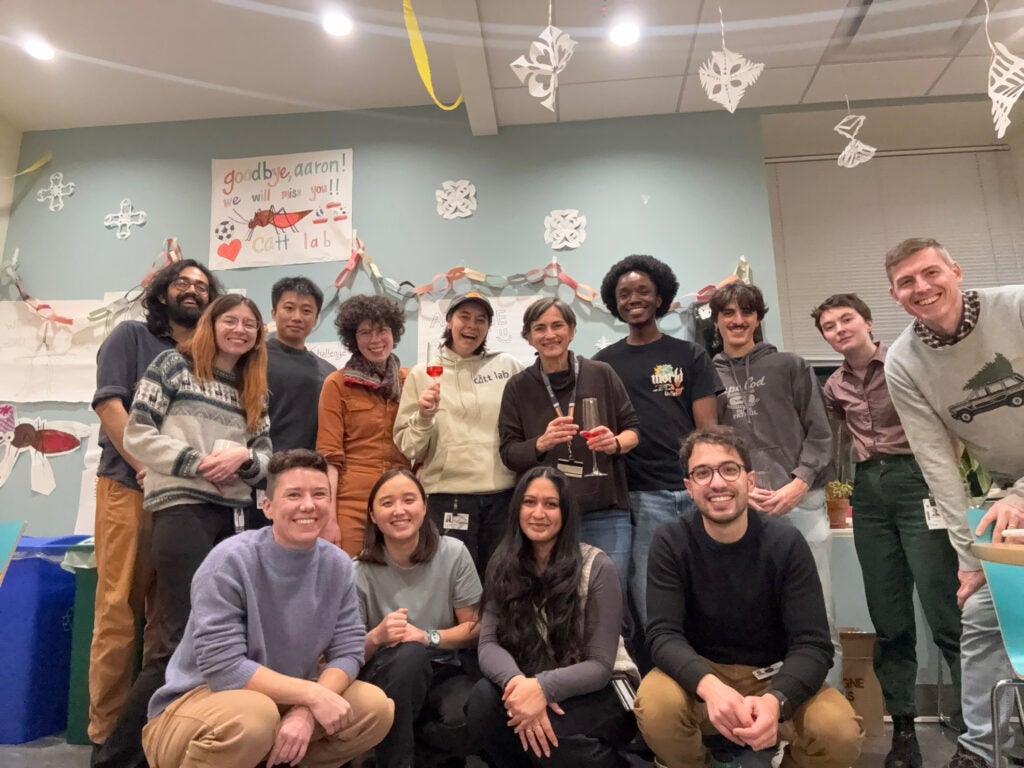
The Catt Lab throws “surprise parties” for members who are moving on from Catteruccia Lab for their career. For the majority of these occasions, a farewell poster is often made by one of our more artistic lab members. Many of these posters are still hanging in our lab, and almost every poster has a beautifully drawn mosquito on it. At these going-away parties, stories are shared, gifts are given, and many laughs are had (as well as tears). Recently a departing member gifted each lab member a beanie decorated with an unofficial “Catt Lab” logo. Moments and gestures like these remind me to be grateful of how caring and thoughtful the community of the Catt Lab is.
Q: What’s something everyone should know about the Catteruccia Lab’s research?
I think everyone should know that the Catteruccia Lab’s research is continuously exploring the outer limits of what is known about mosquito biology and parasitology. Through the collaborative efforts made within and in partnership with the Catt lab, I see our researchers explore and answer questions that they couldn’t answer in isolation. I think the willingness of the Catt Lab to collaborate allows its members to continue being curious, and intentional, about their research efforts.
Q: How does IID’s insectary elevate your research?:
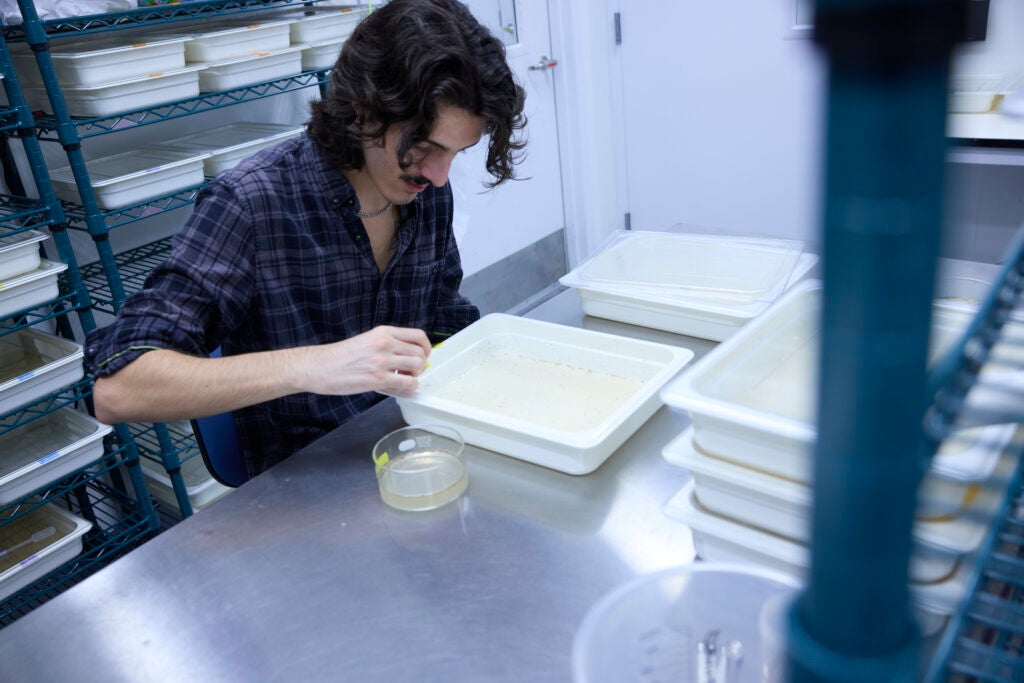
IID’s insectary makes so much of the research published by (or in collaboration with) the Catteruccia Lab possible. With the resource that is the IID’s insectary, the Catteruccia Lab is able to sustain hundreds of thousands of larval and adult stage mosquitoes at once. In turn, this gives our lab the opportunity to supply other labs and researchers with mosquitoes, or answers to mosquito-related questions. And all while this is going on, members of our lab can simultaneously carry out their own large-scale experiments.
Q: What is your favorite part of your research/work?
My favorite part of my experience as a Catteruccia Lab member is that I continuously get to learn. Every member of our lab is willing to speak about or answer the many questions I have on a day-to-day basis. I get to learn, get stumped, learn again, and grow all the time in the Catteruccia Lab. Another part of my experience that I really like is the challenge of recognizing behavioral patterns in larvae and adult mosquitoes. Thanks to my peers, I’ve learned a lot. Learning to recognize patterns and adapt when unforeseen changes occur has been fun and adds an element of “interesting.” I can say the same about trying to influence larval behavior and checking the results of changes made.