For kids facing long hospital stays, a happier ‘reality’
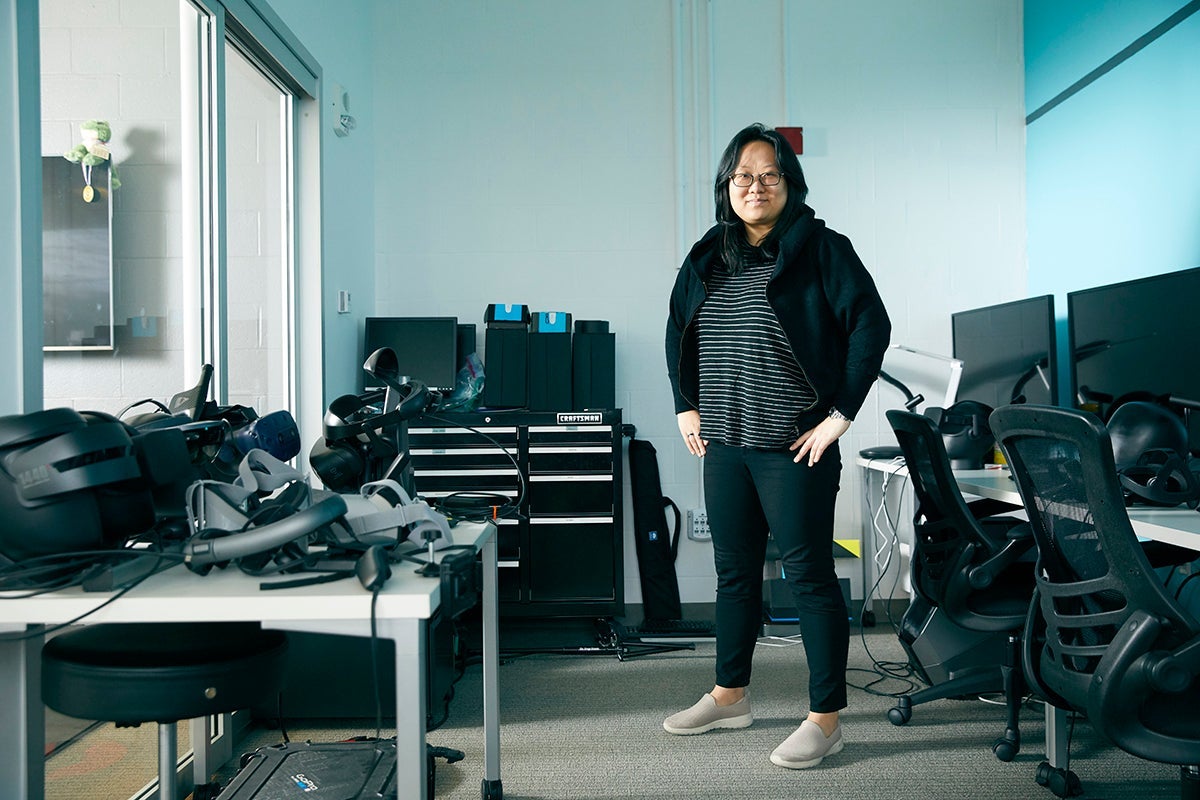
February 10, 2020 – Jean Jung was sick as a kid and spent several years in and out of the hospital. She was often lonely and bored. “The day goes really slowly,” she recalled. “There’s nothing to do.”
Jung wished she could spend time with other kids, but her parents were worried about her getting an infection, so she wasn’t allowed to roam around the pediatric ward and make friends.
Now Jung, who’s slated to earn a master of public health in health care management in May from Harvard T.H. Chan School of Public Health, is working on a project to help other kids facing long hospital stays connect with each other—through virtual reality (VR) technology.
Since January 2019, Jung and a team of three other Harvard graduate students have been laying the groundwork to launch a nonprofit called Dreamworld VR that will enable pediatric patients to virtually visit others like themselves. Children in pediatric wards with chronic diseases such as asthma or diabetes or cancer sometimes have to remain isolated for health reasons; the Dreamworld VR platform would provide a way to get around that problem. Using VR headsets and hand-held controllers, kids would be able to immerse themselves in a colorful, virtual world in which they can design their own “rooms” and “meet” other kids—represented by an avatar like a teddy bear or doll or robot—who are dealing with the same disease.
Studies suggest that loneliness and isolation can hinder a patient’s emotional and social development, which may in turn negatively impact recovery time and mental health. Jung and her teammates hope that Dreamworld VR might be able to not only help stave off children’s loneliness, but also boost their overall health, said Jung.
Trial and error
She got the idea for Dreamworld VR after a two-year stint at Children’s Hospital of Atlanta as a business intelligence financial analyst. On weekends she volunteered in the pediatric ward. She became close with one young girl “who was just stuck there all the time,” Jung recalled. “I felt really bad about how isolated she was.”
Jung, who’d always loved building things, used a kit to create a kid-friendly remote-controlled vehicle equipped with a video camera for her young friend. The vehicle could zip around the pediatric ward and send live video to Jung’s phone. “She had so much fun with it,” Jung said.
But the fun didn’t last long. The hospital banned the device because it violated privacy rules and could have posed an infection risk if it was handled by others. Next Jung brought in a walkie-talkie set so that her friend could chat with other patients, but the hospital soon prohibited that too; the noise bothered people. “But doesn’t that tell you something?” Jung asked. “If the kids want to talk all day, it’s a sign that they really want to connect with each other.”
Jung finally hit on the idea of helping the kids connect through virtual reality. When she told the kids in the pediatric ward about it, they loved the idea. Their enthusiasm helped convince Jung to pursue the idea further. She started looking for graduate programs and chose Harvard Chan School; she figured that earning a public health degree at a school where she could take advantage of other unique opportunities—like the Harvard i-lab—could help bring her virtual reality idea to fruition.
From dream to reality
When Jung described her idea for Dreamworld VR to her academic adviser Richard Siegrist in early 2019, he said he was struck by “how much sense it made in addressing a real issue with children in the hospital—feeling lonely, feeling stressed, feeling ‘why is this happening to me?’”

Siegrist, senior lecturer on health care management, helped Jung connect with colleagues at the i-lab. She was accepted into the Venture Incubation Program and proceeded to assemble a project team of fellow students and a board of advisers, and develop a prototype. Along the way, Dreamworld VR was named a semi-finalist in the MIT 100K competition, received support from the i-lab’s Social Impact Fellowship Fund, and was named a semi-finalist in Harvard’s President’s Innovation Challenge.
Currently, pediatric patients at hospitals around the U.S. are testing the prototype, while Jung explores the possibility of having manufacturers in China create inexpensive, lightweight headsets for kids to use with Dreamworld VR. She and her team hope to launch the nonprofit later this year.
Siegrist said he’s been impressed with Jung’s doggedness in tackling all the steps necessary to create a social venture, including creating the right team, developing a sustainable business model, and making sure her fledgling business adheres to patient privacy rules. “She’s gone through all of those steps in a short period of time with an idea that really has, I think, a lot of potential,” Siegrist said. “She’s a true entrepreneur.”
For her own part, Jung said: “It’s just so lousy to be sick. I’m doing this because I would have wanted something like this when I was a kid.”
photos: Kent Dayton