How to Develop and Test Changes That Improve Health Care

Rashad Massoud’s course shows health care teams how to find stronger change ideas, map them in a driver diagram, and test changes with Plan-Do-Study-Act cycles.
Once a team understands a problem, the next question is what to do about it. Many teams reach for familiar answers: another training session, a new poster, a round of reminders. Those steps feel productive, but they rarely change how care is delivered.
Choosing and testing better changes is the third step in the improvement process taught by Rashad Massoud, program director of Harvard Chan Advanced Learning Academy’s Applied Health Care Quality Improvement Through Simulation. In Rashad’s course, this step means considering changes that may lead to improvement, ranking them by importance and practicality, and testing them, one change at a time where possible.
Where good change ideas come from
Rashad’s course points teams to several sources of ideas: published research, clinical guidelines, official standards, brainstorming within the improvement team, benchmarking against others, and the lessons an organization has already learned.
A promising change often has one or more of these qualities. It is something the team has not tried before. It can start tomorrow. It worked somewhere else. Or it simply feels right to the people who will carry it out.
Changes to avoid
The course is just as clear about what to avoid. The first trap is repeating what has been done before, such as “let’s have a training.” The second is choosing low-impact changes: putting up a poster, holding an education session, or sending reminders. The third is the technical slowdown, such as “we will build a computer program to do this.” Each can absorb time and energy without changing how the work gets done.
Use a driver diagram to map your theory of change
Before testing, a team needs a theory of change: a description of the changes it believes will produce the improvement it wants. Rashad’s course uses a driver diagram to lay that theory out on a single page.
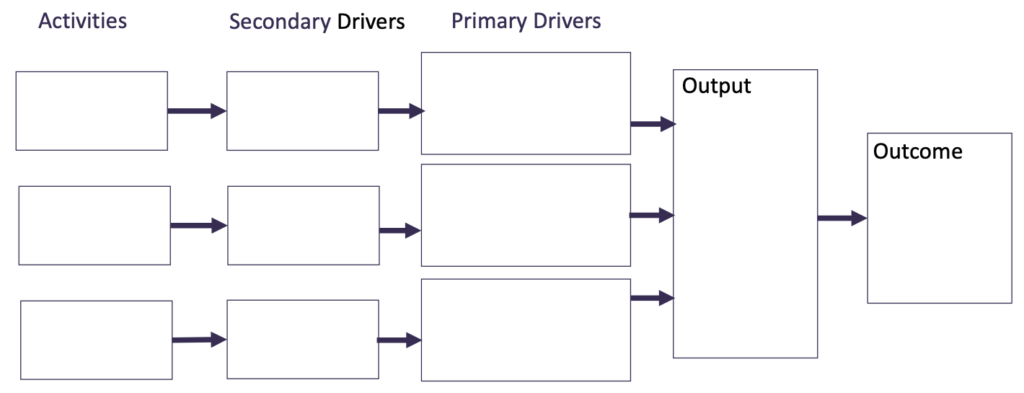
A team usually fills it in from right to left. It starts with the outcome it wants to improve, then asks which primary drivers most affect that outcome, which secondary drivers shape those, and which activities it can actually try. The output sits in between: the short-term result that shows the changes are taking hold. Each arrow is a prediction that one thing leads to the next, and each prediction is something the team can test.
Test changes with Plan-Do-Study-Act cycles
Rashad’s course uses the Plan-Do-Study-Act cycle, drawn from The Improvement Guide by Langley and colleagues, to test each change:
- Plan: state the goal of the test, predict what will happen, and decide who will do what, where, and when.
- Do: carry out the test, note problems and surprises, and begin looking at the data.
- Study: finish the analysis, compare the results with the predictions, and sum up what the team learned.
- Act: decide what changes to make and plan the next cycle.
The course also offers practical guidance. Test big changes on a small scale first, then expand. Test changes one at a time when possible. Treat negative results as a chance to learn. And watch for patterns over time, such as monthly or seasonal shifts, that can affect results. Running tests this way is good project management for health care.
See testing in action
A case study in the course shows how testing works in practice. A team in an intensive care unit is putting in place a bundle of four steps to prevent pneumonia in patients on ventilators. One step, keeping patients sitting up at an angle of 30 to 45 degrees, proves hard to sustain.
The team tests a series of changes. First, it adds a daily goals sheet for each patient. Next, it moves the check on whether patients have slipped down in bed from once a day at the morning round to every eight hours, at each nursing shift change. Finally, it moves the check to every hour, when the respiratory therapist checks the ventilator. Each change is added to the team’s process map, so everyone can see how the work has changed. The case shows how small, focused tests can build toward reliable care, one of several quality improvement tips for health care teams.
Practice testing changes before leading the project
In Rashad’s Applied Health Care Quality Improvement Through Simulation, participants build a theory of change and test changes as part of a live group simulation. Alongside the simulation, they develop a project design for their own setting. That gives participants a chance to try these tools with others before using them in their own work, the kind of practice behind breakthrough results from simulation exercises.
Ready to test changes that make a lasting difference? Explore Applied Health Care Quality Improvement Through Simulation, part of the Leadership in Health Care Certificate of Specialization offered by the Harvard Chan Advanced Learning Academy.