Who Belongs on a Health Care Quality Improvement Team?

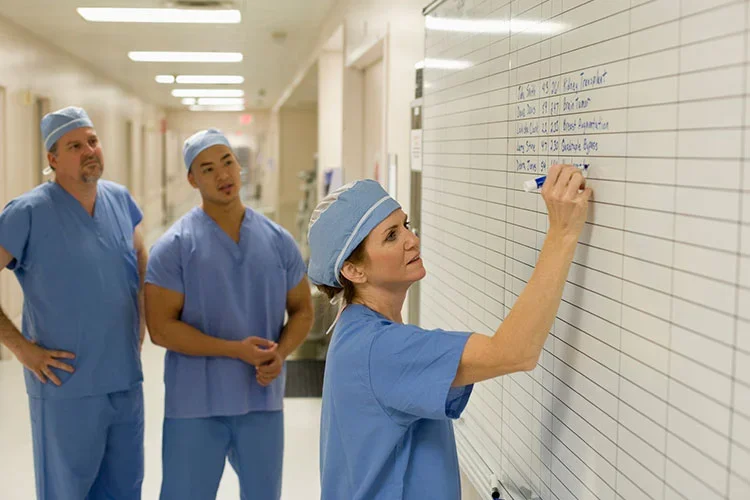
Quality improvement depends on having the right people at the table, and Rashad Massoud’s course shows teams how to build a quality improvement team around every step of the process they want to change.
A ward can have a clear improvement aim and still struggle to reach it. Care rarely depends on one person. A single patient may pass through a clerk, a nurse, a physician, and a lab technician before going home. If the people who carry out those steps are not part of the improvement work, important problems can stay out of sight.
Choosing the right people is part of the first step in the improvement process taught by Rashad Massoud, program director of Harvard Chan Advanced Learning Academy’s Applied Health Care Quality Improvement Through Simulation. In Rashad’s course, identifying the problem means defining the aim, finding the processes that produce the result, deciding who should be on the team, and reaching agreement on the problem.
Why a quality improvement team matters
Health care processes are made up of linked steps. Different people, with different professional roles, carry out each one. Rashad’s teaching points to a common weak spot: quality problems often happen at the hand-over between people working on different steps.
That is one reason teamwork matters so much. Staff who do the work every day can often spot problems and suggest ways to fix them, given the chance. Taking part also improves the ideas a team produces, builds buy-in, and reduces resistance to change. And when people accomplish something together, each member gains confidence, which strengthens the organization as a whole.
Start with the process you want to improve
In the course, building a quality improvement team starts with the aim statement. Participants look at the process behind the aim and ask who is responsible for each step. A representative of each function should have a seat on the team.
A simple clinic visit shows how this works. A patient arrives and checks in at the registration desk, has vital signs taken by a nurse, sees a physician, and may have lab tests before leaving. Each step has a different owner. A team trying to improve that visit would need people who understand each part of it.
Look beyond the people who deliver care
Rashad’s course also asks participants to think wider than the front line. Who else should be involved because the work affects them or depends on them? That can include managers, practitioners, patients or groups that represent patients, and others involved in the system of care.
Some people may not care for patients directly but still shape whether the project succeeds. In the ventilator case, participants consider who should sit on an oversight committee because the team needs their support. Executive sponsors, unit leaders, and the staff who compile patient data are examples of roles that can help a project move forward. That kind of support matters, especially for leaders who want to implement quality improvement efforts across their organizations.
Define roles for members and leaders
A quality improvement team also needs clear roles. In Rashad’s teaching, team members share their knowledge and experience as they work toward the team’s goals. Team leaders take on added responsibilities: they organize the team’s activities, keep its records, and serve as the link between the team and others.
That communication role is important. In the ventilator case, the team meets live to review its progress. Each member is also responsible for reporting back to peers on the project and explaining any changes they need to make. The team becomes a bridge between the improvement work and the people who carry it out every day. Clear roles like these also echo basic project management practices for health care.
Practice building the team before leading the project
In Applied Health Care Quality Improvement Through Simulation, participants form a quality improvement team as part of a live group simulation, then carry that team through the next stages of a project. Alongside the simulation, they apply the same choices to a project design for their own setting. The approach lets participants test their thinking in a realistic setting before they lead improvement work at home.
Ready to build a team that can deliver results? Explore Applied Health Care Quality Improvement Through Simulation, part of the Leadership in Health Care Certificate of Specialization offered by the Harvard Chan Advanced Learning Academy.